Middle East's small to medium enterprises are less connected to the Internet, losing out on the economic benefits of information technology, according to a new report.
In Oman, for example, while about 98% of companies employing 50 people or more were using the Internet, only around 10% of companies with nine employees or less were connected to the web, according to the United Nations Conference on Trade and Development (UNCTAD).
"Because micro, small and medium-sized businesses are significant incubators of innovation, growth and competitiveness, their relative lag in ICT connectivity has important policy implications," said UNCTAD in a new report.
Indeed, regional SMEs have fallen behind their global counterparts who have embraced the Internet and leveraged a strong web presence to reach new markets for their products and services.
SME's reluctance to engage in the Internet is not purely a Middle East phenomenon, though. UNCTAD data shows smaller companies in developed countries are typically more engaged in ICT than developing economies.
"In other countries such as Azerbaijan, Egypt, Kazakhstan and Thailand, the proportion of businesses selling online was as low as below 20%, according to the latest available data, reflecting the potential gains still to be achieved in this area," UNCTAD said.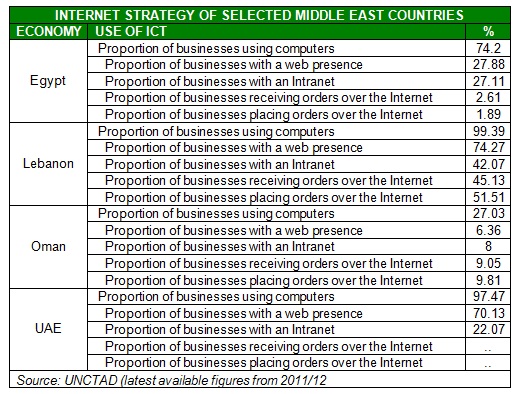
GROWING CONCERN
SMEs can play a crucial role in creating jobs and finding innovative ways to deliver products and services. In China, small businesses create 82% of the jobs and 60% share of GDP. In Mexico, the sector creates 64% of all jobs and 40% of GDP. Even in developed market, SMEs are the backbone of the economy, but many small enterprises in MENA region have seen stunted growth over the years.
The lack of SME uptake of information, communications and technology (ICT) is surprising, given that the region's consumers are avid IT users and have strong presence on the Internet.
Social media usage in Arab world continues to soar, with a 49% increase in usage on Facebook, 54% on Twitter and 79% on LinkedIn in one year alone, according to the Arab Social Media Report.
The UAE has the highest rate among Arab countries in terms of LinkedIn penetration at 22.4%, while Qatar climbed to first place in Facebook penetration with 61% of its population using Facebook, followed closely by the UAE with 58%, the report said.
"On Twitter, Saudi Arabia has 40% of all Arab active users, however, Kuwait enjoys the highest penetration rate with 11.4% of its population active on the microblogging platform."
Small businesses in the region, however, have not stepped up to engage these customers in cyberspace.
A Boston Consulting Group survey of 4,000 SMEs worldwide showed that leaders in technology adoption across all industry sectors, created jobs almost twice as fast as other small businesses.
"Herein lies a big opportunity for both SMEs and policymakers around the world. If more SMEs could achieve the growth rates of technology leaders, we estimate that SME revenue could potentially grow by USD 770 billion in the five countries we surveyed," Boston Group noted. "SMEs in these countries also have the potential to create an additional 6.2 million jobs. Moreover, an increase in technology leaders would help create more vibrant economies because these companies excel at innovation."
IGNORING CYBERSPACE
MENA SMEs have been quite slow to raise their web presence. In Egypt, just over a quarter of small enterprises have a web presence and only 2.6% received business orders with an Internet.
Still, other countries in the region are making inroads. In Lebanon 74% of businesses have a web presence and 51% have taken business orders via the web.
Late last year, a Google survey of 1,500 SMEs in the Middle East noted that 75% of UAE-based small companies had not considered a website for their products and services, with 65% of Saudi companies and 61% of Egyptian companies sharing that view. Most businesses were unsure how the Internet could help their business.
Another survey in Qatar revealed that 55% of SMEs did not have an Internet presence, while 69% did not use social media to advertise. In Saudi Arabia, the region's largest economy, the Internet contributes 2.2% of GDP.
The prize for regional SMEs is huge if only they can move away from a mindset that focuses on physically constrained marketplace that's limited to their borders.
Management consultancy Deloitte predicts that in 2014, Middle East SMEs will increase their expenditure on ICT services by over USD 2 billion to USD 22 billion, 10% over 2013. In 2014, the SME share of ICT spending in the region will be just over 23%, driven by ongoing expansion in the number of SMEs and their needs for key ICT services, such as web-presence, e-commerce and cloud computing, the management consultancy noted.
"For SMEs in the region to develop and grow, it is imperative for them to establish a web presence if they are to develop, grow and benefit from more advanced ICT services," Deloitte said. "With the large penetration gap that prevails, we would expect faster growth in SME ICT spend to start here."
The feature was produced by alifarabia.com exclusively for zawya.com.
© Zawya 2014




















