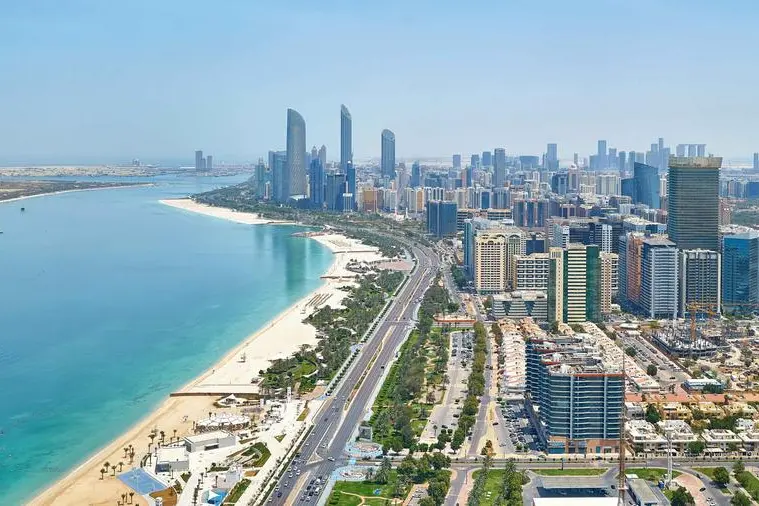
Doha, Cairo and Al Ain - yes, Al Ain - are among McKinsey's picks of the world's top city spots by 2025 by various measures.
Reading McKinsey's Urban World: Mapping The Power Of Cities convinces us that the world will belong to China by 2025 - we will just be living in it. Forget the Middle East and its oil wealth, or Latin America with its flair, charm and commodity-fuelled brilliance, or even India with its bursting economic ingenuity and labour power - China will dominate the proceedings.
McKinsey believes that currently 600 cities in the world house around a combined 1.5 billion people (or 22% of the global population), but contributes $30-trillion to world GDP, or more than half of the total. Currently these cities have 485 million households with an average per capita GDP of $20,000. Of these, the top 100 cities generated 38% of global GDP, which shows a staggering concentration of wealth, productivity and prosperity.
By 2025, the 600 major cities will be home to two billion, or 25% of the population, generating $64 trillion, or 60% of global GDP and 735 million households will have average per capital GDP of $32,000.
And the 600 cities of 2025 will be very different from the 600 cities of today.
"Over the next 15 years, the makeup of the group of top 600 cities will change as the center of gravity of the urban world moves south and, even more decisively, east," notes McKinsey in the report.
"One of every three developed market cities will no longer make the top 600, and one out of every 20 cities in emerging markets is likely to see its rank drop out of the top 600. By 2025, we expect 136 new cities to enter the top 600, all of them from the developing world and overwhelmingly (100 new cities) from China."
This is crucially important for planners and researchers so as not to be wrong footed by the sweeping economic changes. For example, more countries have diplomats and business support services in Auckland than Wuhan in China, even though it will generate ten times the GDP of the New Zealand city within the next fifteen years.
McKinsey Global Institute's Cityscope database crunched numbers from 2,000 metropolitan areas to distil a list of 25 top hot spots on key measures: 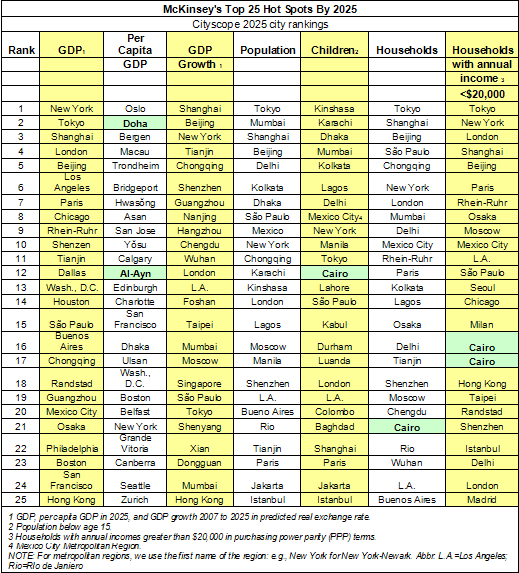
MIDDLE EAST CITIES
So where is the Middle East in all these urban developments? Well, Middle Eastern cities can't possibly compete with the sheer population growth of China and India, but Cairo is expected to have 2.2 million households with annual income of $20,000, the seventh largest in the world, by 2025.
Thirty Middle East cities make it into the top 600 McKinsey cities, but the report does not offer a list of all the cities. But some of the demographics outlined in Saudi Population (http://www.zawya.com/story.cfm/sidZAWYA20110405115450/Saudi_Population), correspond to the rising population numbers and the move to urban centres from rural areas.
"Africa and the Middle East together may have eight million more children in urban centers by 2025," notes McKinsey, adding the bulk of the population in the Middle East will be in the 15-64, which would mean great stress on education and job creation in the Middle East.
Overall, McKinsey expects a staggering 10 million households in the Middle East with annual incomes of $20,000 per capita by 2025, making it a veritable cluster of growth and economic opportunities.
While McKinsey does not go into too much detail on Middle Eastern cities, a2008 PricewaterhouseCoopers (PwC) report estimated that Cairo was the wealthiest city in the Middle East ‑ and 42nd in the world ‑ generating $145-billion (at PPPs).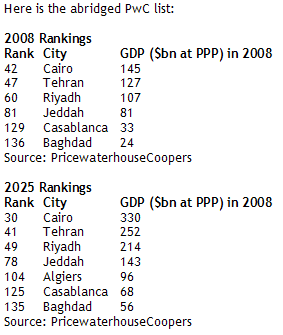
Interestingly, Abu Dhabi, Dubai and Doha don't feature in the PwC survey.
140 MidEast Cities
The Middle East and North Africa region has 140 cities in its giant database of McKinsey Global Institute's Cityscope database, which crunches numbers from 2,000 global cities. "North Africa's cities are all coastal urban centers, while cities are spread more broadly across the Middle East," notes McKinsey.
"Today, these 140 cities generate nearly two-thirds of the region's GDP, and, with the region expected to more than double its GDP to 2025, the urban share is likely to remain roughly the same. We see middleweights contributing virtually all of this growth. We anticipate that the cities of Middle East and North Africa will slightly increase their share in the world economy, from generating two percent of global GDP today to three per cent by 2025."
Other key findings in the McKinsey report:
* McKinsey estimates that today's 23 megacities will contribute just over 10 per cent of global growth to 2025, below their 14 per cent share of global GDP today.
* 13 middleweight cities become megacities by 2025, 12 of which are in emerging markets (the exception is Chicago) and seven in China alone.
* Emerging market mega- and middleweight cities together--423 of them are included in the City 600--are expected to contribute more than 45 per cent of global growth from 2007 to 2025. Across the world, we see 407 emerging market middleweights contributing nearly 40 percent of global growth, more than the developed world and developing region megacities put together.
* Population in the City 600 will grow an estimated 1.6 times as fast as the population of the world as a whole. "By 2025, we estimate that the 600 will be home to more than 25 percent of the world's working-age population, 15 percent of its children (aged below 15), and 35 percent of its older population (aged 65 and above)," writes McKinsey.
* The City 600 will be home to an estimated 310 million more people in the working age population by 2025 -- accounting for almost 35 per cent of the expansion of the potential global workforce. Almost all of this increase is likely to be in emerging market cities and two-thirds in the leading cities of the China region and South Asia.
* Aging cities are not just a developed country phenomenon. We project that the 423 cities from developing regions will contribute almost 80 percent of growth in the 65-plus age group in the City 600 over the next 15 years. The top 216 cities in China will have 80 million new older citizens. Shanghai is expected to be home to twice as many older people as New York.
© alifarabia.com 2011