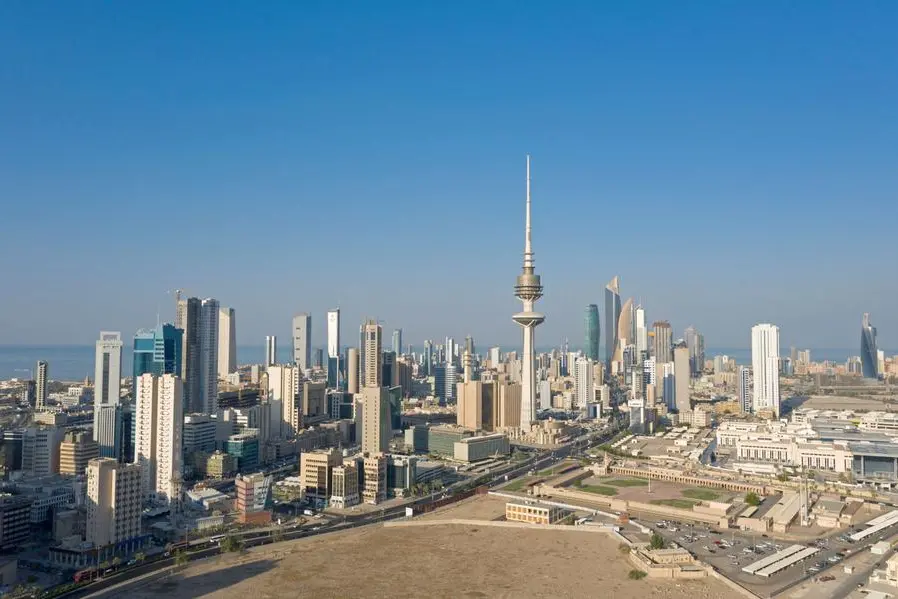
Kuwait's oil-dependent economy needs the USD104 billion Kuwait Development Plan to shake off its lethargy, but the plan may become another victim of the country's political stalemate.
April 26, 2011
26 April 2011
Kuwait's oil-dependent economy needs the $104-bn Kuwait Development Plan to shake off its lethargy. But the plan may become another victim of the country's political stalemate. Executive Summary
Hopes of a Kuwaiti economic renaissance rose after the launch of an ambitious $104-billion Kuwait Development Plan (KDP) in February 2010, a comprehensive policy which aimed at turning Kuwaiti into a dynamic trading and financial hub in the region.
While the government made some quick moves and implemented a few of the much-needed policies, continued political drama has meant that the Kuwait government, led by Prime Minister Sheikh Nasser al-Mohammed al-Sabah, resigned for the sixth time since 2006.
Even before the latest political episode, local and international analysts cast doubts over many of the projects in the KDP. Funding for some of the projects remains an issue and few analysts expects major decisions will be taken as a new government is formed just ahead of a long summer break.
While the Kuwait authorities are fortunate that they do not face a crisis such as that seen in fellow Gulf states of Bahrain, Oman, Kuwaiti citizens remain frustrated over the pace of reforms and the lack of opportunities for the private sector. In that respect, KDP is crucial for the development of Kuwait.
Time To Accelerate KDP
By rights, Kuwait should be one of the best performing economies in the region. Robust political participation - what should have been the envy of other countries in the region - the fifth largest oil reserves in the world, a strong entrepreneurial streak and a young, educated population.
Instead, one probed about the lack of their political freedoms, other Gulf states argue that Kuwait's political participation has done little to improve the country's economic fortunes. On March 31, Kuwait saw its seventh government resign in five years, suggesting that democracy is no panacea for economic ills for the Arab World.
The country remains heavily dependent on its oil revenues, has failed to diversify in a meaningful way and has a bloated private sector.
Some of the key issue facing the economy are:
* Lack of economic diversity. Oil accounts for nearly 50% of the GDP and 76% of exports in 2009.
* 80% of the Kuwaiti working population is employed by the public sector, many with 'jobs for life'.
* Limited avenues for foreigners to participate in the economy and even international institutions - unlike other Gulf states - have limited participation in the economy.
* Political infighting has delayed reforms, slowed down strategic investments and developments that would add new revenue streams to Kuwait's economy.
It is the last point that has really held back the country. In a bid to break out from its lethargy and political deadlock, the government had launched a Kuwait Development Plan in February 2010, which focused on:
"The transformation of Kuwait into a financial and trade hub for investment, in which the private sector leads economic activity, fuelled by the spirit of competition, and raising the efficiency of production under a supporting institutional state agency, establishes values, preserves the social identity, achieves balanced human development and provides appropriate infrastructure, improved legislation and encouraging business environment."
Admirable words, but continued political issues are endangering this mission.
The 2010-14 development plan has a $104-billion tag and is looking to increase the role of the private sector in the economy. But even before the latest political drama, Citibank noted that the ever-present threat of political tensions re-emerging represents a significant challenge to the government's ability to implement its ambitious investment plan.
"It is unlikely, in our view, that full execution of the plan will occur, with a more realistic scenario of around US$70bn of the projects actually being implemented, at best," noted Citibank in a recent report.
After a promising start in 2010, including the passage of the much-delayed privatisation law, progress appeared to stall in the second half of the year, with fiscal data suggesting very little in the way of capital expenditure, says the EIU.
"The country's first independent water and power project is progressing, but the government has recently announced a delay in the privatisation of Kuwait Airways Corporation. Structural economic reform, particularly liberalisation, is still expected to proceed only gradually as political bickering and the unwieldy bureaucracy lead to delays with projects," the EIU notes. (See EIU's Kuwait Country Report:).
Key Projects
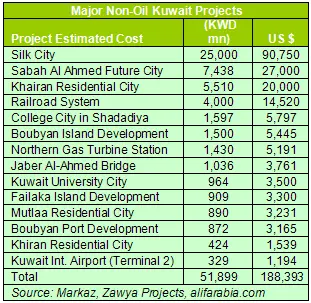
Some key non-oil projects in various stages of planning and execution: