Textile Subsidization and Vision Identification Contribute to the Advancement of the Industry
The future of the Egyptian textile industry is in jeopardy. After the Egyptian revolution, there is loose security and volatility in its ports, and factories in both the public and private sectors are deteriorating and facing numerous difficulties. What are the outstanding problems and challenges confronting the Egyptian textile industry? What are the businessmen's demands to increase exports? What is this sector's significance to the Egyptian economy?
Mr. Khaled Abou El-Makarem, chairman of Fiber Tex Company, believes that the main problem facing the future of textiles and ready-made clothes in Egypt is uncertainty over the subsidization of exports, namely textiles. This state of affairs is due mainly to the instability of employment, the inadequate supply of raw materials and the irregularity of the ports. The latter has serious negative effects: the exporter is late in delivering the cargo, which jeopardizes his credibility with the importer and may lead to losing future business. .
Export Fluctuation
The previous phase was characterized by a fluctuation of exports to the outside world at the ports of Sharq El Tarifaa, Port Said and Dumiyat because of an unstable security situation and drivers' unwillingness to transport goods to these ports, which naturally damaged Egyptian exports during that period. In addition, the curfew had a dire impact on Egyptian ports and damaged their reputation for efficiency.
According to Mr. Abou El-Makarem, it is still unclear whether or not subsidization will continue, especially since factories tend to export their goods at cost for the sake of competitiveness - their sole profit is obtained from export subsidies. Thus one way to raise the competitiveness of Egyptian products is by continuing textile subsidization. Mr. Abu Al-Makarim concluded by saying that it is imperative for the government to commit to paying subsides to the exporters, in order to preserve this industry in Egypt. Export subsidies fell last year by 25% (i.e., from 4 to 3 billion Egyptian pounds (EGP)); in these circumstances we are not calling for increases in export subsidies, but merely payment of these subsidies on time, so that exports will not be affected in the future.
Oldest Industries
A study entitled "The Future of Egypt's Textiles and Clothing Exports in light of New International Trading Rules," prepared by academic researchers Samiha Fawzy and Nada Massoud, emphasized that these industries are among the oldest in Egypt, and that they gave their employees - whether they are economic policy makers or producers - extensive experience in addition to the numerous elements of the industry that earned them a competitive advantage. During the past few years, these industries have witnessed a decline in their level of performance and retreating exports in global markets.
The study expounded that this industry was launched during Muhammad Ali era, and witnessed its heyday in 1927, when Banque Misr established organized factories and companies, the foremost of which was "Misr Spinning and Weaving Company" in El-Mahalla El-Koubra. The textile industry occupies a special place in the minds of the Egyptian people due to its connection with the manufacturing experience of the modern era, which is considered an outstanding symbol of Egypt's economic development. In addition, it enjoys a comparative advantage as its basic components, namely raw cotton and a large work force, are abundantly available in Egypt.
The Reality of the Industry
The Central Agency for Public Mobilization and Statistics issued a study called "The Reality of the Spinning and Weaving Industry in Egypt," which indicated that the textile and ready-made clothes industries are among the most important consumer industries in Egypt, second only to the food industry. This study noted that Egypt consumes a high percentage of its locally produced ready-made clothes. There is extremely high demand within the domestic market - the estimated population of Egypt in 2007 was 73.6 million people - in addition to consumption by tourists and Arab visitors. Furthermore, the study discussed a 60.5% drop in the number of available facilities, from 81 in 2002-2003 to 32 in 2006-2007. The value of production also fluctuated from year to year. In 2002-2003, the 81 facilities operating in the textile industry represented 15.1% of the total number of facilities in the processing industries. This number dropped to 8.2% in 2006-2007 and the production value fell from 7.1% to 4.3%.
The above-mentioned study expanded on the changes that occurred between 2002-2007 regarding the number of available facilities and the output value of the total value price of the textile industry (Spinning, Weaving and Processing) in the private sector, such as: a 17.7% drop in the number of industrial textile facilities from 778 in 2002 to 640 in 2007, a rise in total production from EGP5,773 million in 2002 to EGP7,560 million in 2007 (an increase of 31%), a drop in the textile industry from 8.8% in 2002 to 6.8% in 2007, while output production dropped from 8.9% in 2002 to 3.8% in 2007.
Furthermore, the study observed a 33.9% decline in the number of employees in the spinning and weaving industry in the public sector from 123,337 in 2002-2003 to 81,510 in 2006-2007. Moreover, there was a slight (1%) decrease in the number of employees in the private sector from 86,657 in 2002 to 85,811 in 2007. The worth of unpaid wages in the spinning and weaving industry in the public sector rose 12% from EGP1.9 billion to EGP1.132 billion in 2002. The worth of unpaid public sector wages dropped 5.4% to EGP1 billion and 71 million, while that of the private sector increased 25.5%, from EGP644 million to EGP808 million.
Industry Challenges
The above-mentioned study demonstrated that Egypt enjoys several advantages in the spinning and weaving industry, namely an abundance of the raw material (cotton) and low-wage employment.
The study noted the challenges facing the industry as exemplified in liberating and marketing the cotton, which represents 60% to 70% of the total cost of the spinning operation. Thus changes in the price of cotton or its marketing methodology directly affect its selling price to the spinning facilities, and consequently the cost of production for the spinning, weaving and clothes industry. Moreover, the most important problem of cotton marketing is the high prices of delivery to the local facilities, which places an increased burden on the spinning companies; the current market conditions are unable to bear such a burden. Thus the majority of the knitwear and cloth factories that export their products were forced to import foreign yarn, which was cheaper than Egyptian cotton yarn. This, in addition to problems related to the instability of production year in and year out - which led to the fluctuation of supply quantities of Egyptian cotton in global markets, offering it at non-competitive prices - negatively affected the local markets' ability to fulfill their obligations.
The study pointed out that the various taxes imposed on the industry constitute an additional burden on yarn and spinning companies, such as: the sales tax (18%), the tax on imported machinery (10%), the custom duties on assets ranging from 15% to 40%, the general revenue tax ranging from 8% to 50% and the commercial and industrial profits tax (32%).
The study added that the absence of many elements of effective performance in current technological levels hampers the development of the spinning and weaving industry and makes it less competitive in the global market. These elements include, but are not limited to: outdated machines and equipment (and delays in delivering some of the imported machines and equipment), lack of spare parts, deterioration of maintenance work (which increases the cost of production for the weaving industry), lack of skilled labor, lack of interest in scientific research, problems of clothes and fabrics smuggled into the Egyptian market, bureaucracy and the complexities of administrative hierarchies, the magnitude of debt of the spinning and weaving companies and the rising prices of raw materials.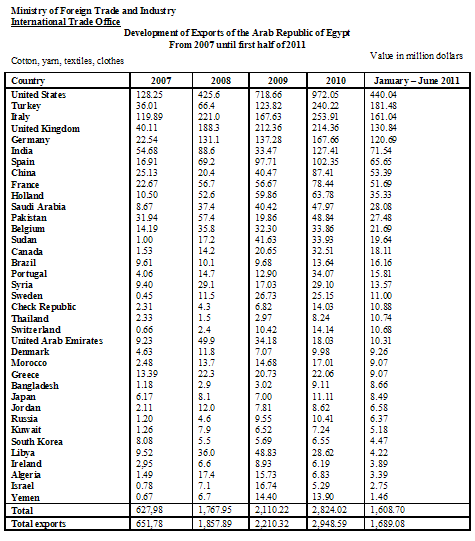
The United States and Italy
According to the most recent statements issued by the International Trade office at the Ministry of Industry and Foreign Trade, as illustrated in Table (1), the volume of Egyptian exports of cotton, yarn, textiles and clothes reached USD1.689 billion during the first six months of 2011; exports rose from USD651.8 million in 2007 to 1.858 billion in 2008, to USD2.210 billion in 2009 and to USD2.948 billion in 2010.
The United States is considered one of the largest importing countries from Egypt, where its Egyptian imports rose from USD128 million to USD425 million in 2008, USD718.6 million in 2009 and USD972 million in 2010 and reached USD440 million during the first six months of this year. The next largest importer is Italy; its Egyptian imports amounted to USD120 million, rose to USD221 million only to drop to USD167.6 million and rise again to USD254 million during 2007-2010, and reached USD161 million during the first six months of this year. Egyptian exports to Turkey totaled USD36 million, rose to USD66 million and jumped to USD124 million and then USD240 million during 2007-2010, and reached USD181 million during the first six months of 2011.
Government Subsidies
Mohammed Al-Murshidi, head of the Chamber of Textile Industries, believes that cessation of government subsidies will adversely affect the textile industry, since it has suffered significant losses during recent months, and is expected to incur bigger losses if the financial support that has been approved for domestic producers of yarn is not paid.
Mr. Al-Murshidi added that the textile industry employs over 90 companies from both the public and private sectors and has 200,000 employees, with investments of up to EGP10 billion; supporting textile producers will definitely boost competitiveness.
Mr. Sharif Lasheen, a member of the Chamber of Textile Industries, said that smuggling is a scourge that will destroy the industry. He pointed out that delayed payment of government subsidies - EGP12 million for the factories - cost these factories EGP600,000 in interest for bank loans. Mr. Lasheen emphasized that government subsidies will return to the state as investments, and stressed that the textile sector is a solid domain with great benefits to the state; it is one of the oldest industries in the country, with over 2 million employees, and thus deserves the country's protection from the plight of smuggling.
© Zawya 2011




















