The government to consider putting 32 Public Private Partnership (PPP) projects out to tender during the upcoming period
The Egyptian Government has announced its wish to promote investments in the infrastructure sectors, namely in the transport, power, water, education and health sectors, due to the prominent role of these investments in stimulating economic growth, improving the business environment, and ameliorating the living conditions of the citizens. It will also involve the private sector in the financing and management of these projects, in a way that ensures the fair division of investment burdens between the public and private sectors.
Atter Hanoura, director of the Public Private Partnership (PPP) Central Unit at the Egyptian Ministry of Finance, revealed that there are 32 projects being studied within the various ministries, which are to be tendered for PPP during the upcoming period. However, the question that poses itself is: what does the future hold for infrastructure investment and PPP projects in light of the current circumstances in Egypt?
An Inevitable Partnership
Initially, Bakr Abdel Wahab, senior vice-president of private equity at EFG-Hermes, which manages two infrastructure investment funds (InfraMed and InfraEgypt), highlighted the importance of infrastructure investment and its economic impact on other sectors. He also emphasized on the significance of PPP projects alleviating the charges of the Government, particularly with the increase of budget deficit and the inflation of public debt, at a time where Egypt is in great need of huge infrastructure investments.
This was also the point of view of Dr. Hazem El-Beblawi, Deputy Prime Minister and Minister of Finance, at the opening of the round table on the future of the PPP projects at the British Embassy in Cairo. He stressed the Government's keenness to attract more foreign investments to the Egyptian market, especially in the field of infrastructure. He revealed the target of Egypt to increase the rate of foreign investments' contribution to the GDP to 15% over coming years. He also underlined the fact that the Government is supporting the PPP projects in order to meet the growing need of infrastructure projects.
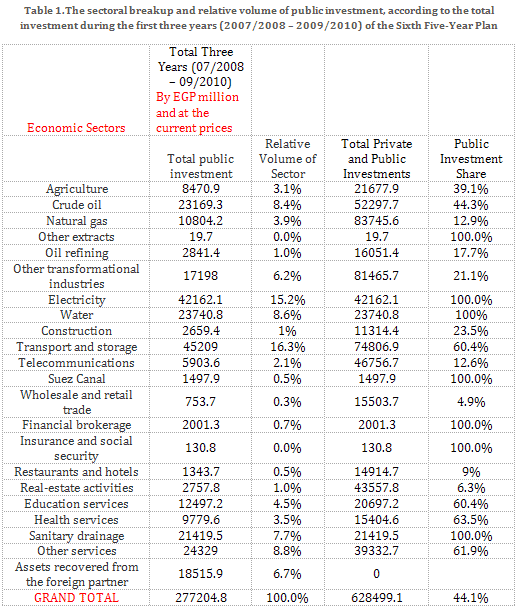
The plan follow-up reports issued by the Egyptian Ministry of Planning (former Ministry of Economic Development) indicated that public investment had contributed by 44% of the total investments during the three years preceding the revolution (the first three years of the Sixth Five-Year Plan 2007/2008 - 2011/2012). These data reveal that most public investments are directed towards infrastructure sectors (so-called social infrastructure), such as transport and storage, electricity, water, sanitary drainage, education and health.
The data also indicates that the total volume of public investment during that period amounted to EGP 277 billion (1 USD = 5.94 EGP). This figure has exceeded the target of the said period, as a result of the additional government credits to counter the effects of the financial crisis. It is noted that the transport and storage sector is at the forefront as it reached 16.3% of the total investment during that period, with an investment size of EGP 45 billion, accounting for 60.4% of the total investment in this sector. The electricity sector is ranked second, with a steady increase in the volume of public investment in this sector which accounted for 15.2% of public investment during that period, with an investment size of EGP 42 billion. Furthermore, the size of public investment in the water and sanitary drainage sectors amounted to EGP 23.7 billion and EGP 21.4 billion respectively, by 8.6% and 7.7% of public investment. The government sector accounts for the entire investment in these sectors.
Projects
Egypt is not new to the PPP projects in infrastructure; the database of the World Bank concerning PPP projects in Egypt includes 18 projects in the power, water and transport sectors between 1990 and 2010. The transport sector accounts for a hefty proportion of the projects (11/18), followed by the power sector (5/18), with the remaining projects in the water, sanitary drainage and water treatment sectors (2/18). The data indicate that the BOT method (Build - Operate - Transfer) is most commonly used, with 13 projects adopting this method, followed by the management contract with 3 projects, then BROT method (Build - Rehabilitate - Operate - Transfer) with 2. The contracting periods ranged from 4 years up to 50 years in some of the projects, such as Borg El Arab Airport and El Alamein Airport.
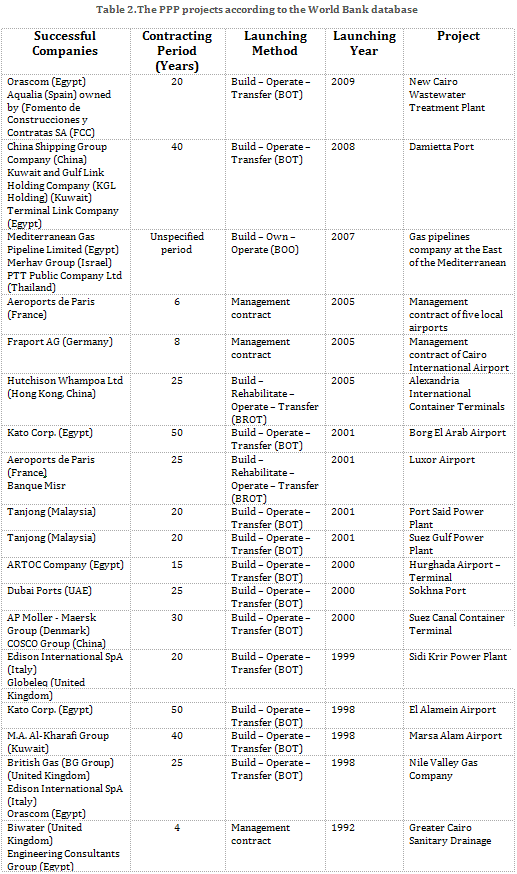
The New Cairo Wastewater Treatment Plant project is considered the first project to be put out to tender under the supervision of the PPP Central Unit at the Ministry of Finance, as stated in a Ministry of Finance study prepared by the researcher Mohamed Dakrory entitled 'Public Private Partnership PPP & The Egyptian Experience'. According to the study, as per the partnership contract in this project, the service provider will receive from the New Urban Communities Authority for the processing of wastewater, according to the size of the water treatment capacity measured in cubic meters, following the completion of the construction phase and the approval of the plant, within the operating period of 18 years.
At the end of the contract period of 20 years, the service provider will hand over the wastewater treatment plant to the New Urban Communities Authority. The contract was awarded to Orasqualia Co. (joint venture of Orascom (Egypt) and Aqualia (Spain)), which submitted the best offer of the total value of EGP 2.646 billion (USD 470 million).
Future Vision
According to Atter Hanoura, the Egyptian Government is keen to move the PPP projects forward. He mentioned that the Government is reviewing some of the projects that have been put out to tender but not completed yet (such as Rod Al-Farag and both wastewater treatment plants at the Sixth of October and Abu Rawash), in order to take the necessary actions for completion. He also declared that October 18 is the closing date for the submittal of the bids for the Alexandria University Hospitals PPP Project, in preparation for the awarding procedures, considered the second project to be supervised by the PPP Unit after the New Cairo Wastewater Treatment Plant. He added that there are 32 projects being studied by the PPP Unit with the various ministries, as a preliminary step to launch them to investors under the PPP system by the beginning of 2012.
Bakr Abdel Wahab expressed his concern about the delay in the tendering of projects, especially that the interim Government may not accept to sign contracts with the private sector for periods up to 20 years, and that the submission of projects is related to political stability, relying on a peaceful election process which will have a positive effect on the economic situation.
With respect to the Rod Al-Farag project, in which Hermes is one of the qualified candidates, Abdel Wahab stated that, like other projects, there is a slowdown in the completion of the rest of the public offering steps and he asserted that there is no timetable set by the Ministry of Finance to complete the project. As per the funding of the infrastructure projects by Hermes through InfraMed and InfraEgypt, he stressed that Hermes welcomes the PPP projects by being a part of the competing coalitions.
Legislative Framework
Sherif Nabil, economic researcher at the Social Fund for Development, confirmed that a good legislative framework is an important element in guaranteeing the success of the PPP projects and in reassuring the investors. He stressed that the Egyptian Government issuing the Law No. 67 of 2010 concerning the 'Organization of PPP in Infrastructure Projects, Services and Public Utilities' in May 2010, is vital for the development of a regulatory and legislative framework that governs the tendering of PPP projects. Nabil mentioned that the new law stipulates that the contribution rate of public funds in the companies or coalitions tendering for these projects shall not exceed 20%. The law specified the contract period between 5 years and 30 years and the minimum value of the project to be implemented shall not be less than EGP 100 million (USD 17 million).
Banking expert Mohamed Abdel Rahman stressed the importance of bank financing, as it is necessary for the success of PPP projects which need a large amount of financing. He explained that the banks are willing to finance PPP projects due to their low risks compared to other projects. Abdel Rahman stated that banks generally tend to form a coalition in order to offer common loans for such type of projects, for the purpose of distributing risk. For example, the New Cairo Wastewater Treatment Plant was financed by a coalition of four Egyptian banks: National Société Générale Bank (NGSB), Commercial International Bank, Ahli United Bank, and Arab African International Bank, which provided a total of EGP 560 million between them.
© Zawya 2011