Inflation is the biggest threat to the planned Gulf Co-operation Council monetary union, the chief economist at Dubai International Financial Centre (DIFC), warned yesterday.
"There is no greater challenge to the union than inflation," said Dr Nasser Al Saidi, chief economist at the DIFC. "Inflation should be a priority item on the policy agendas of the GCC's central bankers."
But Dr Saidi remained confident that the monetary union would be achieved as planned in 2010. "The GCC countries should stick to the set date," he told Emirates Business. "This is vital from the viewpoint of the financial and capital markets."
A DIFC report released yesterday said while the dollar peg has served the GCC member countries well in the past, the time may have arrived for a change in policy to contain inflation.
"The dollar exchange rate peg provided monetary and price stability in the past," said the report, An Assessment of the Progress Toward GCC Monetary Union.
"But structural changes, increased economic and trade diversification with Asia - increasingly the region's main trade and investment partner - and the weakness of the dollar on international markets provide the rationale for a change in policy towards inflation targeting, with monetary policy geared to maintaining inflation within an announced target range," the report said.
Dr Saidi said inflation levels varied greatly between different GCC countries.
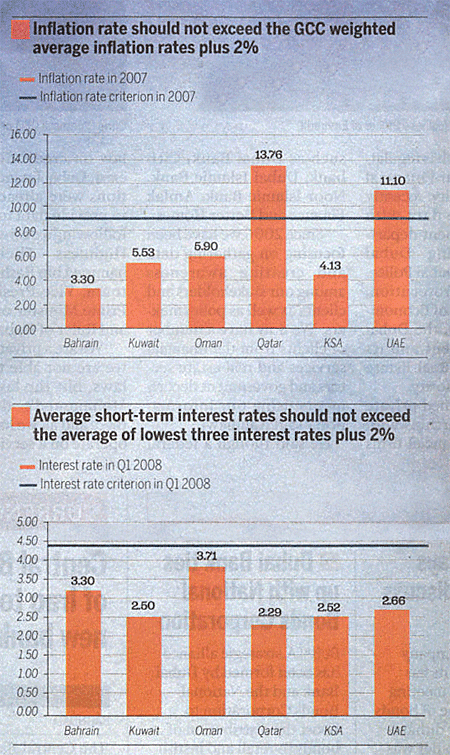
"Inflation rates in Qatar and the UAE are much higher than in other countries," he added. "For a monetary union, inflation rates should not exceed the GCC weighted average inflation rate plus two per cent in each member country.
"Nevertheless I am confident the high inflation rates witnessed in the GCC region are set to decline provided proper monetary tools are implemented.
"The high rates we are seeing are a temporary phenomenon and are not going to last for too long," he said.
Three other key policy issues that need to be addressed before a monetary union is realised have been identified by DIFC.
First, an institutional and governance framework has to be established to ensure smooth, transparent and effective decisions in the conduct of monetary policy and other central bank policies.
"The GCC is yet to agree over an institution," said Dr Saidi. "It could be done in two phases, like the European Union. First, we could create a Gulf monetary authority and then a Gulf central bank.
Second, GCC countries will have to invest in building their statistical capacity in order to provide harmonised economic and financial data to support the monetary union and the common market.
And third, a monetary union, if it is to be achieved and serve its purpose, needs to be supported by investment in financial infrastructure, including legal and regulatory arrangements, payment systems and the development and linkage of money markets and capital markets.
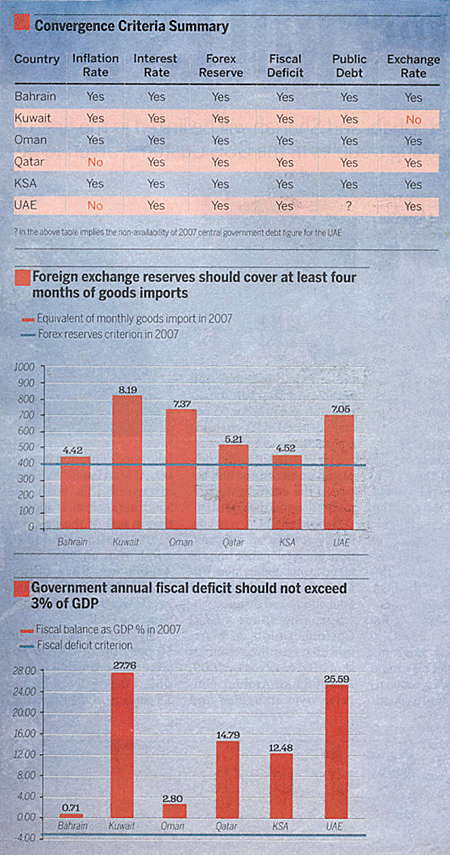
The GCC countries have fulfilled all the criteria needed for a monetary union other than inflation.
The other factors include interest rate parity among member countries, the foreign exchange reserve levels of the respective central banks, limited budget deficits and the ratio of public debt to gross domestic product (GDP).
Average short-term interest rates in the GCC should not exceed the average of the lowest three interest rates plus two per cent in every member country.
"This criterion is satisfied by the member countries," said Dr Saidi. "Due to the dollar peg the interest rates in the countries are at a similar level.
"Foreign exchange reserves should cover goods imported for at least four months and all member countries should be able to finance their exports without affecting their exchange rate.
"Fiscal deficits should not exceed three per cent of gross domestic product. All the countries are running large budget surpluses. Relatively, Bahrain has a lower budget surplus compared to other countries. And the public debt criterion is also fully met by the member countries," said Dr Saidi.
Dollar anchor
The GCC Supreme Council decided at its 21st session in Bahrain in 2000 to use the dollar as the official anchor for member states' currencies from January 1, 2003. It was agreed that bilateral exchange rates should be left unchanged until the adoption of a common currency in 2010.
Kuwait strategy
Kuwait's government has approved a set of proposals from a committee tasked with developing a strategy to fight inflation, including a recommendation of more subsidies.
As well as a wider range of subsidies, the proposals include supporting some food companies in sectors such as livestock and flour mills to reduce prices for consumers.
The plan also includes the creation of a consumer protection committee to prevent fraud and the export of subsidised products.
The cabinet approved the recommendations at its weekly meeting on Monday, daily Al Seyassah cited Minister of Commerce and Industry Ahmad Baqer as saying.
"These recommendations became binding rules after being approved by the cabinet, and starting today we will circulate them to the concerned parties for immediate implementation," he said.
The cabinet also approved an additional budget to implement the committee's 19 recommendations, newspaper Al Anbaa said in an unsourced report.
Both the Ministry of Finance and the Ministry of Commerce and Industry will prepare a draft law of the budget to be presented to parliament for approval, it said.
The world's seventh-largest oil exporter, the only Gulf Arab state without a dollar peg, is fighting record inflation hitting 11 per cent in April and May, driven by food and housing costs. Earlier this month, the government allowed co-operative supermarkets, where nationals can buy subsidised food, to import commodities directly, cutting out wholesale importers in an effort to reduce prices.
In June, Baqer told parliament Kuwait could work with fellow Gulf states to invest in food production and farming abroad in an effort to secure food supplies.
By Shuchita Kapur
Emirates Business 24/7 2008




















