As Ghana's economy falters, the authorities are looking to find ways to stabilize the economy and focus on the country's hydrocarbons sector.
The country's cedi currency declined 20% against the US dollar last year, and president John Mahama has pledged to stabilize the currency, curb inflation, and contain the ballooning budget deficit.
On January 7, president Mahama said the target of reducing budget deficit to 8.5% of the country is achievable.
"We targeted 9% deficit reduction (for 2013) but the provisional outturn is 10.2 [%]. It shows you how difficult governance is," he told the media.
But growth will have to come from infrastructure development and the monetization of its natural resources.
"The government is launching a range of large-scale infrastructure projects, aimed at boosting the country's growth potential. These projects address the large infrastructure gaps present in the economy, a focus point of the Ghana Shared Growth and Development Agenda (GSGDA)," KPMG noted.
The major opportunities lie in the oil industry and natural gas production, which would translate into foreign direct investment for the country.
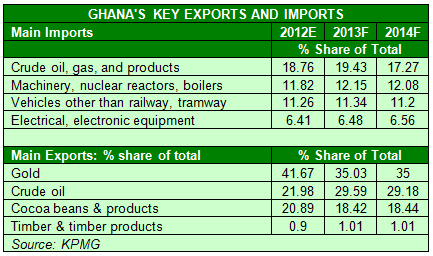
Crude oil made up 22% of Ghana's exports in 2012, second only to its gold exports, which accounted for 41.67% of exports. However, the gap narrowed as gold prices collapsed in 2013, with gold expected to make up 35% of exports and crude oil nearly 30% in 2013. KPMG expects the ratio to be roughly similar in 2014.
The management consultancy expects Ghana's real GDP to rise 8% this year, mainly on the strength of higher oil production and growth in the service sector.
Foreign direct investment is estimated to have been around USD 3.36 billion this year, and rise 1.2% in 2014.
"We project a 15.8% decline in gold exports this year due to both a lower gold price and a decline in domestic output," said KPMG. "Ghana's mining sector is under considerable stress at present. Mining firms are struggling to maintain profitability in the face of increased costs (such as fuel, labor and electricity), lower commodity prices and higher taxes. Meanwhile, crude oil exports are expected to increase by 34.9% this year to USD 4.02 billion. Production by Tullow Oil improved significantly in Q1, but we continue to price in the possibility of a decline in the crude oil price during 2013 H2 and some production delays."
OIL PRODUCTION SET TO RISE
Recent approval to develop the Tweneboa, Enyenra and Ntomme (TEN) fields, would help Ghana raise its production. The TEN field is located close to the giant Jubilee field - which put Ghana on the global oil map - and is expected to produce around 80,000 barrels per day.
Tullow, lead developer of the TEN field, is looking to offload 20% of its stake to help fund the nearly USD 5 billion project.
The projects are expected to come on stream by 2016, just as Jubilee is expected to plateau at 120,000 barrels per day.
"This increased upstream activity will support rising production, which Business Monitor [International] expect will grow from around 110,000b/d in 2013 to 243,000b/d by the end of their forecast period in 2022," the market intelligence firm said.
However, the figures assume the contribution of new supplies beyond fields currently approved, namely liquids from Eni's Sankofa development.
"With the introduction of new supplies from fields under appraisal such as the Mahogany, Teak, Akasa and Banda (MTAB) or the Cape Three Points Block, Business Monitor see risks that output will begin to fall from the end of the decade. There is added downside risk to this view from the prospect of a faster-than-expected rate of decline at the Jubilee field."
Despite its hydrocarbon riches, Ghana is an importer of natural gas. Indeed, crude oil, gas and related products account for 19.43% of imports - the largest import item.
GAS A LESSER PRIORITY
Even though the country has 800 billion cubic feet of proven natural gas reserves, it is not a producer of natural gas, although there are plans to build a natural gas pipeline. The country imports natural gas primarily from Nigeria, but is looking to develop its own resources to cut imports and find viable and sustainable electricity sources.
"Ghana relies heavily on hydroelectricity, which accounts for 85% of electricity generation," the US Department of Energy said. "But past droughts have disrupted supplies and the country hopes to increase electricity generation from natural gas."
There is a chance Ghana can drastically cut natural gas imports, if the country can extract gas from the Jubilee field.
However, there are a number of risks to developing the necessary infrastructure to monetize gas, given the primary target for operators is liquids, said BMI.
"After Sinopec halted work and threatened to completely pull-out of the Jubilee gas project following a row over missed financial obligations by the Ghanaian government, Business Monitor pushed back first gas to 2014. While the project is likely to come online next year, they see risks to future phases from both a lack of funds and the prospect that greater volumes of gas will be directed to increasing recovery rates from the Jubilee oil field as output plateaus."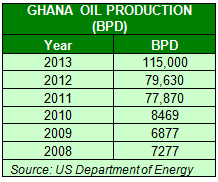
© alifarabia.com 2014




















