How are GCC equity funds affected by economic change? What is the relationship between fund performance and stock market movement? Are funds a better reflection of a country's economy than the stock market?
Our investigation reveals the equity funds sector most representative of its country's economic fundamentals between 2006 and 2010 is that of Bahrain, having a correlation of around 79%. Subsequent correlations, in descending order, are: Qatar, UAE, Kuwait, Oman and Saudi Arabia, the last two exhibiting a negative correlation between economic fundamentals and stock market performance.
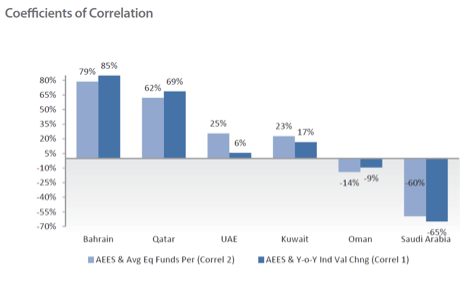
Source: Zawya
A low correlation neither states nor implies that a mutual fund is badly managed or a stock market is badly regulated; it only states that the main forces fueling the mutual market movement are not economic fundamentals. These forces may relate social reform, international events, commodity prices, or other factors. In 2008, for example, the year of the global economic crisis, all GCC stock markets and mutual funds their AEES scores improved or stalled. The negative performance can be attributed to the negative sentiment in global markets.
By exploring these issues, we aim to define the correlation between equity funds performance in the GCC and economic fundamentals as well as stock market performance in order to help maximize the efficacy of fund managers' geographic allocation practices.
"GCC Equity Funds and Economic Fundamentals" aims to test the assumption that the GCC equity funds price in and move in tandem with economic fundamentals, highlighting the major events that may influence our assumed correlation. In a country where correlation is low between economic fundamentals and equity funds performance, allocating assets into that country's equity funds is then better than direct market investments, since mutual funds appear to be more reflective of the country's economy.
The economic indicators we use in this report are:
-Real GDP Growth (Year-on-Year)
-Consumer Price Index
-Current Account as a percentage of GDP
-Total Government Gross Debt as a percentage of GDP
-Gross Official Reserves as a percentage of GDP
This data is obtained from a study by the International Monetary Fund titled "Regional Economic Outlook - Middle East and Central Asia - April 2011", which is available on Zawya's platform.
We provide each GCC economy with an Annual Economic Evolution Score (AEES) between 2006 and 2010, based on the indicators listed above, using a scoring methodology explained in Appendix 1. We calculate the annual percentage change of each GCC equity fund sector and stock-market in the same period and test the correlation between the change in AEES, equity funds performance and stock-market performance. In terms of mutual funds, we have calculated the category's average yearly return for country equity funds between 2006 and 2010. Each category is composed of all the equity funds investing in a single country and with NAVs since December 2005.
Our study does not employ advanced statistical techniques, like tests of multi-collinearity and statistical significance, or principal component analyses. Our findings are observationally significant, and aim at increasing awareness among stock market investors, particularly regarding their asset allocation practices.
For more information on MENA mutual funds, visit Zawya Funds Monitor
Nader El Boustany is Team Leader, Mutual Funds, at Zawya. Hasan Shahin is Senior Market Analyst, Equity Capital Markets Research, at Zawya.
© Zawya 2011




















