Obesity rates in the Gulf are rising to frightening levels. What does this mean in marketing terms?
Obesity has reached epidemic proportions in many countries. Current data from individual national studies suggests that the prevalence of obesity in European countries ranges from 10% to 20% for men and 10% to 25% for women. The obesity rate in children has doubled in the past decade alone.
In the Middle East the figures are even more alarming. One study claims obesity levels across the GCC are as high as 60%, with 50% to 70% of married women falling into this category. GCC children are also among the world's most overweight, with 10% to 15% of primary school children classed as obese.
The health, economic and psycho-social consequences of obesity are quite significant.
Obese people suffer numerous health complications ranging from non-fatal debilitating conditions such as osteoarthritis, to life-threatening chronic diseases such as coronary heart disease, diabetes and certain cancers. The psychological consequences range from lowered self-esteem to clinical depression.
Not surprisingly, the economic impact of obesity and its associated diseases is huge, both in terms of the premature loss of life and healthcare costs. The Washington Business Group on Health estimates that obesity costs private employers in the US up to $12bn a year.
Recent estimates suggest that between two and eight percent of the total healthcare costs in Western countries can be attributed to obesity. There are no figures available for the Middle East.
The prevalence of obesity has increased by about 10% to 40% in most European countries over the past decade. The most dramatic increase is in the UK, where obesity rates have more than doubled since 1980. Today in the UK, one in five adults is obese and one in five children is overweight.
Yet according to Dr Susan Jebb, chair of the Association for the Study of Obesity, many people are complacent about obesity, and feel the problem is something that affects Americans. "The rate of increase of obesity in the UK is exactly the same as in the USA, we are just 10 years behind," said Dr Jebb.
Obesity has been referred to as a "healthcare ticking time bomb", one that threatens to reverse the gains in health and life expectancy made in public health over the past century.
While most people in developed countries usually look forward to longer and healthier old age, the rise in childhood obesity raises the spectre that children growing up today may have shorter lives than their parents.
There is a clear need to educate the public about obesity and its health risks. Far from being a cosmetic issue, as it is often represented in the media, obesity poses a real risk to length of life. A person who is obese at 18 is twice as likely to be dead at 50 than somebody who is not obese at 18. Obesity takes on average nine years off your lifespan.
Experts believe society has not taken obesity seriously as a health issue, just as 30 years ago the risks of tobacco were not taken seriously. For the public, obesity is currently a cosmetic issue, or is about self-esteem. It is not yet in the public's mind an issue of health. The marketing community will be forced to play a central role in this change.
Healthier outlook
New research suggests that such attitudes may be changing. In a recent survey, one in 10 European consumers rated obesity as the most important health threat facing society.
The survey of 2,145 consumers in Germany, France, Spain and the UK was conducted by KRC Research for Weber Shandwick, and identified obesity as the fourth-most-mentioned problem after cancer, alcoholism/drug addiction and heart disease, but ahead of other chronic illnesses such as diabetes and hypertension.
The research also suggested that 87% of consumers believed that diet was the most significant cause of obesity among children, while 77% believed that a sedentary lifestyle was almost as significant a cause. Only 25% considered obesity genetics/heredity to be as significant.
So if the message is beginning to get through to the public that obesity is a serious risk to health, now is the time for action. The challenge is in reversing the environmental factors that have brought about the epidemic.
With European consumers increasingly health conscious, as well as inclined to believe the worst about corporations and willing to blame someone else for their problems, there is a 'perfect storm' brewing that poses serious consequences to food companies that ignore the warnings. From there, it's a short walk to laws, regulations and restrictions.
Consider this statement from a report by the investment bank UBS Warburg: "It is very possible that tighter advertising restrictions will eventually follow from the gathering pace of concern surrounding the spread of the obesity epidemic. There will probably be more lawsuits and pressure from consumer groups to change practices."
A Morgan Stanley research report, Obesity: A Lingering Concern, focusing on the financial risks in the food sector linked to obesity, stated that "The food industry needs to be vigilant to preserve its good image with the public," and pointed out how investors are now looking to the food industry to manage issues in an innovative and pro-active way to avoid the emerging risks of litigation, regulation and reputation damage.
In the end, momentum may matter as much, or more, than the merits.
Understanding the many causes of obesity is clearly an important aspect of tackling the problem. Yet according to some there has been an unprecedented and misguided focus by journalists and the media on apportioning all the blame for obesity on fast food chains, and on selected food and beverage manufacturers.
This kind of approach risks alienating a key group in the obesity debate that can become part of the solution. Robert Davies, CEO of the International Business Leaders Forum, believes the key issue is "whether we get out of this through confrontation, or whether we move forward in a real partnership to tackle what is a real crisis that is simply not going to go away."
While consumers may recognise obesity as a complex problem and understand that the responsibility for it is shared, their concern is that they lack knowledge and understanding of how to find appropriate solutions.
One of the most contentious issues in the obesity debate is the role of marketing and advertising, with opinions divided on the subject. On one hand, advertising, particularly on television, is charged with encouraging children to consume excessive amounts of foods containing high levels of fat, salt and sugar. On the other, advertisers argue that all they are doing is encouraging competition among brands.
While it is clearly one area in which action is being demanded, it would be difficult to introduce regulation on foods and advertising and might well prove counter-productive.
A second factor is clear guidance on portion sizes and what constitutes a healthy diet. The tendency towards super-sizing has occurred worldwide. Consumers are often encouraged to buy larger-sized portions and 'value meals' because they provide better value for money. However, while they may be good for our wallets, they are not necessarily good for our health.
There is also a strong argument for clearer labelling. The fat content of children's food, in particular, and the calorie content of meals sold for children should be signposted and labelled much more clearly to allow people to make informed decisions.
The European Commission has set up a Nutrition and Physical Activity network with the Member States and, perhaps more importantly, an ad hoc Group on Nutrition to assist with the task of developing an action plan on nutrition. This group consists of members from several commission services and provides information on policy developments in the various services as they relate to nutrition, and comments on the consecutive draft versions of the action plan.
Commissioner Byrne has in the meantime also come up with very concrete initiatives, which aim to ensure that we are working towards a healthier diet. The commissioner's fight against obesity offers a policy that seeks to ensure that consumers can make healthy choices.
The most important policy proposal in this area is the Health Claims Regulation, which prohibits any health claim that might be vague, misleading and not scientifically verifiable.
Despite commissioner Byrne's assertion that "there are no 'good' and 'bad' foods", he does seem to be introducing a de facto judgment between good and bad foods, since only food products with specific nutrition profiles (established by reference values of fats, sugar and salt/sodium) will be allowed to carry nutritional or health claims.
Food retailers say that they would like to provide information about healthier options.
However, Richard Ali, head of Food Policy at the British Retail Consortium, believes this might be compromised under the European Union's proposal. "The way we see the food industry being stimulated is through education - public information and consistent communication demonstrating how to have a healthy lifestyle," he said.
Schools and physical activity
Clearly, the educational sector represents an important 'environmental pressure point'.
However, there have been sustained cuts in the amount of time devoted to physical education (PE), as it is under increasing pressure from the core curriculum and school playing fields have been sold off for private development. In addition, there has been little focus on the foods provided in schools.
While acknowledging that schools are very much at the centre of the debate about children and obesity, Ruth Girardet, director of Educational Communications, a consultancy that works with the private sector to develop and implement programmes targeting educational audiences, feels that schools need guidance and help. "Healthy lifestyles and diets are choices but children are very much influenced by context and understanding."
Providing educational resources and other help for schools is one area where the private and public sector could work together most successfully, said Ms Girardet. For example, working with the National Healthy Schools Standard, a private sector organisation, might help schools provide a more enticing dining environment, or could enable them to offer information on balanced diets to parents and children. But she felt this would only work where the company's motives are transparent and its products or brands actually support healthy lifestyle messages. "For any brand that is perceived as unhealthy to offer healthy eating advice to schoolchildren would be seen as cynical and exploitative."
It's not about blame
It's about responsibility, understanding and balance. In response to the obesity crisis, many governments around the world are taking their own actions, exploring options, including 'sin' taxes, advertisement bans, education campaigns, physical activity programmes and more. While some countries believe in strong self-regulatory approaches, others feel that the time has come for more regulation.
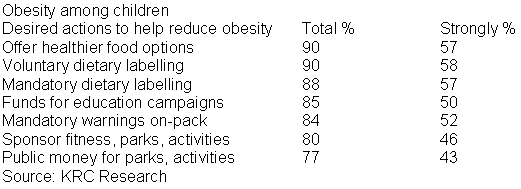
When European consumers were polled on the actions they wished to see to help reduce obesity, it was clear that they were not necessarily looking just for legislative solutions, probably because they did not entirely blame industry for the problem. Instead, the public strongly supported government and corporate actions to address obesity. Consumers were clearly not looking for blanket bans on advertising to children - 53% of respondents were against such a ban - or additional 'sin' taxes on certain foods, supported by just 38% of respondents.
"What is clear is that people see shared responsibility and expect shared solutions involving partnerships between parents, industry and the public sector," said Phil Riggins of KRC Research. "Consumers want increased options, more general information and education to make an informed choice."
Food companies recognise that the causes of obesity are complex. While diet has an important part to play, we also believe that food companies alone cannot be expected to provide the solutions. The WHO's call for concerted action that involves not just governments, NGOs and consumer groups, but the food industry and schools as well, is the right way forward. We want very much to be part of this dialogue and to move forward to play our part in curbing this global epidemic.
Internationally, retailers are increasingly looking at positive and innovative ways of bringing food intake and physical activity together. One leading UK food retailer has been doing store tours for many years, first with Diabetes UK, bringing in state-registered dieticians to help people understand how to read food labels. It has also formed links with GPs. These are small steps but they are things that can be built on.
Working with private food and related companies had shown there was no single right approach. Most companies now accept that there is a problem and that they are part of the solution, which is a very important step forward. The road ahead will probably lie neither in self-regulation nor in government regulation, but in some form of multi-stakeholder approach.
The debate about how to address obesity should not be about blame, but about focus upon understanding, education and responsibility. The WHO has already produced a global strategy that calls on member states and the 1international community - including private companies and NGOs - to act in concert to address the problem.
Industry in general, and the food industry in particular, clearly has a responsibility to address the issues and be willing to engage constructively with its critics. But the NGO community also needs to understand more clearly how business can be encouraged to move forward rather than retreating into 4a shell. Finally, government and health authorities should provide clearer guidance about healthy lifestyles to parents and consumers through public education campaigns.
Some considerations for industry
Review product lines to incrementally reduce sugar, salt and saturated fats.
Ensure that marketing to children does not encourage excess consumption.
Invest in initiatives that promote physical activity, particularly for children.
Review the categories and healthy range of food choices supplied in food vending machines.
Offer more fresh fruit, vegetable and whole grain-based products.
Invest in new products with enhanced health potential.
Provide clearer labelling on products
Communicate more clearly the initiatives that are being undertaken.
Engage in voluntary multi-sectorial initiatives in food literacy and physical activity.
Experts argue that obesity will be tackled best by leveraging the social marketing skills of the private sector. By doing so, the private and public sectors together can create and implement initiatives that will educate, support and benefit the health and well being of children. Marketers, and the marketing communications industry, will play a central part in the economic as well as physical health of the region.
To see the full version of this article, visit www.webershandwick.com
© Gulf Marketing Review 2004




















