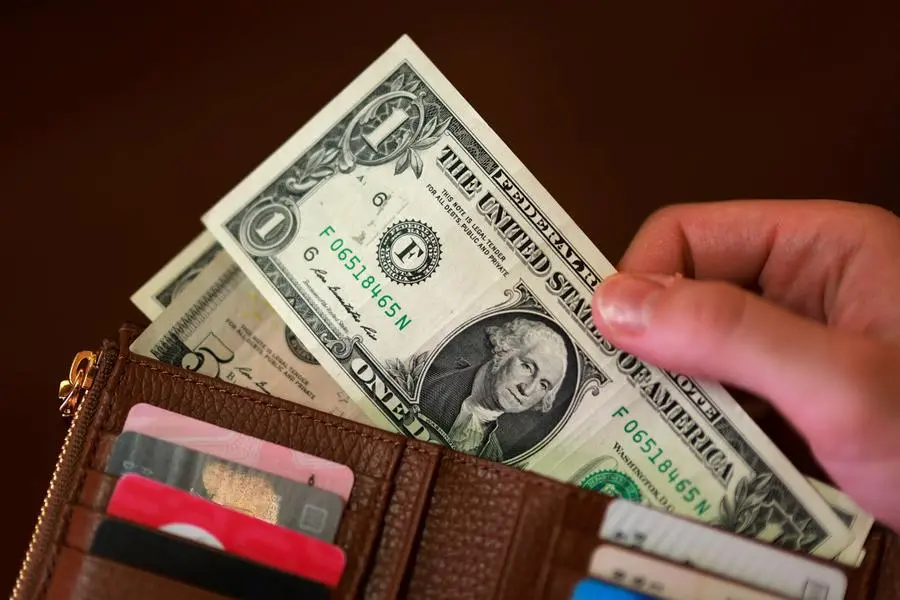
PHOTO
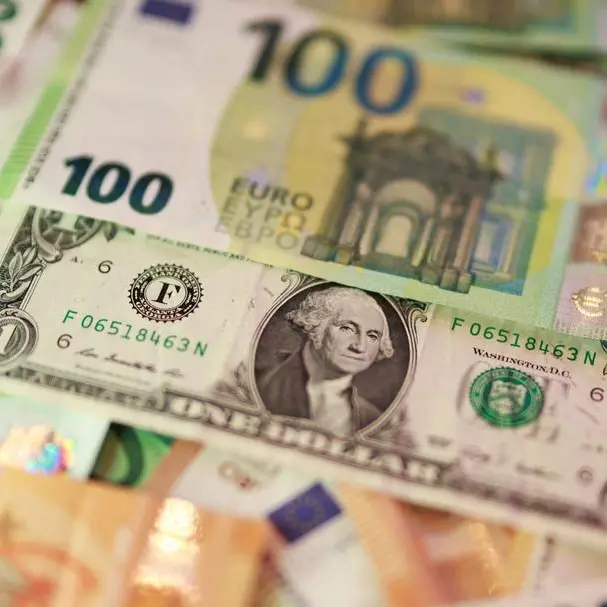
The dollar gained for a fifth straight day on Friday and was poised for its largest weekly percentage rise in two months, as market expectations for the path of monetary policy from the Federal Reserve continue to shift towards possible rate hikes.
The advance in the greenback this week comes as U.S. Treasury yields continue to ascend, with the benchmark 10-year Treasury note reaching 4.581%, its highest in a year, after a raft of economic data earlier this week pointed to rising price pressures with the Strait of Hormuz largely shuttered due to the Iran war.
The dollar index, which measures the greenback against a basket of currencies, rose 0.29% to 99.23, with the euro down 0.35% at $1.1627 after hitting a five-week low of 1.1617.
"It's looking to me that the bond market's leading the charge on this one, as they often do, that they're starting to get worried about inflation," said Joseph Trevisani, senior analyst at FXStreet in New York.
"If you're going to get an oil price in WTI from 95 to 105, then a lot of inflation expectations have to be reset, and in fact, they're resetting. Well, if they're resetting, the bond market's going to do exactly the same thing, and that's what the bond market is doing."
West Texas Intermediate crude rose 3.07% to $104.28 a barrel and Brent rose to $108.60 per barrel, up 2.72% on the day after comments from U.S. President Donald Trump and Iran's foreign minister further dented hopes of a deal to end ship attacks and seizures around the Strait of Hormuz.
FED OFFICIALS SIGNAL INFLATION FOCUS
The five-day streak of gains for the dollar would mark its longest since late March, with the index up roughly 1.5% for the week. The euro was off about 1.4% on the week, its biggest drop in two months.
Several Fed officials this week indicated that keeping inflation pressures in check was a top priority, while others did not rule out the possibility that rate hikes may be needed if price pressures continued to mount.
Federal Reserve Bank of New York President John Williams said late on Thursday he did not see a need right now for the central bank to weigh any change in interest rate policy amid the uncertainty created by the Middle East war as monetary policy was in a "good place."
Markets are now pricing in a 48.4% chance the Fed could hike rates by at least 25 basis points at its December meeting, compared with 14.3% a week ago, according to CME FedWatch.
The yield on benchmark U.S. 10-year notes was last up 12 basis points, on pace for its biggest daily jump since April 9, 2025, to 4.579%. The 30-year bond yield shot up 10.5 basis points to 5.1178% after hitting 5.122, its highest since May 22.
Erik Nelson, head of G10 FX strategy at Wells Fargo, said in a note that he expected the recent dollar strength would "fizzle out and return to USD weakness as the Fed fails to validate rate hike pricing", as holding rates unchanged was viewed as tightening for most Federal Open Market Committee members.
Against the Japanese yen, the dollar strengthened 0.19% to 158.65. Japan's wholesale inflation accelerated in April at the fastest pace in three years as the Iran war boosted oil and chemical goods prices, data showed on Friday, bolstering the case for the central bank to raise interest rates as soon as June.
The yen has weakened more than 1% on the week, pushing it back towards the 160 mark that recently prompted another intervention in the currency by Japanese officials.
Sterling weakened 0.37% to $1.3348 after hitting a five-week low of $1.3325 as political turmoil surrounds Prime Minister Keir Starmer as he seeks to hold on to power. The pound was off about 2% on the week, on track for its biggest weekly drop since November 2024.
(Reporting by Samuel Indyk in London and Rae Wee in Singapore; Editing by Kate Mayberry, Jamie Freed, Ros Russell, Andrew Heavens and Alex Richardson)