Three decades ago, countries like Malawi, Burundi and Burkina Faso were ahead of China on a per capita basis. But China is now the world's second largest economy, with 400 million people lifted out of poverty.
"This success has attracted attention from other developing countries, especially Africa," says He Wenping, professor and director of African Studies at the Chinese Academy of Social Sciences. "Hopes are high for drawing lessons from China's experiences to speed up their own development."
Much has been said about China's interest in Africa and whether Beijing intends to influence the continent's vulnerable countries with promises of funding and development, but there is no doubt China has played a crucial role in lifting the African economy.
The Chinese-government funded China-Africa Economic and Trade Cooperation (CAETC) has collected fresh data on China-Africa trade in a new report published this month.
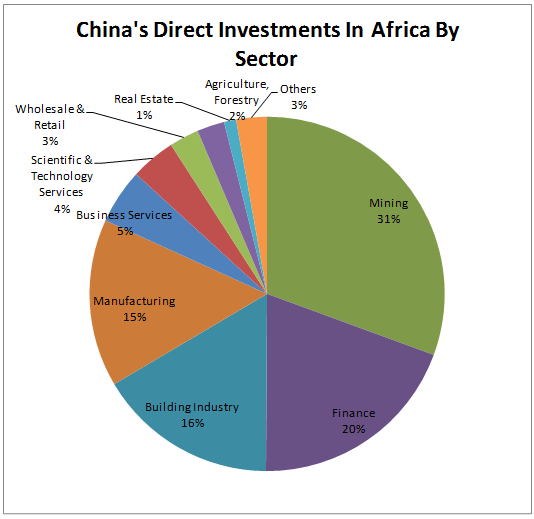
China's direct investment in Africa had risen from USD 9.33 billion as recently as 2009 to USD 21.23 billion by last year, and investments have been growing at 20.5% per annum over the past three years
"The rapid growth of China's direct investment in Africa is indicative of Africa's development potential and investment appeal, and also points to the mutually beneficial nature of China-Africa cooperation," the report noted.
The Asian giant has also sewn up bilateral investment treaties (BIT) with 32 out of the 54 African countries, as well as set up joint economic commission mechanisms with 45 African countries, casting its trade and investments wide across the region.
That has been reflected in booming business ties, as China-Africa trade was just shy of USD 200 billion last year.
"Of this, USD 85.319 billion consisted of China's exports to Africa, up 16.7%, and USD 113.171 billion was contributed by China's imports from Africa, up 21.4%," the report said. "Total China-Africa trade volume, China's export volume to Africa and China's import volume from Africa all reached new highs."
As both regions forge closer trade ties, they have captured greater market share in each other's economies as well.
Over the past 12 years, Chinese raised its market share of total exports to Africa from 3.88% to 14.11%. Meanwhile, Africa's share of global exports to China shot up from 3.76% to 18.07%.
More than 2,000 Chinese enterprises are investing and developing in more than 50 African countries, and working in sectors as diverse as agriculture, mining finance, transportation and real estate.
WARY OF CHINA
Western nations have been concerned about rising Chinese influence in Africa. As China beat the United States to become Africa's largest trading partner in 2009, OECD countries have been wary of rising Chinese control of African assets.
Much of the blame though, lies with the Europeans and Americans themselves. Their policy of aid, rather than trade, has not lifted millions of Africans from poverty and it has barely made a dent on economic growth.
Instead, the African countries have benefited from trade and investment from China and other emerging markets.
The rise of trade ties between developing countries have come at a time when OECD countries have been at their weakest.
Waylaid by global financial turmoil, both the United States and Europe have been focused on kick-starting domestic growth rather than nation-building projects abroad.
China stepped into the breach and focused on mutually beneficial agreements with virtually all the key African states.
"However, this does not mean China is being altruistic. Helping Africa is important, but China would not do so if it had nothing to gain," wrote Yun Sun, visiting fellow at the Global Economy and Development, John L. Thornton China Center, Africa Growth Initiative.
"Indeed, China emphasizes that any bilateral relationship has to be mutually beneficial. And China's investment in Africa does pay itself back in multiple ways economically: development and exploitation of Africa's natural resources, access to local market, employment opportunities for Chinese labors and service contracts for Chinese companies on infrastructure projects that China funds."
GLOBAL POLITICAL CLOUT
Supporting African countries with few natural resources also helps the country leverage its global political influence and smooth the path for regional transportation links between landlocked states.
However, not every one in Africa is convinced of Chinese influence in the continent.
Earlier this year, Lamido Sanusi, Governor of the Central Bank of Nigeria, noted that trade with China was "a significant contributor to Africa's deindustrialization and underdevelopment" and reeked of "the essence of colonialism".
However, Zhong Jianhua, China's special representative on African Affairs, told the Africa Research Institute, that China has no master plan of its involvement in Africa.
"When people generalize about China, I say to them, "the 'China' you are talking about does not exist. You must be precise". When referring to the Chinese government, you must be clear about which government - provincial, local or central - and which activity. You cannot generalize and say "this is China in Africa", any more than you can say "China is good" or "China is bad". China is neither bad nor good. China is a combination of these things."
ROOM FOR EVERYONE
Competing for Africa does not have to be a zero-sum game for both Chinese and Western governments.
Earlier this year China pledged financing of more than USD 20 billion to Africa over a three-year period, while the United States is focused on building trade ties with Africa by pledging to renew the African Growth and Opportunity Act that allows greater trade incentives for African and American companies.
"The growing importance of the sub-Saharan Africa region to the global economy has brought the region into focus for US and Chinese engagement," said The Brookings Institution in a report published in August.
"Despite a somewhat competitive stance from the US on China's actions in sub-Saharan Africa, the US, China and Africa have the potential to benefit from unified engagement in the areas of security, trade, investment and natural resource management."
These include focusing on common goals such as increasing African access to power and utilities, renewable energies and even cooperation in mining and other extractive industries.
Africa presents a great opportunity. And while China has taken the lead, there is no reason to think that other nations cannot develop their own trade ties with the continent and capture a piece of the growing pie of African opportunities.
alifarabia.com 2013




















