PHOTO
Intra-regional M&A activity in MENA will undergo a “re-prioritising” of certain sectors amid a regional slump in dealmaking caused by the sustained US/Israel–Iran conflict, Goldman Sachs said.
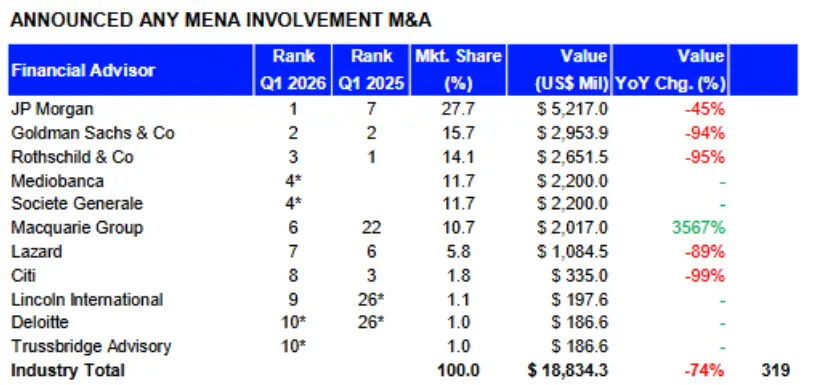
According to LSEG data, M&A activity with any MENA involvement declined 74% year-on-year (YoY) in Q1 2026, slipping to $18.8 billion from the previous year’s $66.4 billion.
Deals involving a MENA target totalled $4.6 billion over the same period, marking a decline of 90% YoY and recording the lowest Q1 total in a decade.
Jassim AlSane, co-head of MENA Investment Banking at Goldman Sachs, told Zawya that it was “too early” to infer a trend from Q1 numbers in light of current events. Against the backdrop of a heightened conflict, M&A activity has prioritised sectors offering security, supply resilience, and inflationary hedges.
“The regional fundamentals remain intact, and if anything, the economies in the GCC have proven their resilience despite the volatility in geopolitics,” AlSane said.
Goldman Sachs emerged as one of the leading banks in the region for M&A transactions in Q1, clocking in a total value of $2.95 billion and commanding more than 15.7% of the market share in the region, according to LSEG.
Its biggest deal of the quarter was the $6 billion sale of gaming studio Shanghai Moonton Technology by Chinese tech company ByteDance to the Riyadh-based Savvy Games Group, owned by Saudi Arabia’s Public Investment Fund.
According to AlSane, the first quarter also saw the bank advise Bahrain industrial group Alba’s acquisition of Aluminium Dunkerque from the US fund AIP. LSEG data indicates that a unit of Bahrain Mumtalakat Holding Company, the country’s sovereign wealth fund, made a $2.2 billion cash payout to acquire Europe’s largest smelter in one of the country’s biggest corporate deals in recent years.
Goldman Sachs also advised German aircraft-leasing company Amedeo Air Four Plus on the sale of its assets to Qatar-listed Lesha Bank in a $253.951 million cash deal.
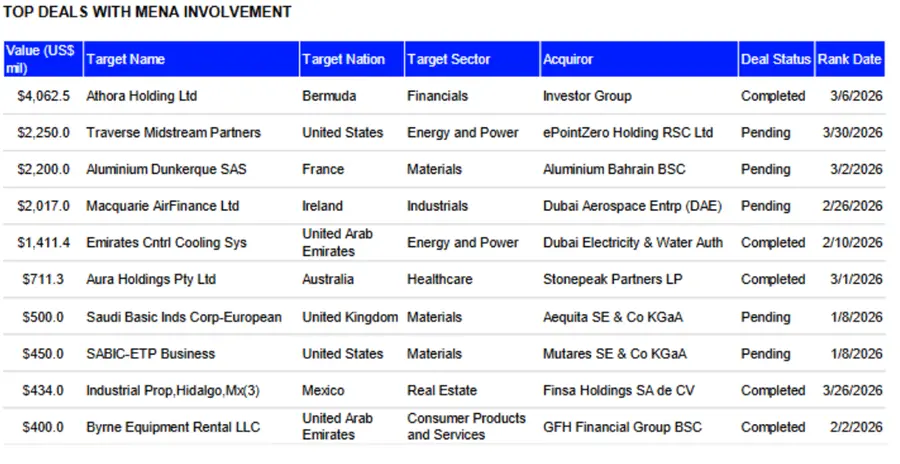
According to AlSane, gaming and aircraft leasing, “primarily driven by strategic consolidation and capital rotation”, have been increasing in prominence over the last 18 months. LSEG data also states that energy and power, financials, and industrials have emerged as the top sectors by value in Q1.
“Deal activity has been primarily led by strategic platforms that are owned by regional sovereigns,” AlSane said. “These companies, especially those backed by the sovereigns, have been given long-term mandates to grow and lead as national champions.”
According to LSEG, outbound M&A activity in the MENA region declined 55% from year-ago levels to $11.5 billion in Q1, marking a two-year low.
However, AlSane said that Goldman Sachs still pegged outbound activity as a dominating force compared to intra-regional activity. “Regional strategic players are continuing to execute their global expansion strategy with strong conviction,” he added.
Many analysts are sceptical that a prolonged US/Israel–Iran conflict will further slow down the pace of dealmaking over the short to medium term. AlSane said it was unlikely to dent overall M&A activity in the region.
“Looking at our pipeline, we have deals across the spectrum – many are going ahead as planned, and some are taking longer to advance,” he said.
(Reporting by Bindu Rai, editing by Seban Scaria)