RIYADH: The Ministry of Finance projects actual revenue to be SR505 billion ($134.67 billion) in 2009 and actual expenditure to be SR550 billion ($146.67 billion), resulting in an actual deficit of SR45 billion ($12 billion), said an official statement issued by the ministry on Monday.
Increases in actual over budgeted expenditures in 2009 reflect increases in expenditures on projects in the Two Holy Mosques and other holy sites, food and welfare subsidies, transfer of temporary to permanent employment, and increases in student enrollments in universities as well as scholarships abroad.
The ministry said public debt would decline from SR237 billion ($63.2 billion) at the end of 2008 to SR225 billion ($60 billion) at the end of 2009, although as a percentage of GDP it will increase from 13.3 percent at the end of 2008 to 16 at the end of 2009 because of the decline in nominal GDP in 2009. The Kingdom's public debt is totally domestic.
The 2010 national budget will continue to focus on enhancing economic development and improving the investment environment that supports strong and balanced economic growth. This year's budget includes SR260 billion for investment projects, a 16 percent increase over the 2009 budget. The budget gives high emphasis to projects that ensure sustainable and balanced development as well as job creation. Specifically, the focus continues to be on education, health, social and security services, municipal services, water and sewage services, and roads and highways.
Moreover, the budget attaches a particular importance to projects related to research and development (R&D) as well as science and technology projects and e-government. It supports the King Abdullah Initiative for Education Development amounting to SR9 billion through the Education Development Holding Company owned by the Public Investment Fund (PIF).
New projects include 1,200 new schools, in addition to the 3,112 schools currently under construction and more than 770 schools completed in 2009, and rehabilitation of 2,000 existing school buildings. Scholarship abroad will continue next year, with focus on technical trainers.
Allocations for new health projects include new primary care centers throughout the Kingdom, 92 new hospitals with a capacity of 17,150 beds, the ministry said. For social services, the new budget includes appropriation to build sport clubs, social centers, and social welfare and labor offices. In addition, it includes further support for poverty reduction programs.
Municipality Services: Total expenditure amounts to SR21.7 ($5.8) billion, an increase of 15 percent over the 2009 appropriation. New projects include inter-city roads, intersections and bridges, and road lights. It also includes sanitary and other environment-related projects.
Transportation and Telecommunication: Total expenditure amounts to SR23.9 billion ($6.4 billion), an increase of 24 percent over the 2009 appropriation. New projects include roads totaling 6,400 kilometers to be added to 35,000 km of roads currently under construction, ports, airports, railroads development and new postal services.
Water, Agriculture, and Infrastructure Sector: Total expenditure amounts to SR46.0 ($12.3) billion, an increase of 30 percent over 2009 appropriation. Appropriations for new projects include enhancing water sources, dams and wells, as well as improving water and sewage networks. There are also allocations for new water desalination plants and the upgrading of existing ones. Moreover, these appropriations include new projects, which will be undertaken in the two industrial cities of Jubail and Yanbu to attract domestic and foreign investments.
Specialized Credit Development Institutions and Government Financing Programs: Specialized government development funds and banks will continue to provide loans to the industrial and agriculture sectors, which should help in creating jobs and enhancing growth prospects. It is projected that SR48.3 billion ($12.9 billion) will be disbursed by the credit institutions (the Real Estate Development Fund, the Saudi Industrial Development Fund, the Saudi Credit and Saving Bank, the Agriculture Development Fund, the Public Investment Fund, and the Government Lending Program) in 2010. The total value of loans provided by these institutions since their inceptions amount to more than SR388.4 billion ($103.6 billion).
Economic Developments in 2009:
Gross Domestic Product: According to the Central Department of Statistics and information, GDP is estimated in 2009 to be SR1,384.4 billion ($369.2 billion) in current prices, reflecting a contraction of about 22.0 percent compared to 2008. Nonoil GDP is estimated to grow by 5.5 percent. This growth is mainly attributed to the government stimulus program. Private sector is estimated to grow by 2.85 percent in current prices in 2009.
In real terms, overall GDP is estimated to grow by 0.15 percent. However, nonoil GDP is estimated to grow by 3.0 percent, with the government sector growing by 4.00 percent and the private sector by 2.54 percent in 2009. All components of the GDP recorded positive growth in 2009, except the oil sector. In particular, the industrial sector is estimated to grow by 2.20 percent; the construction sector by 3.90 percent; the electricity, gas, and water sector by 3.35 percent; the transport and communication sector by 6 percent; the wholesale, retail, restaurants, and hotels by two percent; and the finance, insurance and real estate sector by 1.80 percent in constant prices. In addition, private sector contribution to GDP is projected to be 47.80 percent in constant prices.
General Price Level Inflation: As measured by the cost of living index, it is estimated at 4.40 percent in 2009, while the non-oil GDP deflator showed an increase of 2.40 percent.
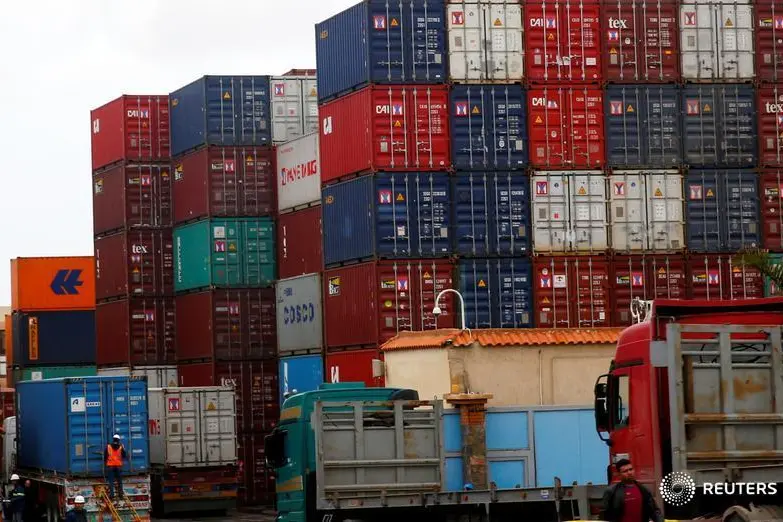
Foreign Trade and Balance of Payment: The Saudi Arabian Monetary Agency (SAMA) estimates the total value of exports of goods and services at SR691.6 billion ($184.4 billion) in 2009, representing a contraction of about 41 percent compared to 2008. Nonoil exports of goods are estimated at SR 101.8 billion ($27.1 billion), reflecting a decline of 16.4 percent and representing 15.0 percent of total goods exported.
Total imports of goods are estimated at SR301.3 billion ($80.4 billion) in 2009, representing a decline of 21 percent compared to 2008. According to preliminary data from SAMA, trade balance is estimated to record a surplus of SR390.3 billion ($104.1 billion) in 2009, a decline of 50.9 percent compared to last year, as a result of the decline in oil price and quantity as well as nonoil exports.
Current account is estimated to record a surplus amounting to SR76.7 billion ($20.5 billion) in 2009 compared to SR496.2 billion ($132.3 billion) in 2008, a decline of 84.5 percent.
Money and Banking: The broad money supply during the first 10 months of 2009 grew by 8 percent. Bank deposits recorded a growth rate of 8.2 percent during the first 10 months of 2009 and total banks claims on public and private sectors declined by 5.7 percent. Banks' capital and reserves increased by 24.1 percent reaching SR163.6 billion ($43.63 billion).
Capital Market: The Capital Market Authority (CMA) continued its efforts to develop the bonds market and improve the transparency, fairness, and investors' protection. On deepening the financial market and providing more investment opportunities, the CMA has approved 10 IPOs (initial public offerings) totaling about SR26.6 billion.
It has licensed 24 mutual funds and 14 new brokerage and portfolio management firms, increasing the number of licensed firms to 124.
Other Developments:
a. The 2009 Article IV Consultation of the IMF with Saudi Arabia concluded that the prospect of Saudi Arabia's economy is positive and the performance of non-oil sector will remain strong.
b. Standard and Poor's (S&P) Ratings maintained Saudi Arabia sovereign rating at (AA-).
c. The IFC 2010 Report on Ease of Doing Business ranked Saudi Arabia at 13 among 183 countries, up from rank 15 in 2009 Report.
d. New fiscal, institutional, and structural reforms have been introduced in 2009.
These included restructuring of the Agriculture Development Fund, the creation of the National Committee for Clean energy Development, the National Plan for Nuclear and Radiation Emergency, Tax Incentives for Investment in Some Geographical Areas, By-Laws for nonprofit Technical and Vocational Training, and rules for dealing with national employees in sectors slated for privatization, among others.
© Arab News 2009