Apr 03 2011 |
more articles from
|
25 Fascinating Facts About Saudi Real Estate
Everyone knows there is a housing shortage in Saudi Arabia, and the lack of a clear mortgage law is hindering growth, but what are the other dynamics impacting on Saudi real estate?
Here is a handy and detailed list of interesting, and some troubling, facts you may or may not know about Saudi real estate.
1. Saudi Arabia has many sub-segments within its real estate industry with their own dynamics, which can be broadly divided into Riyadh, Jeddah, the Holy cities, Eastern province and City developments.
2. Estimates of the supply shortage vary, but Banque Saudi Fransi (BSF) places the current shortage at half a million, crossing one million by 2012. Currently, the stock of housing stands at 3.95 million, with new supply coming in at 380,000 per year.
3. The Saudi population dynamic deserves research of its own, but suffice is to say that its population is anywhere between 22 million to 25 million and has been growing at an annual rate of 2.1% in the past six years. "National population growth remained rapid through the 1990s, during which it averaged 2.8 percent per year. As a result, around 30 percent of Saudis are aged between 15 and 29," writes Jeddah-based Jadwa Investments. "This generation is now entering the labor force and the creation of suitable jobs is one of the main challenges the Kingdom faces."
5. Global Investment House estimates there are currently 4.815 million housing stock with a vacancy rate of 1.8%.
7. But analysts expect a time lag, especially as the country's capacity is around 120,000 per units per year, according Kuwait-based Global Investment House.
8. The king second royal decree focused on raising the amount of the upper limit of the loan by Real Estate Development Fund from SR300,000 to SR500,000. This proposed limit should not negatively affect the number of beneficiaries of the fund's loans.
9. Of course, building houses on such a scale will require time to tender, design and execute the projects, and also include the involvement of other ministries including infrastructure development such as power, telephone lines and roads etc.
10. Saudi Arabia will need to complete 900 houses per day over the next five years to meet demand, according to real estate consultants Jones Lang La Salle (JLL).
11. Current developments are usually at a micro level, with less than five units per project. Building large-scale expertise could benefit the handful of large Saudi developers and other regional players like Arabtec, Orascom Construction, CCC and Drake & Scull.
12. Seventy per cent of current supply is focused on 10% of the population.
13. Saudi families are large and extended with multiple generations living together. Hence they need large accommodation. Even the family sizes have shrunk over the decades, they still remain large. Hence, two to three bedroom apartments are not ideal, villas and low-rises are favoured by Saudi nationals.
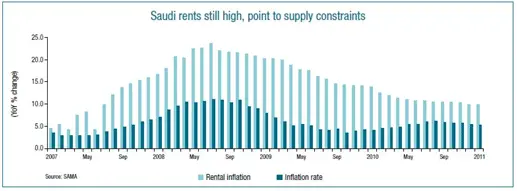
14. The housing sector in Riyadh and Jeddah is witnessing a rise in rents, making housing expensive for majority of the population. Samba estimates that rents in Saudi Arabia are rising by 9% per annum. In Riyadh rents for apartments rose 10% and 5% for villas.

15. The eastern province, which is where the majority of oil developments are located along with the headquarters of Saudi Aramco, is also suffering from acute housing shortage.

"Across the key residential development schemes in the Greater Dammam area, approximately 11,500 residential units will be offered to the market by 2015," notes a Cluttons report.
"In addition to these organised developments, there are numerous small developments of a handful of properties, being developed by local building contractors and individuals.
16. The government has committed to build one million housing units by 2014, which should meet 80% of demand in the Eastern province. Arabtec and Saudi Bin Laden have already agreed on a SAR5-billlion development to build 5,000 villas.
17. Banque Saudi Fransi (BSF) wrote late last year that the asking prices of both large and small villas in the eastern city of Khobar had increased by 4.6% and 6% respectively to SAR 1.9 and SAR 1.18 million.
18. In Jeddah, winter floods have added another dimension to housing. Most of the new supply in major projects comprise mid-market apartments appearing in the new sub-divisions running to the west of the Haramain Highway and along Prince Miteb. Villa developments are also being undertaken in the districts between Sary Street and the Ubhur Creek (Shatea, Zahra, Basateen), and north of Ubhur Creek along the west side of the Madinah Highway, notes JLL.
19. At King Abdullah Economic City, the Bay La Sun apartments developed by Emaar have opened this year, generally priced at over SAR 1 million. The next residential development within this project 'Hawadi' is much more affordable, offering a range of apartments and duplexes geared to the middle class incomes, priced between SAR 250,000 and SAR 750,000, according to JLL data.
20. Large districts in the south east of Jeddah have been set aside by the municipality for development of low-income housing. These areas will be needed to accommodate the population that will eventually be resettled from the Khozama and Ruwais districts that are to be redeveloped by public-private consortiums.
21. The government anticipates a total of 40,000 new housing units coming on line around the Jeddah area.
22. Global Investment House says execution risk for Saudi developers could aggravate the issue especially due to funding constraints.
23. "Land sales are highly volatile and unpredictable and form a key risk factor in forecasting revenues for Saudi real estate developers," writes Global in a report. "The application and the impact of the new package of laws concerning credit extension to real estate developers and the mortgage law could impact future dynamics."
24. Finally, political risk owing to the current upheavals across the MENA region impacts market activity and drives risk premiums higher, warns Global.
25. The Real Estate Development Fund ( REDF ) accounts for 81 per cent of loans to Saudis. Banks have to get more involved to ensure that the Saudi citizens have choice and better services.

MORTGAGE LAW: THE KEY TO RESOLVING HOUSING CRISIS?
The absence of a well-defined and articulated mortgage law is one of the hurdles impeding rampant growth in Saudi Arabia's real estate sector, but it is not the only reason.
Most Saudis earn around SAR36,000 a year, making housing difficult to afford, especially as most of the housing is focused on the high-end of the market.
"We see this pattern continuing in the foreseeable future as the largest share of units due for delivery remain highly priced for the low-mid income bracket," says Global in a report.
However, even if a mortgage law comes into place tomorrow, it will not be the silver bullet that will resolve Saudi Arabia's housing crisis.
"We remain skeptical on its capacity to deliver an efficient solution to the sector's vulnerabilities. Our view is devised given low base effect and limited reach owing to the disparity between the strict financial requirements expected from lenders and the wide base of inadequate borrowers."
Saudi government is looking to raise home ownership to 80% among citizens by 2024, according to a government strategy document.
Here is the simple math:
A Saudi national should have an annual salary of SAR110,508 to be able to qualify for 20-year mortgage loan with 90% financing on a SAR550,000 house. That's beyond the reach of an overwhelming majority of the country.
"This shrinks the addressable market significantly to less than 8% representing part of the upper two income quintiles. Accordingly, we anticipate a weak market response to the new laws as approved mortgage volumes remain low," writes Global in a report. "To counter this in the short term, we prefer seeing more funding extended to developers in order to accelerate construction progress.
"Yet the short-term housing scenario is complex and puts young Saudis at a disadvantage. The law's passage would have the immediate effect of spurring enthusiasm in Saudi property. But prevailing house asking prices and salaries place ownership out of reach for numerous public and private sector employees, especially those in the early years of their careers."
There are signs the state is striving to expedite the passage of a long-delayed mortgage law which, by delineating the rights of borrowers and lenders, could over time encourage banks to expand the risk profile of their clientele, potentially heralding a wave of growth in consumer finance.
In the absence of a robust house financing market, the Real Estate Development Fund ( REDF ) must feel like Atlas with the country's entire housing worries on its shoulders.
The fund accounts for 81% of all financing and no wonder the Saudi King is pumping SR40-billion more capital into the fund.
Launched in 1974, the REDF has granted more than 600,000 private loans as well as 2,488 investment loans, with a total value of SR145.5 billion, resulting in the construction of 555,866 residential units, in around 396 cities and villages, according to the Ministry of Finance, which manages the fund.
Still, the waiting period to get an REDF is a jaw-dropping 18 years and while the King's new measures could bring it down, BSF thinks that it will still not be enough to bring the waiting period down to the government's target of eight years.

"Even with a smooth-running state state-funded home financing scheme, a serious issue of price affordability remains. REDF loan recipients receive up to SR300,000, which is not adequate to cover land and construction related costs of home building. In our H2 real estate survey, the median price of a large apartment in 12 Saudi districts in Riyadh, Jeddah, Khobar, Dammam and Dhahran was SR485,833, while for small villas it was SR1.06 million," says BSF, adding that under the new rules loans are raised to SR500,000, which would make it within the reach of many Saudis.
A 2008 NCB report also breaks down the affordability for average Saudi households at different income levels and notes the loan payment to income ratio for the purchase of a 225sqm apartment by a household to be 23% is very reasonable.

The Saudi housing market is set to change dramatically over the past few years. A big question mark however remains the unrest in the country. We have argued in another article (The King's Speech) that the Saudi government has responded to a political crisis with an economic bailout. And while housing is a crucial aspect of Saudi life, it is not the silver bullet that will solve all its citizens' needs and issues.
© AlifArabia 2011
Zawya Comment Policy
-
Zawya encourages you to add a comment to this discussion. You agree that when you add content to this discussion your comments will not:
1.1 Contain any material which is libelous or defamatory of any person, is obscene, offensive, hateful or inflammatory or causes damage to the reputation of any person or organisation.
1.2 Promote sexually explicit material, violence, discrimination based on race, sex, religion, nationality, disability, sexual orientation or age or any illegal activity.
1.3 Be made in breach of any legal duty owed to a third party, such as a contractual duty or a duty of confidence.
1.4 Be threatening, abuse or invade another's privacy, or cause annoyance, inconvenience or needless anxiety.
1.5 Be used to impersonate any person, to misrepresent your identity or affiliation with any person, or be likely to deceive any person.
1.6 Give the impression that they represent Zawya.
1.7 Advocate, promote or assist any unlawful act such as (by way of example only) copyright infringement or computer misuse. - The content posted on www.zawya.com is created by members of the public. The views expressed are theirs and unless specifically stated are not those of Zawya. Zawya reserves the right to review all comments prior to posting and edit or delete any contribution, but Zawya is not responsible for and can not be held liable for any content posted by members of the public on www.zawya.com.
- Zawya is not responsible for the availability or content of any third party sites that are accessible through www.zawya.com. Any links to third party websites from www.zawya.com do not amount to any endorsement of that site by Zawya and any use of that site by you is at your own risk.
- By submitting your comment, you hereby give Zawya the right, but not the obligation, to post, air, edit, exhibit, telecast, webcast, re-use, publish, reproduce, use, license, print, distribute or otherwise use your comments worldwide, in perpetuity.
Comments By Our Users (1)
Interesting
Post Your Reply
Copyright © 2012 Zawya Ltd. All rights reserved. |
provided by www.zawya.com |


Post Your Comment