Central Asia will outperform other Eurasian regions in 2013, although growth is slowing, according to the European Bank for Reconstruction and Development.
"In most of Central Asia, economic growth continued decelerating in response to the global economic slowdown, combined with one-off exogenous factors (including poor agricultural harvests and a gold mine strike in the Kyrgyz Republic)," said the EBRD in its 2013 outlook for the emerging economies in the wider Europe-Asia region that it covers.
The slowdown in the economies of major Central Asian trading partners such as Russia, China, Turkey and the European Union are also likely going to impact economic growth.
Mongolia (16%) and Turkmenistan (10%) will be the fastest-growing economies in the region, posting blistering growth on the back of hydrocarbons and mineral resources.
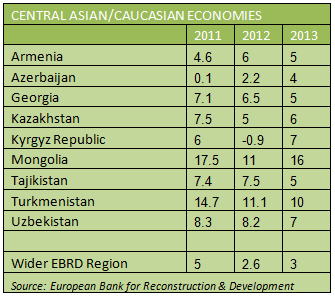
While Mongolia is basking in a mining boom, Turkmenistan is expected to maintain its double-digit growth on the back of large public-sector projects and increased gas exports.
"Turkmenistan continues to experience a buoyant economic expansion with GDP growth of 14.7% in 2011 and around 11% in 2012, driven by large public construction projects and increased gas exports to China and Iran," said the EBRD.
"GDP growth is expected to reach 10% in 2013 and remain strong over the medium term, supported by exploration of Turkmenistan's abundant gas reserves and further diversification of export routes. Overall inflation remained moderate, even though price of bread increased threefold in July 2012 following a poor harvest."
Kazakhstan (6% GDP growth) and Uzbekistan (7%) are also expected to post impressive growth compared to their regional counterparts, although external factors will likely dampen the exuberance of most Central Asian economies.
But there are signs that the wider region is bottoming out and it will lift growth across the wider geographical area.
"Growth in the transition region continued to slow down in the third quarter of 2012, but the deceleration is showing signs of bottoming out," said the EBRD.
"We estimate that GDP growth in the transition region has dropped to 2.6% last year from 4.6% cent in 2011 and will moderately rise to 3.1% this year. Downside risks to the outlook have continued to recede as the likelihood of further deterioration of the Eurozone crisis diminishes."
Keeping unemployment in check
Most importantly, unemployment levels in Central Asia remain in single-digits, compared to other places in the wider Eurasian region.
Unemployment in places like Tajikistan (2.5%) and Kazakhstan (5.3%) are manageable, compared to the high double-digits joblessness rates in emerging South Eastern Europe states and Central European economies.
However, Georgia's unemployment has hit a troubling 15%, as the economy enters a new election cycle.
"As the external financing package mobilized by a range of donors during the twin crises of 2008 has largely been exhausted, the new authorities' challenge will be to mobilize private sources of financing for supporting investment in key sectors," said the EBRD.
"Uncertainty about the external environment has been mitigated by a precautionary arrangement with the IMF. Further normalization of trade relations with Russia should help support export-led growth over time."
Indeed, while the Mediterranean and Central European emerging economies look towards the European Union for growth, Central Asian and Caucasian economies will pins their hopes on Russia.
"A possible further deterioration of the Eurozone crisis still poses the largest downside risk to the outlook," said the EBRD. "The weaker Russian economy would in turn seriously impact the non-commodity exporting countries of the CIS [Commonwealth of Independent States]."
Hope on the Big Brother
Russia is itself going through a period of economic growth after enjoying a strong few years as crude oil prices soared. The International Monetary Fund expects the economy to moderate to 3.7% as commodity prices decline and government expenditure rises as president Vladimir Putin continues to spend and the country prepares for major sporting events in 2014 and 2018.
"Against an improving global backdrop, the economy is expected to grow in line with potential in 2013, though with downside risks," said the IMF in a January 23 report on the country.
"The outlook is for moderate growth of about 3.7% this year, reflecting expectations of flat oil prices, still-weak external demand, rising imports, and moderating internal demand."
But the Fund warns that downside risks "are significant", especially as a worsening global economy would affect Russia primarily through the oil price channel.
"Domestic risks include further delays in reforms and a negative impact from rapid unsecured retail credit growth on private sector balance sheets."
While the IMF is worried about structural reforms in Russia, other crucial indicators suggest the economy is set to perform quite well.
Latest data from the Russian statistical agency shows that the number of citizens with disposable monthly incomes in excess of RUB 45,000 (USD 1,500) rose by more than three million or by some 25.5% to reach an all-time high of 14.9 million in 2012.
The unprecedented rise in living standards is bound to have a major impact on consumption patterns.
"This growing affluence of the average Russian consumer is the key driver behind structural improvements in consumer demand, supporting strong growth in demand for high-value goods and services, which we expect to continue," wrote Vladimir Osakovisky, an analyst with Bank of America Merrill Lynch. "This also helps explain surprisingly robust demand data in some segments, despite a continued slowdown in the broader economy."
These consumption indicators bode well for Central Asian economies that rely on a prosperous Russian economy for remittance, trade and exports.
"Persistent strength of consumer demand will likely be a good base for a broader economic recovery later in the year, when we expect consumer demand strength to be supported by the expected rebound of demand in the key export markets," said Osakovisky.
What's good for the Russian economy is likely good for its Central Asian trading partners.
© alifarabia.com 2013