Gabon's financial problems have been vastly exaggerated. An erroneous news report late last month suggested Gabon's government had suspended salaries of government employees as it did not have adequate funds.
The news, which was later rectified, was met with great alarm by investors as the country is Africa's fifth largest oil producer and had secured USD 1.5 billion as recently as December.
Although the government is trying to cut public-sector wage bill, there is no threat to its credit or its ability to pay its bills and public sector wages.
"Higher capital expenditure, as public-sector investment is ramped up, should see some deterioration in the fiscal balance near-term," said Victor Lopes, analyst at Standard Chartered Bank. "We expect a 2014 deficit of 2.5% of GDP. However, efforts to contain the public-sector wage bill - and thereby deal with a long-standing weakness within Gabon's credit metrics - should be positively received in the medium term." Gabon's major problem is not lack of funds, but the slow pace of diversification.
Analysts expect the country's GDP to expand by 6-7% per annum over the medium term, but the oil sector dominates the economy, accounting for 80% of exports, 45% of GDP and 60% of budget revenue.
To diversify its economy and transform Gabon into an emerging market economy by 2025, the government has launched an investment initiative, the "Strategic Plan Gabon Emergent" (PSGE).
Overall, USD 12 billion worth of infrastructure outlays are planned for the 2010-16 period focused on the non-oil sector.
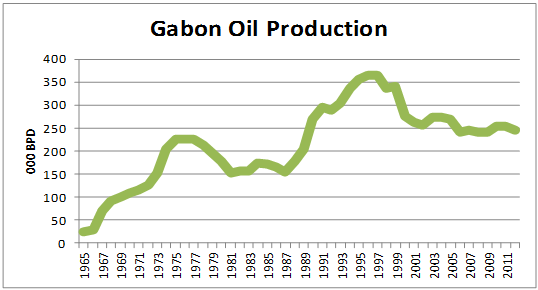
The diversification policy is crucial. Gabon's crude oil production has declined by around 34% from its peak in 1997 and, unless large discoveries are made, output will continue to decline over the medium to long term.
"In addition, the process of economic diversification and reform has been very slow, and issues such as a challenging business environment, limited economic freedom, widespread corruption, a narrow skills base, a low level of competitiveness, and opaque policy-making continue to hamper private sector and non-oil economic development," noted KPMG. "As a result, the economy has remained undiversified and susceptible to oil price shocks and the almost inevitable decline in oil production."
FOREIGNERS DOMINATE OIL SCENE
Gabonese government has not helped matters with greater say in the sector.
The government created a state-owned oil company, Gabon Oil Company in June 2011, in a bid to increase the government's involvement in oil production by taking equity stakes in future awards.
Currently, Gabon's oil sector is dominated by foreign oil companies. The four largest production entities are Total, Shell, Perenco and Addax Petroleum, but some of the companies are facing problems.
In February, the Gabonese government ordered French oil company Total SA to pay USD 805 million in back taxes. Gabon has also secured Addax Petroleum, a unit of China's Sinopec, a USD 400 million tax due to the government.
"Headlines concerning litigation against certain oil companies that the government claims have not complied with local rules are unlikely to deter future investment."
Despite the regulatory challenges faced by investors, Gabon's political outlook remains stable, with the next elections expected to be held in 2016.
"The government was reshuffled in January 2014 but we do not expect any major changes in economic policy," said Standard Chartered Bank. "Rather, the reshuffle was seen as a way of providing new impetus to government action.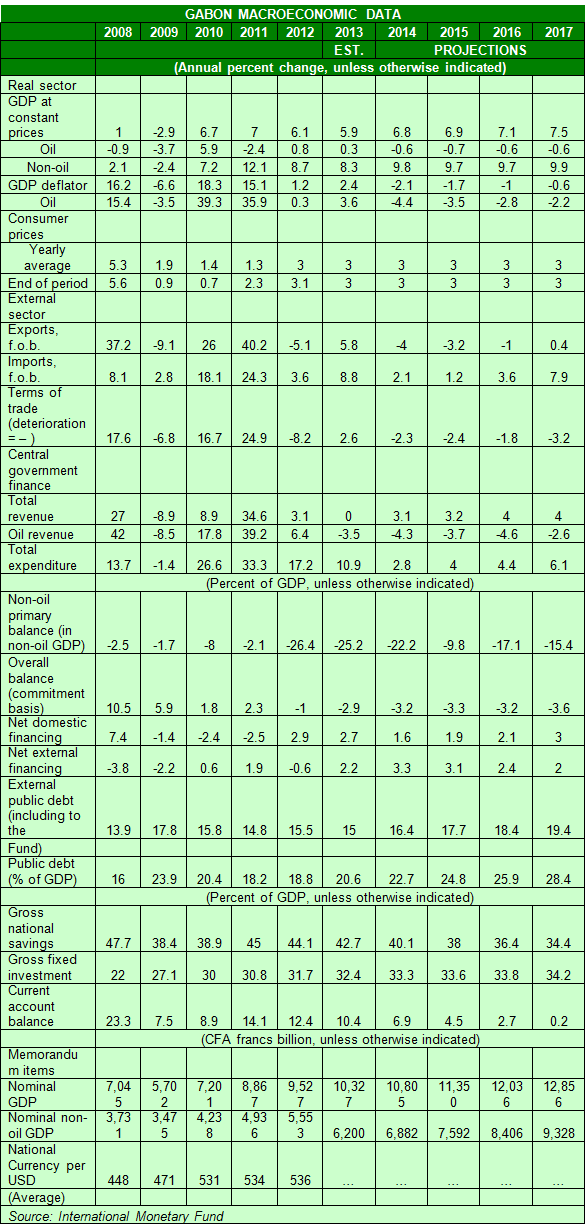
JOBS FOR GABONESE
Although Gabon's non-oil economy has grown by an average of 5% in recent years, the country has not created enough jobs for the rapidly growing population. Unemployment has reached 20%, with an estimated 36% of youth unemployed.
"The high level of unemployment reflects both a skills mismatch and a poor business environment," according to the International Monetary Fund. "Less than 8% of students receive technical education, leading to a severe shortage of these types of workers in the labor market."
The country is looking to monetize other mineral sources, but has had little luck so far. In February, the government cancelled a project to develop iron-ore deposits with China Machinery Engineering Corp. due to lack of progress. The government is now seeking partners to develop the deposit that could yield as much as 30 million metric tons of the raw material that's used to make steel.
The government believes a large amount of its revenue will stem from increased mining and oil proceeds, and mining output is expected to increase by almost 15% this year on the back of continued expansion in the manganese and gold mining sectors and as new investment flows into the economy.
"We anticipate that Gabon's net FDI will be historically elevated over the next few years as international firms invest in the local oil industry as well as in the special economic zones. We forecast that net FDI will increase to 4.1% of GDP this year, from 3.4% of GDP in 2012, before receding to 3.5% of GDP next year," said KPMG.
The management consultancy notes that Gabon's GDP growth will be underpinned by the massive infrastructure spending spree over the medium term.
"Nevertheless, the degree to which the infrastructure spending spurs diversification and growth in the non-extractive sectors will dictate where Gabon's economy will be in 10 years' time."
The World Bank also approved a USD 18 million loan to help Gabon diversify its economy and create jobs for 25,500 Gabonese - of which majority are expected to be women - over the next five years.
"Recognizing the drop in oil reserves, the government is centering its new strategy on diversifying the economy by improving the investment climate, developing skills, and providing assistance to small and medium-size businesses," said Zouera Youssoufou, World Bank country manager for Gabon.
The feature was produced by alifarabia.com exclusively for zawya.com.
© Zawya 2014