08 June 2006
With the recent addition of a hydrocarbon terminal to the list of services to be provided by Morocco's developing Tanger-Med port, the project is attracting investors who are looking beyond the port to the potential of the kingdom.
On May 22, the Tangier Mediterranean Special Agency (TMSA), the company managing the project, awarded a concession to build and operate a hydrocarbon terminal at the Tanger-Med port to Horizon Terminals Limited (HTL), which is a consortium grouping of the United Arab Emirates, Afriquia SMDC of Morocco and the Independent Petroleum Group (IPG) of Kuwait.
A TMSA communiqu stated that according to the 25-year concession convention, the consortium is committed to invest $32.3m before starting operations in December 2008.
The concession provides for designing, funding, equipment, tapping and maintenance of the terminal, that is to comprise of an oil post in deep water and a 308,000-cu-metre storage facility. The terminal will also serve as a supply platform to the local market and to shipping.
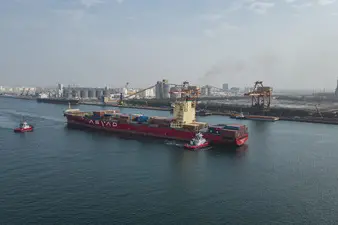
The Tanger-Med port is located at the Strait of Gibraltar, just 15 km from Europe and 35 km from Tangiers.
Its strategic location, at the crossing of two major maritime routes, will enable it to serve a market of hundreds of millions of consumers through its industrial and logistics free zones, which will be run by well-known private operators.
It will also corner a significant part of the container market, which is expected to grow by 50% to 100% between 2006 and 2012, with traffic at Tanger-Med expected to reach 2m 20-foot equivalent units (TEUs) by 2012.
Tanger-Med also aims to become the leading hub for cereal transhipment, a facility which is non-existent in the north-west African region at present.
The project is divided into several concessions covering the operating zones of the two container wharfs, the cereal wharf, the Ro-Ro terminal, the hydrocarbon wharf and the logistics free zone.
The high-profile project as a whole will require a total investment estimated at Dh11bn ($1.3bn), with $520m earmarked for building and equipping the deep-water port, $280m for facilities in the free zones, $410m for connection and transport infrastructure, and $120m for off-site work to connect the port to utilities networks.
The Tanger-Med project - which aims at positioning Tangiers as a global hub for maritime transport - is a strategic priority for the economic and social development of Morocco's northern region. It is part of Morocco's export-oriented strategy, which focuses on eight clearly identified export sectors, with particular emphasis on the Association Agreement with the EU to be fully implemented by 2012, and the free trade agreement (FTA) with the US, which came into force in January 2006.
The overall goal of the project is to significantly reduce transport costs for the kingdom.
According to Said El Hadi, TMSA's chairman of the board of directors, the decrease in transport costs could top 40% for specific routes. Yet it is still unclear how this will actually impact the country's average transport costs, as this will depend on the quality, reliability and cost of the connections between Tanger-Med and the rest of the country, as well as on the re-organisation of traffic once the project is realised.
In addition, the new port will spur the opening of new maritime routes, thus cutting average transport time to the US from three weeks to around one week, and to Asia from the present five to six weeks to just three to four weeks.
Meanwhile, the Ro-Ro terminal is expected to ease the flow of merchandise to and from Europe, thus significantly reducing transport time and costs. In addition, TMSA expects the port itself to generate up to 12,000 direct and indirect jobs, $180m in value-added and private investments worth $240m.
The port's 130-ha logistics free-zone will be managed for the first 10 years by Jafza, the company which manages the highly successful Jebel Ali free zone in Dubai. With this move, TMSA is aiming to benefit from Jafza's operational know-how, experience and commercial network. The logistics free-zone will target the EU and North and West African markets for transhipment, storage, packaging and labelling, as well as electronics products assembling. Further encouraging investment in the kingdom, TMSA has plans to develop its own 600-ha industrial free-zone.
While in the first stage of development, this will be coupled with the existing Tangiers Free-Zone (TFZ), expected to be realised in 2009.
TMSA hopes that the new free-zones will generate up to 100,000 jobs in the long run, as well as $240m in value-added and private investments worth up to $1.2bn.
With work progressing on schedule, and high-profile partners taking an interest in the project, Moroccan businesses are looking forward to the port's opening, which could be as early as July 2007 for the first container terminal, while the second terminal is expected to launch operations in May 2008.
With the recent addition of a hydrocarbon terminal to the list of services to be provided by Morocco's developing Tanger-Med port, the project is attracting investors who are looking beyond the port to the potential of the kingdom.
On May 22, the Tangier Mediterranean Special Agency (TMSA), the company managing the project, awarded a concession to build and operate a hydrocarbon terminal at the Tanger-Med port to Horizon Terminals Limited (HTL), which is a consortium grouping of the United Arab Emirates, Afriquia SMDC of Morocco and the Independent Petroleum Group (IPG) of Kuwait.
A TMSA communiqu stated that according to the 25-year concession convention, the consortium is committed to invest $32.3m before starting operations in December 2008.
The concession provides for designing, funding, equipment, tapping and maintenance of the terminal, that is to comprise of an oil post in deep water and a 308,000-cu-metre storage facility. The terminal will also serve as a supply platform to the local market and to shipping.
The Tanger-Med port is located at the Strait of Gibraltar, just 15 km from Europe and 35 km from Tangiers.
Its strategic location, at the crossing of two major maritime routes, will enable it to serve a market of hundreds of millions of consumers through its industrial and logistics free zones, which will be run by well-known private operators.
It will also corner a significant part of the container market, which is expected to grow by 50% to 100% between 2006 and 2012, with traffic at Tanger-Med expected to reach 2m 20-foot equivalent units (TEUs) by 2012.
Tanger-Med also aims to become the leading hub for cereal transhipment, a facility which is non-existent in the north-west African region at present.
The project is divided into several concessions covering the operating zones of the two container wharfs, the cereal wharf, the Ro-Ro terminal, the hydrocarbon wharf and the logistics free zone.
The high-profile project as a whole will require a total investment estimated at Dh11bn ($1.3bn), with $520m earmarked for building and equipping the deep-water port, $280m for facilities in the free zones, $410m for connection and transport infrastructure, and $120m for off-site work to connect the port to utilities networks.
The Tanger-Med project - which aims at positioning Tangiers as a global hub for maritime transport - is a strategic priority for the economic and social development of Morocco's northern region. It is part of Morocco's export-oriented strategy, which focuses on eight clearly identified export sectors, with particular emphasis on the Association Agreement with the EU to be fully implemented by 2012, and the free trade agreement (FTA) with the US, which came into force in January 2006.
The overall goal of the project is to significantly reduce transport costs for the kingdom.
According to Said El Hadi, TMSA's chairman of the board of directors, the decrease in transport costs could top 40% for specific routes. Yet it is still unclear how this will actually impact the country's average transport costs, as this will depend on the quality, reliability and cost of the connections between Tanger-Med and the rest of the country, as well as on the re-organisation of traffic once the project is realised.
In addition, the new port will spur the opening of new maritime routes, thus cutting average transport time to the US from three weeks to around one week, and to Asia from the present five to six weeks to just three to four weeks.
Meanwhile, the Ro-Ro terminal is expected to ease the flow of merchandise to and from Europe, thus significantly reducing transport time and costs. In addition, TMSA expects the port itself to generate up to 12,000 direct and indirect jobs, $180m in value-added and private investments worth $240m.
The port's 130-ha logistics free-zone will be managed for the first 10 years by Jafza, the company which manages the highly successful Jebel Ali free zone in Dubai. With this move, TMSA is aiming to benefit from Jafza's operational know-how, experience and commercial network. The logistics free-zone will target the EU and North and West African markets for transhipment, storage, packaging and labelling, as well as electronics products assembling. Further encouraging investment in the kingdom, TMSA has plans to develop its own 600-ha industrial free-zone.
While in the first stage of development, this will be coupled with the existing Tangiers Free-Zone (TFZ), expected to be realised in 2009.
TMSA hopes that the new free-zones will generate up to 100,000 jobs in the long run, as well as $240m in value-added and private investments worth up to $1.2bn.
With work progressing on schedule, and high-profile partners taking an interest in the project, Moroccan businesses are looking forward to the port's opening, which could be as early as July 2007 for the first container terminal, while the second terminal is expected to launch operations in May 2008.
© Oxford Business Group 2006