Inflations rates in Kuwait will continue to rise due to importation of most commodities
Abundant liquidity and strong purchase ability keep inflation high
Relative drop in residential real estate in March
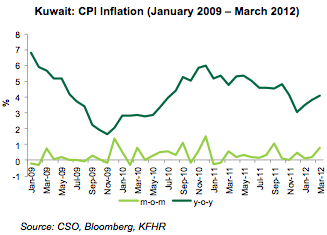
A report prepared by KFH-Research regarding consumption price index in Kuwait noted that the inflation rate has increased in March to reach 4.1% compared to 3.8% in February. This is the highest inflation rate in Kuwait during the past four months. The report added that the constant increase in prices of food items is the main reason behind increase in rates of inflation.
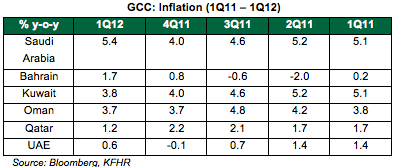
Kuwait's consumer price index (CPI) based inflation rose to 4.1% y-o-y in March 2012 from 3.8% y-o-y in February 2012, mainly driven by higher food prices, according to the Central Statistical Office (CSO) of Kuwait. In 1Q12, average inflation rate is 3.8% y-o-y as compared to 4.0% y-o-y in 4Q11. On a monthly basis, inflation rose by 0.8% in March 2012 from 0.2% in February 2012.
A Four-Month High
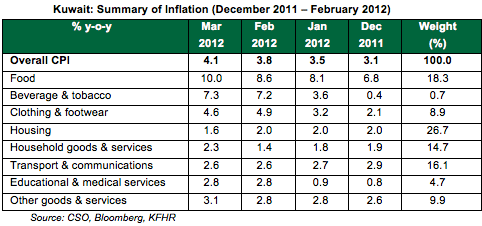
The food segment (which attributes 18.3% of CPI basket) rose to 10.0% y-o-y during March 2012 from 8.6% y-o-y in February 2012 (lowest level: 0.7% y-o-y in August 2009). Soaring food price in Kuwait is in line with the rising trend of global food prices. In tandem with food prices, beverages and tobacco prices (0.7% of CPI basket) inched up to 7.3% y-o-y in March 2012 (February 2012: 7.2% y-o-y).
On the other hand, household goods and services segment prices (14.7% of CPI basket) increased to 2.3% y-o-y in March 2012 (February 2012: 1.4% y-o-y). Other goods and services segment prices (9.9% of CPI basket) also rose to 3.1% y-o-y in March 2012 (February 2012: 2.8% y-o-y). This indicates that domestic demand in Kuwait is still strong.
In contrast, prices of housing segment (largest portion of CPI basket at 26.7%) eased further to 1.6% y-o-y in March 2012 from 2.0% y-o-y in February 2012 due to lower rents following excess supply in both the commercial real estate and residential sectors.
Meanwhile, transport and communications segment prices (16.1% of CPI basket) remained unchanged at 2.6% y-o-y in March 2012 from the previous month supported by government's fuel subsidy system. Similarly, educational and medical services segment prices (4.7% of CPI) also remained unchanged at 2.8% y-o-y in March 2012 (February 2012: 2.8% y-o-y).
Food Price Pressure in the GCC
Similar like other GCC countries, the rise in Kuwait's overall inflation is mainly driven by higher food prices. For example, Saudi's inflation rate stood high at 5.4% y-o-y in March 2012 (February 2012: 5.4% y-o-y), while Bahrain's inflation rate was high at 4.7% y-o-y in March 2012 from 0.4% y-o-y in February 2012. The GCC imports most of its food items for domestic consumption which leads to imported food price pressure. The rising global food prices pass through local value chains in the GCC and leads to higher inflation. Food and beverage producers are now looking to push higher commodity prices up the value chain where ultimately the cost will be borne by the consumer.
The FAO Food Price Index increased further to 215.9 points in March 2012 from 215.4 points in February 2012. After several months of declines, prices of rice recovered somewhat in March 2012, underpinned by large purchases by China and Nigeria. Weak growth in world palm oil production, limited global soy oil export availabilities and declining rapeseed production, all contributed to the rise in oils prices. Overall, sugar prices were volatile, as the market looked for direction ahead of the beginning of the new season in Brazil, the world's largest sugar producer and exporter.
World: Food Price Index (January 2000 - March 2012)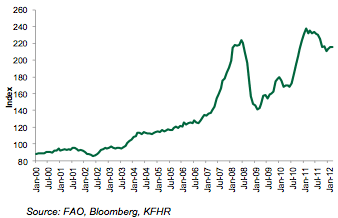
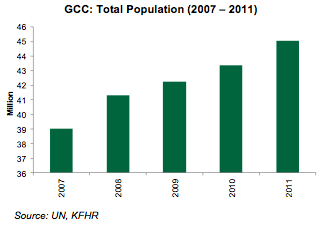
Based on the World Trade Organisation (WTO), the GCC is the biggest importer of food in the world by buying more than 90.0% of its total needs. The GCC's very high dependence on external food sources pushes the region to be vulnerable to global food price fluctuations. The food imports in the GCC have considerably risen in the last few years in tandem with rising population. GCC's population grew by 3.9% y-o-y to 45.1 million in 2011 from 43.4 million in 2010 and this upward trend is expected to continue in the coming years. To overcome the food shortages, some of the GCC countries such as Saudi Arabia and the UAE are already developing food processing units in some Asian and African countries. It is important to note that, production of food items locally within the GCC is not a viable option as it costs more than the import costs.
Besides global food price variations, the GCC is also susceptible to increasingly changing food policies of the exporting countries such as blanket ban on exports of certain food commodities which are scarce in those markets. Furthermore, weakening of the US dollar may increase the cost imports for the GCC. The GCC currencies float closely in value in relative to the US dollar as most GCC currencies are pegged to the US dollar.
Conclusion
Strong economic growth and better employment opportunities has increased income level and purchasing power among Kuwaiti nationals, thus inducing strong demand for goods and services. Moreover, the increased government spending on housing, job creation and social welfare improvement is expected to further add to liquidity and hence contribute to an added rise in inflation. Increasing liquidity signals potential demand-led inflation in future.
Due to rising global fuel and food prices and rising liquidity, we expect Kuwait's inflation to remain high at a range of 4.0%-4.5% y-o-y in 1H12. Nevertheless, inflation rate is expected to ease to 3.5%-4.0% y-o-y in 2H12 as the government's price control measures on fuel and food items through extensive subsidy system will prevent higher inflation in the future. At the same time, housing segment (largest component of Kuwait's CPI basket) is also expected to put a drag on overall inflation from rising above uncomfortable levels.
© Press Release 2012