Making room for Iran - assuming it could quickly ramp up production after years of sanctions - could be a challenge for other OPEC producers, especially in the face of rising non?OPEC supplies, according to the International Energy Agency.
Tehran's negotiation with six of the world's most powerful countries (United States, Russia, China, France, the United Kingdom and Germany) is moving along, raising hopes that Western powers may lift sanctions on the country.
Even though Iran has secured some relief on its sanctions, notably on petrochemical exports and maritime insurance, the United States and European Union restrictions on Iranian oil exports remain firmly in place. In turn, Iran has agreed to a temporary freeze on many nuclear activities as well as increased co?operation with the International Atomic Energy Agency. All parties agreed to use the six?month period covered by this interim accord to push toward a more permanent arrangement.
"While Tehran will find it easier to ship its oil, notably to India, the lifting of insurance restrictions does not open the floodgates for Iran oil exports," said the IEA. "Tanker tracking data show that Iran took as much as 15 million barrels out of floating storage last month, but such draws do not necessarily equate to incremental exports."
"Washington has made clear its determination to enforce oil sanctions as vigorously as ever. On 29 November, it renewed sanction waivers for Iran oil importers, a clear signal that imports of Iranian oil would remain under scrutiny. China, which had no hand in designing either the US or EU sanctions, came closer to implicitly endorsing them by becoming a full signatory of the Geneva deal."
NO NEW OIL
Indeed, the Energy Information Administration, the US Department of Energy's statistical arm, estimates that new oil from Tehran will not be forthcoming any time soon."The imposition of sanctions on associated insurance and transportation services by the European Union had a significant effect on Iran's exports when implemented in July 2012, but Iran has been able to create arrangements that allow it to export limited quantities of oil to several countries," the agency said.
"EIA does not anticipate those countries significantly increasing their oil imports from Iran, so without an easing of sanctions covering Iran's ability to sell additional oil, the country is unlikely to significantly increase its production or exports in the short term."
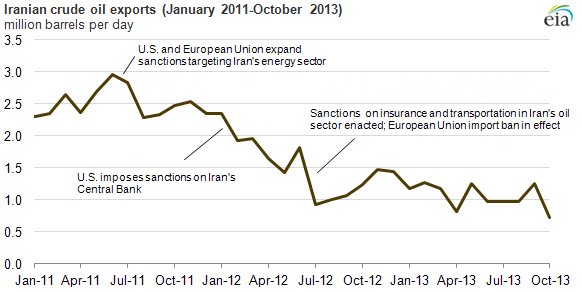
Iran's crude output, which hit 3.98 million barrels per day in 2007, has seen its production scale back to around 2.68 million barrels per day in October, but even a quick relief from the sanctions would not see Iran returning to those levels due to the country's dilapidating energy infrastructure.
"Even if sanctions on Iranian oil were eventually relaxed, meaningful increases in production would require a longer period and additional investment in Iran's upstream, and thus would take time to materialize," the Paris-based IEA said.
AMBITIOUS TARGET
The Iranian oil minister recently expressed a desire to conduct business with major oil companies and even met with the CEO of Italian oil giant Eni SPA, as the country is eager to reinvigorate its energy sector.
It is also looking to boost revenues.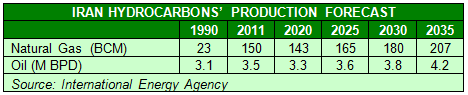
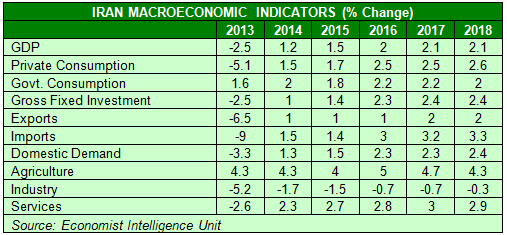
Last year, the country earned significantly less than the USD 95 billion it earned from oil revenues in 2011, as the Iranian rial shrank. The economy contracted by nearly 2% in 2012 and another 1.5% in 2013, with only mildly positive growth prospects of 1.3% in 2014.
The new administration under moderate president Hassan Rouhani is looking to bring confidence back into the economy and lay the groundwork for international companies to return to the country and stimulate private sector involvement.
"Targets for increasing gas output are ambitious in the current investment and political climate, and we expect oil production to stagnate in 2014-18 as long as sanctions remain in place," said the Economist Intelligence Unit. "Nevertheless, were more technologically advanced international companies to invest in the sector, Iran's hydrocarbons production could change direction dramatically, particularly the country's relatively under-exploited natural gas reserves."
Indeed, Iran has signaled its intention to increase its crude oil production at the recently concluded OPEC meeting on December 4 in Vienna, Austria. Given that Iraq also pledged to raise its crude production, the new surge in production presents a challenge to other OPEC producers.
"Many market commentators have speculated that fast?rising production from US light, tight oil formations and other sources could put pressure on OPEC's crude oil output in 2014," the IEA said.
A stable Iran's return to the oil market is good for global economy as it raises the supply and reduces the political premium on crude, but it may lead to adjustments among fellow OPEC producers such as Saudi Arabia, Kuwait and the UAE which have benefited from rising exports at the expense of other member countries.
"In the extreme case where non-OPEC production strengthens next year, and Libya and Iran partially recover, the global oil supply demand balance could see a swing of 2-3 million b/d. The potential return of Libyan and Iranian oil could thus significantly exacerbate the surplus, triggering additional downside in Brent crude oil prices," said Bank of America Merrill Lynch in a recent report.
alifarabia.com 2013