Uzbekistan's ranking as the 7th most corrupt nation in the world tells the story.
Transparency.org's data shows that the Central Asian state ranked 170th among 176 nations in its annual corruption perception index, and underlines the harsh business environment awaiting investors.
Scores of international companies are reporting problems with Uzbeki partners, and complaining of forced stealing of shares with little chance of support from the authorities. News agency Deutsche Welle recently reported a German candy manufacturer who was robbed of his shares from his company by a powerful Uzbeki family.
Other German construction companies have also complained they have not been paid EUR 60 million for work completed on a convention center in the capital city of Tashkent.
Meanwhile, Russia's biggest telecom operator Mobile TeleSystems (MTS) has seen its Uzbeki mobile operating license suspended after the company was accused of violating Uzbeki telecom laws.
The company has written off USD 1.1 billion for most of its assets in Uzbekistan and its subsidiary has filed for bankruptcy after it was ordered to pay USD 600 million by a court. MTS denies any wrongdoing and is hopeful it can return to Uzbekistan in the future.
Other cases of expropriation involving foreign investors include the seizures of Wimm-Bill-Dann Foods, a Russian-owned milk processing factory in 2010, and Turkuaz, a Turkish chain grocery store in 2011.
Meanwhile, Oxus Gold, a UK-listed mining company saw its assets seized in Uzbekistan. The company was involved in the 192-square kilometer Amantaytau Goldfields (AGF) license area in Uzbekistan. The company says that certain licenses and permits essential for AGF's ongoing operations were not renewed.
"Oxus' wholly-owned subsidiary, Oxus Resources Corporation was forced to declare a force majeure under the AGF-JV agreements as it was no longer able to manage AGF and fulfill its obligations," the company said in a statement.
"International arbitration is being pursued by the company to seek compensation for the Group."
'High risk' for investors
Maplecroft, a risk management consultancy, considers Uzbekistan a 'high risk' country and ranks it 13th out of 197 states it measures in its Resource Nationalism Index 2013.
"Officially, the Uzbek government welcomes foreign investment, but in reality it does not live up to its regulatory guarantees," notes Maplecroft in a report on the country. "Heavy government intervention in key economic sectors, however, poses significant restrictions on foreign investment."
The country also fares poorly in World Bank's Doing Business survey, and is ranked 154 out of 185 countries, with an unsatisfactory ranking in protecting investors (136th) and last in international trade.
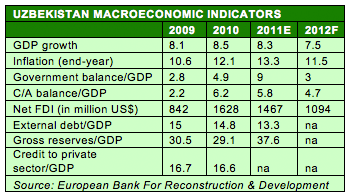
These statistics are masked by high economic growth in the country, primarily on the back of higher commodity exports.
"GDP grew by 8.3% in 2011 and by 8.2% through September 2012, boosted by high prices of major export commodities, and policies focused on domestic consumption and state-led investment," the IMF said. "Growth has been led by services, transport and communication, agriculture, and industry. The external position remains strong and the current account is in surplus despite the recent drop in gold exports."
But it is unclear how long Uzbekistan can continue to register growth when its business and legal framework are weakening further.
The European Bank for Reconstruction and Developments notes that the energy sector remains largely unreformed and state controlled and has only recently embarked on a program of efficiency improvements.
"However, implementation of this program is complicated by obsolete equipment that requires substantial investment for modernization and reconstruction."
Despite their long-term structural challenges, oil and gas reserves remain of interest to foreign investors, Maplecroft said.
"Presenting direct risks to investors in the extractive sector, however, is the propensity for appropriation of property of foreign firms. Indeed this is a risk that appears to be on the rise."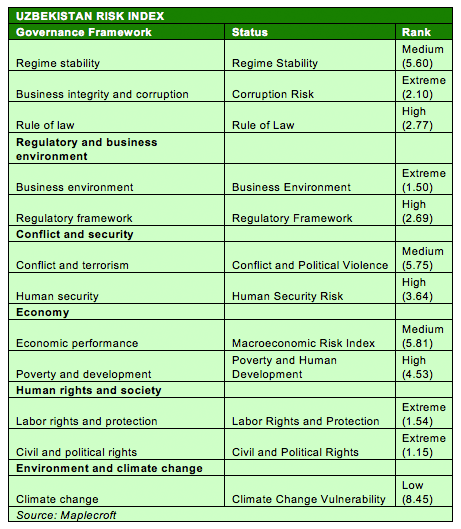
New privatization program
Despite the troubling state of the country's business environment, the government has unleashed a privatization program. Tashkent is offering close to 500 public corporations including oil and gas and mining companies to foreign and domestic investors.
"While this program could signal the beginning of a renewed transition process, the prospects are still uncertain given previous privatization announcements that did not materialize," notes the EBRD.
"Major investment programs and projects will be supported by the Fund for Reconstruction and Development into which the government has accumulated nearly USD 10 billion."
While the government has made some effort to reform the banking sector and implement a number of other business improvements, most analysts agree more needs to be done.
"The government is expected to keep economic growth high at around 8% in 2012 and 2013, with the help of continued large government spending," said EBRD.
"In the medium-to-long term, however, Uzbekistan's growth prospects will likely be constrained by the slow progress with structural reforms, continued directed lending practices by the state, limited currency convertibility and continued disengagement with international financial organizations."
© alifarabia.com 2013