19 October 2011
Dubai and Abu Dhabi find themselves at the opposite end of the sovereign debt spectrum.
While Dubai continues to remain in the list of the ten riskiest 'sovereigns' in CMA Datavision's quarterly update, Abu Dhabi is now seen as among the ten safest sovereign debt.
CMA provides independent, intraday pricing on approximately 1,400 CDS and CDS indices, and is widely used by traders, risk managers, treasurers and researchers in financial institutions.
The data shows that Dubai is the tenth riskiest sovereign with a 30.4% chance of a default, while Abu Dhabi is the tenth least risky sovereign with an 8.4% chance of a default.
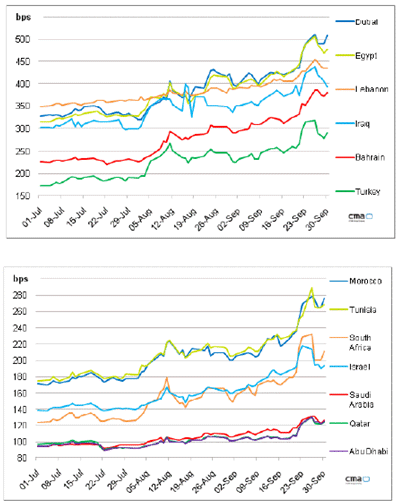
"The Middle East observed gradual widening of spreads this quarter as the emerging markets in general saw a gradual reduction of risk by the market in Q3. All spreads spiked up in the last week of September," says the CMA quarterly report. "Qatar and Abu Dhabi remain relatively stable, with Abu Dhabi entering the top 10 least risky table."
The dichotomy between Abu Dhabi and Dubai risks is peculiar, given that the market appears to think that Abu Dhabi's secure debt position does not mean it will bail out Dubai. The more opportunistic don't believe that scenario and are calling on investors to buy the emirate's debt.
See story here: Buy Dubai Debt
Meanwhile, Saudi Arabia also emerged as one of the least risky sovereigns, one rung higher than Abu Dhabi.
Other regional countries do not appear to be eliciting similar confidence among investors. Saudi neighbour Bahrain saw its spreads jump significantly over the third quarter, as it did Egypt as both countries continue to suffer from deteriorating political conditions.
There is a good chance Egypt could see spreads widen even further.
On October 18, Standard & Poor's cut Egypt's rating to BB- from BB.
"Risks to macroeconomic stability have risen during the transition period for Egyptian political reform, which we expect to evolve over the next two years," analyst Trevor Cullinan said.
The ratings service noted that legitimate and pressing public expectations for improved living standards that will likely prompt the government to continue to spend, adding to budget deficits and inflation risks.
Moody's ratings agency also stated that Egypt's government offer to resign (which was later withdrawn) is also a 'credit negative' for the Arab World's most populous country.
"The economy is struggling to find its footing. GDP contracted 4.2% in first-quarter 2011, although it stabilized somewhat in the April-June period. Direct investment in Egypt by foreigners completely collapsed in the first half of 2011, recording a small net outflow, and tourist arrivals were down 42.3% in the March-June period from the same months in 2010. The IMF sees growth remaining at an anaemic 1%-2% annual rate this year and next," Moody's states grimly in its report on Egypt on October 16.
Greece most likely to default
If it makes Egyptian feel any better than always cast a glance to their north, towards the EU States, where Greece and Portugal find themselves in the dubious position as the two countries in the world most likely to default.
Italy and Hungary also found themselves in the list of top 10 most risky sovereigns as the cost of protection rose significantly across all global credit markets.
"The markets are pricing in an almost certain default event in Greece as the upfront cost of protection peaked at 63% vs. 100 coupon - implying a recovery level below 40% (CMA now assume 32% recovery)," the report states.
Venezuela, Argentina, Pakistan and Ukraine remain in the top 10 riskiest as emerging market economies also came under pressure this quarter, as investors fled all risky assets.

Safe as Saudis
Fittingly, Saudi Arabian debt is seen as the safest in the region, and ninth least risky overall, with Abu Dhabi not far behind, ranked as the tenth safest sovereign debt in the world.
The two Arab states have found themselves in good Nordic company. Norway is the least likely sovereign in the world to default, with Sweden third and Finland in fifth position.Surprisingly, the United States jumped from the seventh least risky to second least risky in the third quarter, CMA data shows.
Seems like the market did not get the memo that Standard & Poor's had downgraded the United States and taken away its golden-plated triple A ranking.
"The U.S. downgrade was already factored in by the credit markets in Q2 2011 as evidenced by its CDS Implied Rating of 'CMA_aa+', calculated by CMA last quarter. However, the actual downgrade of the world's largest economy to AA+ was not expected by the equity market (it was the first time in history that the U.S. has not been rated 'AAA') and precipitated a sell-off in global equity markets in August," notes CMA in the report.
Dubai and Abu Dhabi find themselves at the opposite end of the sovereign debt spectrum.
While Dubai continues to remain in the list of the ten riskiest 'sovereigns' in CMA Datavision's quarterly update, Abu Dhabi is now seen as among the ten safest sovereign debt.
CMA provides independent, intraday pricing on approximately 1,400 CDS and CDS indices, and is widely used by traders, risk managers, treasurers and researchers in financial institutions.
The data shows that Dubai is the tenth riskiest sovereign with a 30.4% chance of a default, while Abu Dhabi is the tenth least risky sovereign with an 8.4% chance of a default.
"The Middle East observed gradual widening of spreads this quarter as the emerging markets in general saw a gradual reduction of risk by the market in Q3. All spreads spiked up in the last week of September," says the CMA quarterly report. "Qatar and Abu Dhabi remain relatively stable, with Abu Dhabi entering the top 10 least risky table."
The dichotomy between Abu Dhabi and Dubai risks is peculiar, given that the market appears to think that Abu Dhabi's secure debt position does not mean it will bail out Dubai. The more opportunistic don't believe that scenario and are calling on investors to buy the emirate's debt.
See story here: Buy Dubai Debt
Meanwhile, Saudi Arabia also emerged as one of the least risky sovereigns, one rung higher than Abu Dhabi.
Other regional countries do not appear to be eliciting similar confidence among investors. Saudi neighbour Bahrain saw its spreads jump significantly over the third quarter, as it did Egypt as both countries continue to suffer from deteriorating political conditions.
There is a good chance Egypt could see spreads widen even further.
On October 18, Standard & Poor's cut Egypt's rating to BB- from BB.
"Risks to macroeconomic stability have risen during the transition period for Egyptian political reform, which we expect to evolve over the next two years," analyst Trevor Cullinan said.
The ratings service noted that legitimate and pressing public expectations for improved living standards that will likely prompt the government to continue to spend, adding to budget deficits and inflation risks.
Moody's ratings agency also stated that Egypt's government offer to resign (which was later withdrawn) is also a 'credit negative' for the Arab World's most populous country.
"The economy is struggling to find its footing. GDP contracted 4.2% in first-quarter 2011, although it stabilized somewhat in the April-June period. Direct investment in Egypt by foreigners completely collapsed in the first half of 2011, recording a small net outflow, and tourist arrivals were down 42.3% in the March-June period from the same months in 2010. The IMF sees growth remaining at an anaemic 1%-2% annual rate this year and next," Moody's states grimly in its report on Egypt on October 16.
Greece most likely to default
If it makes Egyptian feel any better than always cast a glance to their north, towards the EU States, where Greece and Portugal find themselves in the dubious position as the two countries in the world most likely to default.
Italy and Hungary also found themselves in the list of top 10 most risky sovereigns as the cost of protection rose significantly across all global credit markets.
"The markets are pricing in an almost certain default event in Greece as the upfront cost of protection peaked at 63% vs. 100 coupon - implying a recovery level below 40% (CMA now assume 32% recovery)," the report states.
Venezuela, Argentina, Pakistan and Ukraine remain in the top 10 riskiest as emerging market economies also came under pressure this quarter, as investors fled all risky assets.
Safe as Saudis
Fittingly, Saudi Arabian debt is seen as the safest in the region, and ninth least risky overall, with Abu Dhabi not far behind, ranked as the tenth safest sovereign debt in the world.
The two Arab states have found themselves in good Nordic company. Norway is the least likely sovereign in the world to default, with Sweden third and Finland in fifth position.Surprisingly, the United States jumped from the seventh least risky to second least risky in the third quarter, CMA data shows.
Seems like the market did not get the memo that Standard & Poor's had downgraded the United States and taken away its golden-plated triple A ranking.
"The U.S. downgrade was already factored in by the credit markets in Q2 2011 as evidenced by its CDS Implied Rating of 'CMA_aa+', calculated by CMA last quarter. However, the actual downgrade of the world's largest economy to AA+ was not expected by the equity market (it was the first time in history that the U.S. has not been rated 'AAA') and precipitated a sell-off in global equity markets in August," notes CMA in the report.
© alifarabia.com 2011