11 December 2011
Here's the good news for Middle East oil and gas developers: The world will still need plenty of oil by 2040. Oil will satisfy 32% of global energy demand by that time, from 34% in 2010 - that's a mere smidgen of a loss of market share in 30 years, which is not bad given the euphoria behind green energy.
And that's just in relative terms, for in absolute terms oil demand is rising - from 177 quadrillion btus of oil in 2010 to 220 quadrillion btus by 2040.
Admittedly, these are the predictions of one of the biggest global players in fossil fuels - ExxonMobil, so there may well be a hydrocarbon bias, but still it is a telling signal of market direction.
ExxonMobil says that its annual Energy Outlook, which looked far into the future of energy by 2040 in the current edition, is what it basis its own investment decisions on - so there is an imperative to get it right without fear or favour.
And there's even more good news for Middle East hydrocarbon-based economies: Gas will rise 1.6% each year till 2040 and emerge as the second biggest energy source, displacing coal.
Overall, ExxonMobil is bullish on the global energy outlook, expecting total energy demand to rise 30% by 2040, with virtually all energy sources playing a role as the world's population hits 9 billion, new economies rise and new technologies and regulatory policies set the direction of the global energy industry.
"The Outlook for Energy demonstrates that by applying innovation and technology, the world does not need to choose between economic growth and environmental stewardship," said Rex W. Tillerson, chairman and chief executive officer of Exxon Mobil Corporation.
"As people in developed countries look to regain their economic momentum, and as everyone seeks improved living standards for themselves and their families, ExxonMobil will continue to invest in the technologies that enable us to provide the reliable, affordable energy central to economic growth and human progress."
MIDDLE EAST ENERGY DEMAND TO RISE FIVEFOLD
No prize for guessing where the growth will come from: China, India, emerging markets such as Africa and the Middle East itself.
OECD countries will see flat growth - but that does not give the full picture as the developed economies' GDP will actually double through to 2040 and its standard of living will remain high. Higher regulatory controls and greater technological efficiencies will keep demand flat.
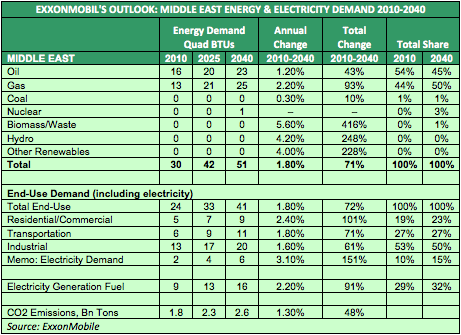
Non-OECD countries' GDP will collectively grow 4.5% a year till 2040. And so will their demand. Share of non-OECD nations energy use will rise from 57% of total global demand in 2010 to 68% by 2040.
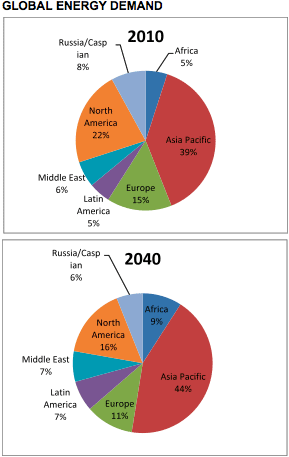
Middle East will see its energy demand rise to 7% in 2040 from 6% in 2010 - not a huge increase percentage wise, but in absolute terms that's five-time rise from 11 quadrillion btus in 2010 to 55 quadrillion btus in 2040. Overall, the Middle East's energy demand will rise 73% in 30 years, or 1.8% each year.
Only Africa (2.7% annual energy demand growth rate) and India (2.6%) will grow faster on an annual basis than the Middle East.
Here are some of the key points of the survey:
* By 2040 there will be 2.8 billion households in the world, needing electricity, heating, refrigeration and power to fire up gadgets, TVs, computers and other appliances. Middle East will be edging up to around 90 million households by the time.
* Global demand for coal, on the other hand, will peak around 2025 and then decline, as improved efficiency couples with a shift to less carbon-intensive energies, particularly in the electricity generation
* Natural gas is the second most commonly used fuel for residential/commercial purposes in developed countries, and by 2040 it will account for 30% of their demand in the sector. Gas is very versatile; it can be used for space heating, water heating, commercial cooling, cooking, drying, and combined heat and
power in commercial buildings.
* By 2040, oil and natural gas will be the world's top two energy sources, accounting for about 60 percent of global demand, compared to about
55% today. Gas is the fastest-growing major fuel source over this period, growing at 1.6% per year from 2010 to 2040. Investments and new technologies, applied over many years and across multiple regions, will enable energy supplies to grow and diversify.
* The need for energy to make electricity will remain the single biggest driver of demand. By 2040, electricity generation will account for more than 40% of global energy consumption.
* Demand for coal will peak and begin a gradual decline, in part because of emerging policies that will seek to curb emissions by imposing a cost on higher-carbon fuels. Use of renewable energies and nuclear power will grow significantly.
* Oil, gas and coal continue to be the most widely used fuels, and have the scale needed to meet global demand, making up about 80% of total energy consumption in 2040.
* Natural gas will grow fast enough to overtake coal for the number-two position behind oil. Demand for natural gas will rise by more than 60% through 2040. For both oil and natural gas, an increasing share of global supply will come from unconventional sources such as those produced from shale formations.
* Gains in efficiency through energy-saving practices and technologies - such as hybrid vehicles and new, high-efficiency natural gas power plants - will temper demand growth and curb emissions.
* Global energy-related carbon dioxide (CO2) emissions will grow slowly, then level off around 2030. In the United States and Europe, where a shift from coal to less carbon-intensive fuels such as natural gas already is under way, emissions will decline through 2040.
* Wind, solar and biofuels also will see strong growth. By 2040, they will account for about 4% of global demand. Growth in wind power is especially rapid. Wind is the fastest-growing energy source in the Outlook period, rising at about 8 percent a year - or more than 900% - over the period.
* ExxonMobil expects that by 2040, hybrids and other advanced vehicles will account for nearly 50% of light duty vehicles on the road, compared to only about 1% today.
* India and Africa - and other Non OECD regions, including Latin America, the Middle East and other Asian nations such as Indonesia, Thailand and Vietnam - will become the growth leaders in the industrial sector.
* Oil and other liquid fuels will remain the world's largest energy source in 2040, meeting about one-third of demand. Globally, demand for liquid fuels will rise by almost 30% over the next 30 years. Close to 80% of this increase is tied to transportation.
* Advances in technology will be key to expanding liquid fuel supplies. As conventional crude oil production holds relatively flat through 2040, demand growth will be met by newer sources. The biggest gains will come from global deepwater production, which more than doubles through 2040. This growth illustrates the power of new technologies. Deepwater production was in its infancy just 10 years ago; by 2025, it will provide 10% of global liquid fuels supplies.
In addition to deepwater, there also will be tremendous growth in production from oil sands, in both Canada and Venezuela. By 2040, oil sands will account for 25% of total liquids supply in North and South America.
Tight oil and natural gas liquids (NGLs) also will see significant growth through 2040. Each of these fuels is benefiting from new application of established techniques that have enabled the extraction of oil and gas from shale and other challenging rock formations. These technologies already have delivered tremendous production growth in the United States and are beginning to be applied globally. Biofuels also will gain share, rising to around 5% of total liquids supply, while coal-to-liquids, gas-to-liquids and volume gains resulting from refinery processes grow to provide just under 5% of supply.
As a result of the growth in these newer resources, by 2040, conventional crude will account for only about 60% of liquid fuels supply, down from 80% in 2010.
Here's the good news for Middle East oil and gas developers: The world will still need plenty of oil by 2040. Oil will satisfy 32% of global energy demand by that time, from 34% in 2010 - that's a mere smidgen of a loss of market share in 30 years, which is not bad given the euphoria behind green energy.
And that's just in relative terms, for in absolute terms oil demand is rising - from 177 quadrillion btus of oil in 2010 to 220 quadrillion btus by 2040.
Admittedly, these are the predictions of one of the biggest global players in fossil fuels - ExxonMobil, so there may well be a hydrocarbon bias, but still it is a telling signal of market direction.
ExxonMobil says that its annual Energy Outlook, which looked far into the future of energy by 2040 in the current edition, is what it basis its own investment decisions on - so there is an imperative to get it right without fear or favour.
And there's even more good news for Middle East hydrocarbon-based economies: Gas will rise 1.6% each year till 2040 and emerge as the second biggest energy source, displacing coal.
Overall, ExxonMobil is bullish on the global energy outlook, expecting total energy demand to rise 30% by 2040, with virtually all energy sources playing a role as the world's population hits 9 billion, new economies rise and new technologies and regulatory policies set the direction of the global energy industry.
"The Outlook for Energy demonstrates that by applying innovation and technology, the world does not need to choose between economic growth and environmental stewardship," said Rex W. Tillerson, chairman and chief executive officer of Exxon Mobil Corporation.
"As people in developed countries look to regain their economic momentum, and as everyone seeks improved living standards for themselves and their families, ExxonMobil will continue to invest in the technologies that enable us to provide the reliable, affordable energy central to economic growth and human progress."
MIDDLE EAST ENERGY DEMAND TO RISE FIVEFOLD
No prize for guessing where the growth will come from: China, India, emerging markets such as Africa and the Middle East itself.
OECD countries will see flat growth - but that does not give the full picture as the developed economies' GDP will actually double through to 2040 and its standard of living will remain high. Higher regulatory controls and greater technological efficiencies will keep demand flat.
Non-OECD countries' GDP will collectively grow 4.5% a year till 2040. And so will their demand. Share of non-OECD nations energy use will rise from 57% of total global demand in 2010 to 68% by 2040.
Middle East will see its energy demand rise to 7% in 2040 from 6% in 2010 - not a huge increase percentage wise, but in absolute terms that's five-time rise from 11 quadrillion btus in 2010 to 55 quadrillion btus in 2040. Overall, the Middle East's energy demand will rise 73% in 30 years, or 1.8% each year.
Only Africa (2.7% annual energy demand growth rate) and India (2.6%) will grow faster on an annual basis than the Middle East.
Here are some of the key points of the survey:
* By 2040 there will be 2.8 billion households in the world, needing electricity, heating, refrigeration and power to fire up gadgets, TVs, computers and other appliances. Middle East will be edging up to around 90 million households by the time.
* Global demand for coal, on the other hand, will peak around 2025 and then decline, as improved efficiency couples with a shift to less carbon-intensive energies, particularly in the electricity generation
* Natural gas is the second most commonly used fuel for residential/commercial purposes in developed countries, and by 2040 it will account for 30% of their demand in the sector. Gas is very versatile; it can be used for space heating, water heating, commercial cooling, cooking, drying, and combined heat and
power in commercial buildings.
* By 2040, oil and natural gas will be the world's top two energy sources, accounting for about 60 percent of global demand, compared to about
55% today. Gas is the fastest-growing major fuel source over this period, growing at 1.6% per year from 2010 to 2040. Investments and new technologies, applied over many years and across multiple regions, will enable energy supplies to grow and diversify.
* The need for energy to make electricity will remain the single biggest driver of demand. By 2040, electricity generation will account for more than 40% of global energy consumption.
* Demand for coal will peak and begin a gradual decline, in part because of emerging policies that will seek to curb emissions by imposing a cost on higher-carbon fuels. Use of renewable energies and nuclear power will grow significantly.
* Oil, gas and coal continue to be the most widely used fuels, and have the scale needed to meet global demand, making up about 80% of total energy consumption in 2040.
* Natural gas will grow fast enough to overtake coal for the number-two position behind oil. Demand for natural gas will rise by more than 60% through 2040. For both oil and natural gas, an increasing share of global supply will come from unconventional sources such as those produced from shale formations.
* Gains in efficiency through energy-saving practices and technologies - such as hybrid vehicles and new, high-efficiency natural gas power plants - will temper demand growth and curb emissions.
* Global energy-related carbon dioxide (CO2) emissions will grow slowly, then level off around 2030. In the United States and Europe, where a shift from coal to less carbon-intensive fuels such as natural gas already is under way, emissions will decline through 2040.
* Wind, solar and biofuels also will see strong growth. By 2040, they will account for about 4% of global demand. Growth in wind power is especially rapid. Wind is the fastest-growing energy source in the Outlook period, rising at about 8 percent a year - or more than 900% - over the period.
* ExxonMobil expects that by 2040, hybrids and other advanced vehicles will account for nearly 50% of light duty vehicles on the road, compared to only about 1% today.
* India and Africa - and other Non OECD regions, including Latin America, the Middle East and other Asian nations such as Indonesia, Thailand and Vietnam - will become the growth leaders in the industrial sector.
* Oil and other liquid fuels will remain the world's largest energy source in 2040, meeting about one-third of demand. Globally, demand for liquid fuels will rise by almost 30% over the next 30 years. Close to 80% of this increase is tied to transportation.
* Advances in technology will be key to expanding liquid fuel supplies. As conventional crude oil production holds relatively flat through 2040, demand growth will be met by newer sources. The biggest gains will come from global deepwater production, which more than doubles through 2040. This growth illustrates the power of new technologies. Deepwater production was in its infancy just 10 years ago; by 2025, it will provide 10% of global liquid fuels supplies.
In addition to deepwater, there also will be tremendous growth in production from oil sands, in both Canada and Venezuela. By 2040, oil sands will account for 25% of total liquids supply in North and South America.
Tight oil and natural gas liquids (NGLs) also will see significant growth through 2040. Each of these fuels is benefiting from new application of established techniques that have enabled the extraction of oil and gas from shale and other challenging rock formations. These technologies already have delivered tremendous production growth in the United States and are beginning to be applied globally. Biofuels also will gain share, rising to around 5% of total liquids supply, while coal-to-liquids, gas-to-liquids and volume gains resulting from refinery processes grow to provide just under 5% of supply.
As a result of the growth in these newer resources, by 2040, conventional crude will account for only about 60% of liquid fuels supply, down from 80% in 2010.
© alifarabia.com 2011