10 January 2013
East African oil may soon beat Middle Eastern oil in global markets, notes an analyst. Not so fast, as the trillion-dollar promise is blocked by massive infrastructure issues facing the region.
In Eastern Africa, there is a trillion-dollar difference between promise and execution.
The region has emerged as a new hot spot, gaining the attention of the world's largest energy companies, and the fight over London Stock Exchange-listed Cove Energy last year is a case in point.
Royal Dutch Shell and Thailand's PTT Exploration & Production's spent much of last year fighting tooth and nail to buy Cove Energy. PTT eventually outbid the Angola-Dutch giant to buy the company for USD1.9-billion which has an 8.5% stake in a Mozambique license containing some major gas discoveries.
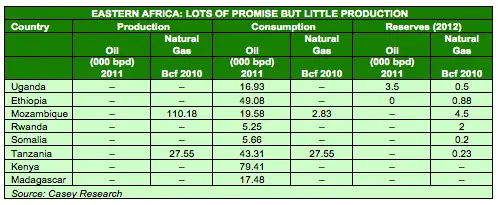
"The country currently has 4.5 trillion cubic feet in reserves and produces 110.18 billion cubic feet per year," says Casey Research in a new note to clients. "If the recent discoveries of natural gas are confirmed, Mozambique will rank fourth in the world for natural-gas reserves - behind Russia, Iran, and Qatar."
The investment advisory service based out of Vermont is clearly bullish calling the region "the next trillion-dollar deal," and examines how "East African oil may soon beat Middle Eastern oil in the global markets, and what you need to know about this up-and-coming energy giant."
London-based Chatham House concurs that East Africa is the new star on the global energy horizon.
"East Africa shows how quickly oil and gas frontiers shift and how new finds swiftly change the way that industry investors and analysts treat a region..." said the research house. "During the last twenty years, figures for known oil reserves in Africa have risen by more than 25 per cent, and gas reserves are now known to be more than 150 per cent higher."
Analysts, investors and the governments of the East African states are hoping that the promise can turn into execution.
Even the International Energy Agency is bullish about the Eastern African states prospects.
"We project that production from Mozambique, Tanzania and Kenya will reach about 45 bcm in 2035, from less than 5 bcm today," the IEA said.
NEW DISCOVERIES
For now, though, it's unclear whether the international oil companies can monetise the wealth.
The rush for East Africa started in 2007 when Heritage Oil and Tullow Oil announced a 1-billion-barrel discovery in Lake Albert, Uganda. Oil and gas explorers have reported major discoveries each year in the region since then, most recently out of a Kenyan project of Africa Oil (V.AOI) spudded in January 2012.
"We expect activity in East Africa to increase significantly as world powers and international integrated oil players jockey for positions via both acquisitions and exploration," said Casey Research house.
Italy's Eni discovered larges gas deposits in Mozambique's Mamba North and South fields - which are considered among its biggest gas fields, estimated to have two trillion cubic metres.
United States developer Anadarko discovered several large gas fields in deepwater Rovuma basin of offshore Mozambique between 1 to 2 tcm.
"Given the limited size of the domestic market and the long distance from neighbouring South Africa, developing these resources will depend on LNG exports," said the International Energy Agency. "Anadarko has started front-end engineering work for an initial two-train, 10 million tonne per year plant and expects to take a final investment decision in 2013."
The agency expects exports to Asian markets could start as soon as 2018, but many operators are expected to take a decision in 2013.
UK-based BG and Ophir Energy and Norway's Statoil have also discovered gas estimated to contain 340 billion cubic metres of gas reserves.
In December, Ophir Energy's said its joint venture project with BG in Tanzania's Jodari field could hold as much 3.4 trillion cubic feet of natural gas.
"The appraisal programme has significantly de-risked the Jodari field underlining its potential to anchor Tanzania's first multi-train LNG development," said Nick Cooper, CEO of Ophir. "The Ophir-BG Joint Venture will now appraise the Mzia discovery and return to Jodari-1 to conduct Tanzania's first flow test. Thereafter the Joint Venture expects to return to high impact exploration drilling in Block 1 during Q1 2013".
BIGGER THAN THE NORTH SEA
Like many of its other industries, Africa's natural resources remain largely under-explored and unexploited. Whereas the U.S. Gulf Coast, North Sea and much of the Middle East are well developed and well scoured geologically, vast swathes of the Eastern African basins remain mysteries.
Casey Research estimates that the prospects for oil production in East Africa are several times larger than the entire North Sea - the giant hydrocarbons' field which produces one-third of Europe's oil and gas needs.
The investment advisory says that Eastern Africa's taxation and regulatory regime is largely comparable to North Sea too.
"The North Sea has a government take of approximately 62%, or a three-star fiscal system. This is the most common rating; the world average is 67%," said Casey Research.
"As a rule of thumb, countries with higher levels of geological potential typically have higher government takes - but not in East Africa. Given the level of opportunity that lies within the East African Rift, the taxation levels are very reasonable. This means a bigger slice of profits for investors."