China pushing its influence deep in Sub Saharan Africa, getting a head-start over other capital-exporting regions such as the Middle East, to position themselves in the resource-rich continent.
While the rest of the world is still circumspect about Africa's business potential, the Chinese are entrenching themselves in the continent, drawn by its natural resources and pliant regulatory infrastructure.
"The acceleration of Chinese economic engagement with Africa is striking," says the Africa Research Institute. "Foreign direct investment increased thirty-fold between 2003 and 2011, from USD 491 million to USD 14.7 billion. "
This year, the Chinese have already pledged USD 20 billion of loans to Africa over three years for infrastructure, agriculture and manufacturing, the institute adds.
"If the funds are committed, China will become Africa's principal financial backer. China is already Africa's leading bilateral trade partner. Two-way trade grew from USD 10.6 billion in 2000 to USD 166 billion in 2011."
This compares to Sub-Saharan African trade with the European Union worth a total of USD 188.9 billion and with the United States reaching USD 90.2 billion.
So much so that a hard landing of the Chinese economy would have a significant impact on major African economies, but the size and timing would differ from country to country, Fitch Ratings says.
"A series of shocks to the Chinese economy slow Chinese growth by 3 percentage points in 2013 and 1pp in 2014, our model shows African real GDP growth slowing by an accumulated 0.9pp compared with our baseline forecast in 2013 and 2014, to an average of 4.6% a year in each year," Fitch said in a report.
Other nations are watching rising Chinese influence in the continent with great concern. The United States believe that Beijing is exploiting the continent for its natural resources, while the French -- a traditional colonist power in the area - are also wary of the Asian giant's moves as it encroaches on its traditional playground.
However, as Zhai Jun, deputy foreign minister of China noted dryly: "African belongs to the Africans - it is not anyone's 'cheese'".
Western nations also blame China for not using its influence in African states to urge reform and greater human rights, but instead look the other way or even - indirectly - bankroll autocratic regimes in Africa.
But African government ministers praise China for a "can do", non-prescriptive approach. "Chinese officials and investors have criticised western governments and donors for being out of touch with the needs of contemporary Africa," says the ARI.
Beyond the Chinese rhetoric and concern of western nations, is a simple economic equation. China is a major exporter of capital and also has major needs for mineral, resources, agricultural and other commodities.
The Chinese began their African adventure in the last decade with the launch of the Forum on China-Africa Cooperation (FOCAC), but it has now been superseded by a number of private and state-owned Chinese enterprises that have found Africa a brand new investment prize.
Much of the Chinese focus has been on Angola, Sudan and the Republic of Congo, and the three nations account for two-third of SSA exports to China, primarily in oil.
Including Democratic Republic of Congo and South Africa, the five countries account for 95% of SSA exports to China.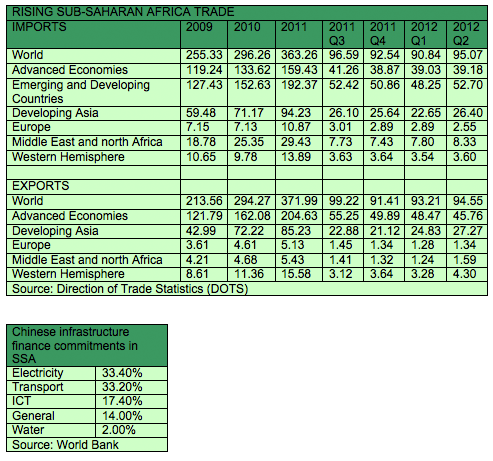
NOT AN EXPLOITATIVE RELATIONSHIP
Citibank says that while the relationship between China approach seems to be exploitative and "neo-colonial", the story on the ground is far more complex.
But the Chinese government and companies are re-thinking how to be involved in the SSA resource story, notes Citibank.
"For example, Chinese companies led the development of the Sudanese oil sector, led by the China National Petroleum Company (CNPC). Not only was CNPC the main developer of the fields, but also in the construction of the pipeline to Port Sudan. Given this close level of involvement, up to 80% of Sudanese oil exports are sold to China. However, this approach to development of resources in SSA by Chinese companies is unlikely to be repeated in most countries."
There are estimated to be more than 2,000 Chinese companies operating in the vast continent and some analysis show as much as a million Chinese now live in Africa.
Worried about the sudden change in demographics and the rise of poor quality imported goods from China, African authorities are now imposing some restrictions on Chinese movement, especially the smaller businesses, which have no direct link with the Beijing government.
"Poor quality goods and strict no return policies have provoked widespread demands for better regulation of Chinese imports. Concerns about reputational damage have prompted officials in Beijing to address quality control," notes the ARI.
Indeed, the China Department for Africa has pledge greater quality control to avoid problems in the future.
Sub-Saharan Africa is an important outlet for Chinese economic growth.
Apart from the continent's obvious needs for infrastructure, and rising investment needs in virtually all areas of the economy, SSA offers China a great outlet to extend trade, away from the tried and tested developed economies, which view China with great suspicion.
According to the Chinese Ministry of Commerce, Chinese companies are now signing infrastructure deals worth around USD 50 billion a year in SSA.
"Another way to think about Chinese involvement in the construction industry in SSA in the last decade is as a surplus labour export model," says Citibank. "Effectively, many of the Chinese companies active in the construction sector in SSA are state owned companies which have won contracts at aggressively cheap prices. It seems their goal is not necessarily to ensure high rates of profitability, but instead to be representatives of Chinese diplomacy, and to broadly break even and continue to employ a large number of Chinese workers."
SSA too, clearly needs China. Tired of the West's indifference, and dwindling aid, the continent needs to overcome its political challenges and social inequalities with investment that can help the continent to get on its feet.
China is filling that investment vacuum in Africa.
© alifarabia.com 2012