PHOTO
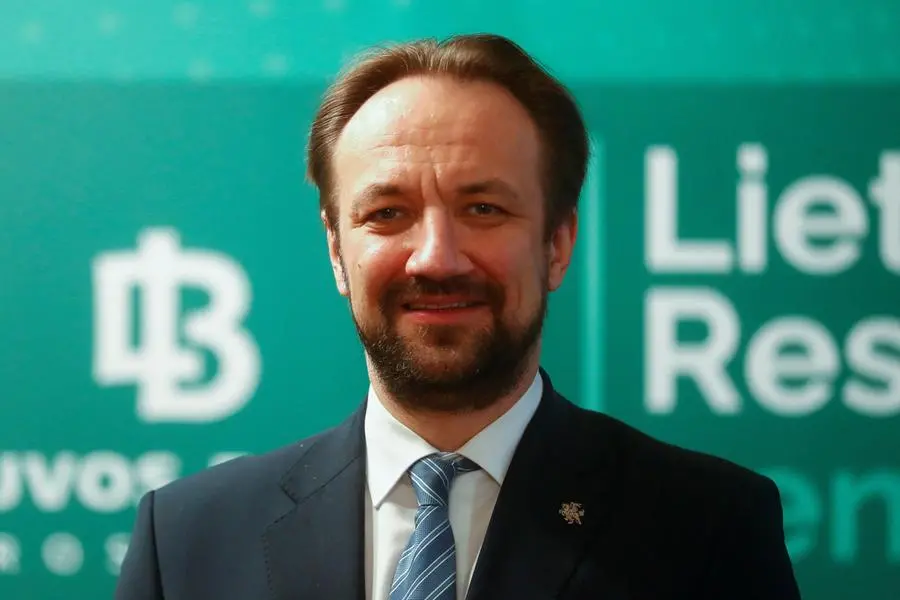
European Central Bank policy fits the moment and the economy has adapted well to volatility but the bank must prepare for new shocks, possibly from Russia's military threat, ECB policymaker Gediminas Simkus told Reuters in an interview.
The ECB has achieved remarkable success last year, becoming the only major central bank to hit its inflation target, even as U.S. tariffs, war on the European Union's eastern border, Chinese goods dumping and food price surges kept uncertainty exceptionally high.
Simkus argued political turbulence, which started with the pandemic in 2020 and also includes Russia's invasion of Ukraine, would likely persist and could easily upset the ECB's "good place" of inflation at target, growth at potential and interest rates in the neutral setting.
"We talk quite a bit about the U.S. but their policies involve us mostly on the trade front," the Lithuanian central bank governor and a member of ECB's policy council said. "We have neighbours to the east and the risk there is of a different character: it is a threat of military aggression."
Lithuania and fellow Baltic countries Estonia and Latvia, once part of the Soviet Union, have long expressed fears about possible Russian aggression, citing cyber attacks, disinformation campaigns and incursions by drones and fighter jets.
Simkus said the ECB should make sure cash distribution and payment systems are resilient to this sort of risk and monetary policy is flexible enough.
"It's obvious that if you face enhanced military risk, cash is something that people might be striving for, and you need to be very efficient," he said.
Among other risks, he said the ECB should ensure banks are ready for climate change.
EQUAL CHANCE OF HIKE OR CUT
In the near term, the ECB's job is simple, Simkus argued, and policy will remain on hold at the next meeting on February 4, since small inflation fluctuations around 2% are normal. But there is little certainty beyond that, he cautioned.
"I fully believe there is an equal chance that our next move, whenever it comes, is either an increase or a cut in rates," Simkus said, implicitly pushing back on earlier comments from ECB board member Isabel Schnabel, who made the case for an eventual hike.
Financial markets see no interest rate change at all this year but anticipate some hikes next year on the premise that Germany's spending splurge will kick-start economic activity and its growth spurs the rest of the euro zone.
Simkus, however, pushed back on the idea of giving signals beyond the immediate future.
"The lesson of the past is that we cannot commit to any policy path or to a promise," he said. "We need to be open and accept that the environment is volatile and shocks are coming."
DON'T OVERREACT, SPOT THE TRENDS
The volatility may put pressure on the ECB to act quickly but the reality is that the economy itself is less reactive to shocks and forecasters often overestimate threats.
"The key is not overreacting to every single change in data. We need to spot trends and the major forces shaping the economy," Simkus said.
This is especially true in the era of trade frictions since tariffs seem to have a smaller, indirect impact on inflation, hitting growth first and transforming the economy more slowly.
"I will be looking closely at economic activity to assess whether we need to change course," Simkus said. "These shocks impact growth more immediately while the effect on inflation takes time."
(Reporting by Balazs Koranyi and Francesco Canepa Editing by Tomasz Janowski)