PHOTO
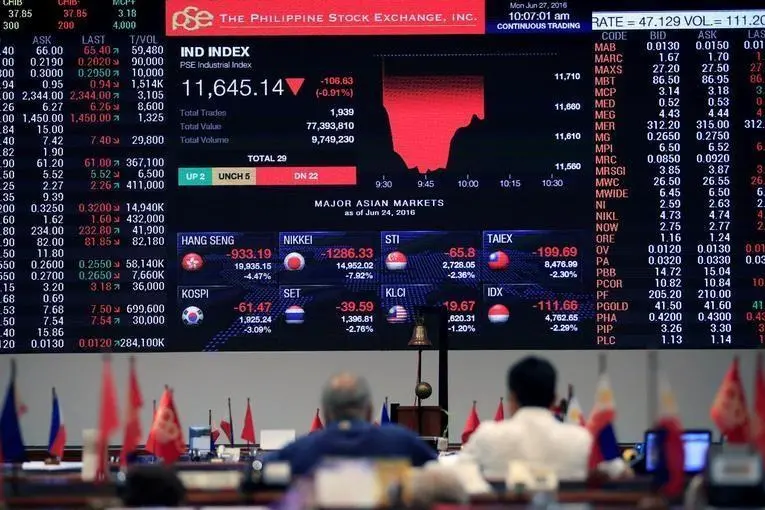
Local stocks rose anew yesterday to break past the 6,400 level again as investors - mostly foreign funds - picked up select issues ahead of the rate-setting meeting of the Bangko Sentral ng Pilipinas (BSP).
The benchmark Philippine Stock Exchange index (PSEi) closed at 6,410.09, up by 74.18 points or 1.17 percent, while the broader All Shares index finished at 3,426.41, up by 25.54 points or 0.75 percent.
Juan Paolo Colet, managing director at China Bank Capital, said market-on-close buying of select blue chips lifted the index as investors positioned ahead of the BSP's policy meeting today.
'The local market bucked the negative performance of most Asian stock indexes and brushed aside jitters on the Chinese economy and the direction of US monetary policy. The PSEi's rise is most likely a technical rebound and we remain wary of selloffs,' Colet said.
Total value turnover was thin at P3.857 billion. Market breadth was slightly positive, 92 to 89, while 45 issues were unchanged.
Elsewhere in Asia, other regional markets slip as more disappointing Chinese economic data and the absence of meaningful stimulus from Beijing continued to weigh on investor sentiment.
China's new home prices fell for the first time this year in July, the latest in a string of downbeat numbers that point to a rapid loss in economic momentum and underline the urgency for more bolder policy support to shore up activity.
On Tuesday, China reported weaker than expected July activity data, which was followed by news that Beijing would no longer publish youth unemployment data, which further rattled confidence in Beijing.
The PBOC also unexpectedly lowered its policy rate on Tuesday, earlier than many investors had expected. That move followed a string of disappointing data on loans and credit, the housing market and trust industry as well as the threat of deflation.
'Investors' sentiment toward China is pretty bad,' said Redmond Wong, Greater China market strategist at Saxo Markets.
Wong was most concerned about month-to-month decline in China's retail sales and weak infrastructure investments, which suggested a lack of local government funding.
'We think the Chinese Central bank is not going hard enough on reducing interest rates, encouraging the banks to lend more and stimulate very flat consumer activity,' said John Milroy, an investment adviser at Ord Minnett.
Copyright © 2022 PhilSTAR Daily, Inc Provided by SyndiGate Media Inc. (Syndigate.info).