PHOTO
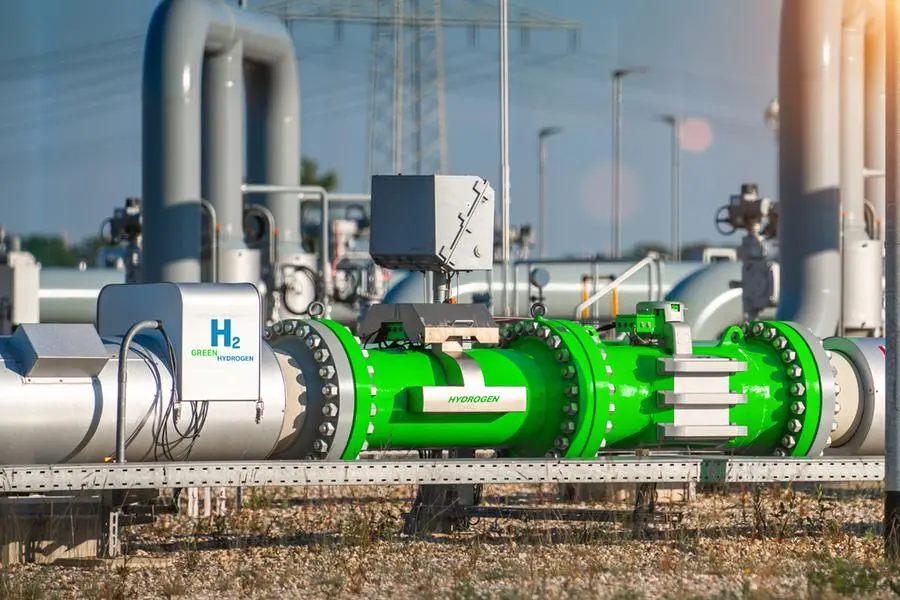
Fewer than five green hydrogen projects in Egypt have advanced beyond the feasibility stage despite Cairo’s efforts to position itself as a global hub for renewable hydrogen production, according to a new report by Switzerland-based Green Hydrogen Organisation (GH2).
The report, summarising a July roundtable co-hosted with the British Embassy, highlighted that Egypt’s policy framework offers some of the most generous incentives globally — including up to 55 percent tax rebates and single-window 'Golden License' approvals underpinned by strong fundamentals such as abundant land, favourable wind and solar capacity factors, and a strategic location near Europe and Asia.
The Suez Canal Economic Zone hosts over half of Egypt’s project pipeline and is involved in a €397 million H2Global contract to supply renewable ammonia to Europe through 2033.
Yet, billions of dollars of potential investment that includes more than 30 memoranda of understanding signed with international companies due to structural hurdles, the report, issued on Tuesday ahead of a GH2-backed forum in Cairo this week, said.
Weak global demand
Egypt’s difficulties, the report admitted, mirror a global trend of lack of customers and demand for green hydrogen and its derivatives. Globally, only 4 percent of renewable hydrogen and ammonia projects have reached final investment decision (FID) or are under construction, BloombergNEF data shows, with just 13 percent backed by binding offtake contracts. Early market prices - around $600 per tonne for ammonia shipped from China - adds to the pressure.
High cost of capital
The high cost of capital in Egypt erodes competitiveness even with solar and wind tariffs as low as $0.02/kWh, according to the report.
“Developers in Egypt face borrowing rates of 16–18 percent. In OECD markets, the figure is 4–6 percent,” it stated.
Roundtable participants called for blended and concessional finance solutions, first-loss guarantees, contracts-for-difference and other climate finance solutions to further bring down the cost of capital.
“Developers underlined how even relatively small projects, such as a 100 megawatt (MW) electrolyser, require years of coordination, legal work, and capital structuring,” the report noted.
Grid bottlenecks
According to the report, although Egypt has expanded renewable land allocations to over 41,000 sq km - enough for 180 gigawatts (GW) - the grid can handle only around 36GW today while storage capacity is limited to 60GWh.
A $5–6 billion transmission upgrade, a proposed green corridor, and a new transmission company remain on paper, and wheeling charges remain opaque. Questions also remain over who will fund desalination plants, pipelines, and storage infrastructure and how grid access will be priced.
“Without this, even a 100 MW electrolyser project is taking years to negotiate,” the report said, adding that the reliance on shared infrastructure and complex project negotiations result in delays and additional costs.
Missed domestic opportunity
The report underlined the need to ensure that projects slowly making their way towards FID contribute to the local economy. More than 95 percent of hydrogen production plans are geared for exports leaving fertiliser production, food security and domestic industry largely untapped.
“It is a missed opportunity, and one Egypt cannot afford. From the outset, efforts need to be made to make sure that even projects mainly aimed at export are integrated in the local economy,” the report noted.
Regional competition
Egypt also faces growing regional competition with Morocco this year approving six projects worth $32 billion under its “Offer” framework, bundling land, permits, and grid access into bankable packages. Mauritania has passed a Green Hydrogen Code, Algeria is anchoring projects through Sonatrach, and Saudi Arabia’s $8.4 billion NEOM hydrogen project is already 80 percent built.
Further afield, India’s August auction delivered 10-year green ammonia contracts at around $600 per tonne, while China controls roughly 40 percent of global electrolyser manufacturing. All these underscore the urgency for Egypt to move from policy to execution.
“Both countries are already shipping products. They are not waiting,” the report concluded.
Read more: Green ammonia struggles: Low carbon pricing, competition hinders offtake deals
(Writing by Anoop Menon; Editing by SA Kader )
Subscribe to our Projects' PULSE newsletter that brings you trustworthy news, updates and insights on project activities, developments, and partnerships across sectors in the Middle East and Africa.