PHOTO
Dubai-UAE:The Emirates Mars Mission, the first interplanetary exploration undertaken by an Arab nation, has triggered a rush of new observations, discoveries and insights into Mars’ unique atmosphere, its composition and dynamics.
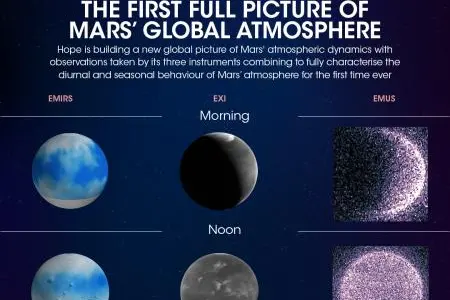
With key announcements already made including new and startling observations of Mars’ discrete aurora and unprecedented views of dayside oxygen and carbon monoxide structures in the planet’s atmosphere, new avenues of exploration are now being opened up by the slew of data being brought back from the Hope spacecraft. For the first time, Hope is building a full diurnal picture of Mars’ atmosphere.
“The success of Hope is already assured from our early results and observations and we can already see a vast number of new potential avenues of exploration opening up as a result of our early data,” said Emirates Mars Mission Science Lead, Hessa Al Matroushi. “We are seeing Mars in remarkable detail and are able to characterise the diurnal behaviours of Mars’ atmosphere for the first time ever. The potential we are now seeing from the mission undoubtedly exceeds our expectations.”
Papers and posters being shared and presented at the AGU21 Fall Meeting in New Orleans reflect the unique picture of Mars’ atmosphere being built by EMM’s Hope Probe, with a combination of Hope’s advanced instrumentation and smart elliptical orbit providing new views of the Martian atmosphere at all times through the day, night and seasons of the Red Planet.
Christopher S. Edwards, EMIRS Instrument Lead, said: “The ability of EMM to observe Mars at all local times on short timescales enables the daily variation of these clouds to be studied. The EMIRS observations show that clouds are thickest and cover the most area early in the morning and late in evening with fewer clouds near midday. The comparison of clouds observed by EMIRS at thermal-infrared wavelengths to those observed by EXI at visible wavelengths can provide further information about the clouds, such as size of the water ice aerosols that make up the clouds.”
“As on the earth, clouds on Mars are an important part of the water cycle and characterizing how they change from hour-to-hour and day-to-day is an important part in understanding both the present and past climates,” said Michael Wolff, EXI Instrument Lead.
Filling a crucial gap in our understanding of Mars and meeting its mission objective of addressing a number of science goals defined by MEPAG (the Mars Exploration Program Analysis Group), Hope’s ground-breaking observations are available to scientists and enthusiasts globally, uploaded to the EMM Science Data Centre and available freely from the emm.ae website.
Hope set out to measure the global, diurnal and seasonal response of the Martian atmosphere to solar forcing; the atmospheric conditions relating to the rate of atmospheric escape – particularly of Hydrogen and Oxygen and the temporal and spatial behaviour of Mars’ exosphere. With early results showing exciting observations of Mars’ discrete aurora and additional bandwidth and resources available to encompass additional observations, further measurements of auroral phenomena have been brought into the mission’s goals, extending its capabilities beyond Hope’s planned goals.
Mars Hope carries three instruments:
EXI – The Emirates eXploration Imager digital camera captures images of Mars with a resolution of 2 to 4 km along with measuring the amount of water ice and ozone in the lower atmosphere through the UV bands.
EMIRS – The Emirates Mars InfraRed Spectrometer measures the emitted energy from the martian surface and atmosphere, deriving the global distribution of dust, ice cloud, and water vapor in the Martian lower atmosphere.
EMUS – The Emirates Mars Ultraviolet Spectrometer measures oxygen and carbon monoxide in the thermosphere and the variability of hydrogen and oxygen in the exosphere.
“By comparing the images of hydrogen that we gain from the EMUS instrument to the maps of water ice, water vapor, and dust acquired by the EXI and EMIRS instruments, scientists will be able to reconstruct the details of how hydrogen is transported through the Martian atmosphere and how water has been lost from the planet over the history of the Solar System,” Said EMM Deputy Science Lead and EMUS Instrument Lead Justin Deighan. “Thanks to the uniquely large orbit of the Hope probe around Mars, the instruments on the Hope probe are able to view the planet from different points of view across all times of day, bringing powerful new insights to our understanding of Mars’ atmospheric dynamics.”
The Mission’s Hope Probe is following its planned 20,000 – 43,000 km elliptical science orbit, with an inclination to Mars of 25 degrees, giving it a unique ability to complete one orbit of the planet every 55 hours and capture a full planetary data sample every nine days throughout its one Martian year (two Earth year) mission to map Mar’s atmospheric dynamics.
EMM and the Hope probe are the culmination of a knowledge transfer and development effort started in 2006, which has seen Emirati engineers working with partners around the world to develop the UAE’s spacecraft design, engineering and manufacturing capabilities. Hope is a fully autonomous spacecraft, carrying three instruments to measure Mars’ atmosphere. Weighing some 1,350 kg, and approximately the size of a small SUV, the spacecraft was designed and developed by MBRSC engineers working with academic partners, including LASP at the University of Colorado, Boulder; Arizona State University, the University of California, Berkeley, Space Science Institute, Boulder and Northern Arizona University.
The Hope Probe’s historic journey to the Red Planet coincided with a year of celebrations to mark the UAE’s Golden Jubilee.
-Ends-
About the Emirates Mars Mission
Announced in July 2014 by the UAE President His Highness Sheikh Khalifa Bin Zayed Al Nahyan, and His Highness Sheikh Mohammed bin Rashid Al Maktoum, Vice President and Prime Minister of the United Arab Emirates and Ruler of Dubai, the Emirates Mars Mission has been developed by the Mohammed Bin Rashid Space Centre (MBRSC), in conjunction with its knowledge transfer partners and funded by the UAE Space Agency.
Conceptualized to disrupt and accelerate the United Arab Emirates’ space sector through shaping a scientific community, and boosting space education in the country, the Probe aims to build the first full picture of Mars’s climate throughout the Martian year.
The Hope Probe reached Mars orbit in 2021, the 50th anniversary of the foundation of the UAE, which became an independent nation on December 2, 1971.
More about the mission and science data for download are available at www.emm.ae
Media Contact: chris.urquhart@fleishman.com
© Press Release 2021
Disclaimer: The contents of this press release was provided from an external third party provider. This website is not responsible for, and does not control, such external content. This content is provided on an “as is” and “as available” basis and has not been edited in any way. Neither this website nor our affiliates guarantee the accuracy of or endorse the views or opinions expressed in this press release.
The press release is provided for informational purposes only. The content does not provide tax, legal or investment advice or opinion regarding the suitability, value or profitability of any particular security, portfolio or investment strategy. Neither this website nor our affiliates shall be liable for any errors or inaccuracies in the content, or for any actions taken by you in reliance thereon. You expressly agree that your use of the information within this article is at your sole risk.
To the fullest extent permitted by applicable law, this website, its parent company, its subsidiaries, its affiliates and the respective shareholders, directors, officers, employees, agents, advertisers, content providers and licensors will not be liable (jointly or severally) to you for any direct, indirect, consequential, special, incidental, punitive or exemplary damages, including without limitation, lost profits, lost savings and lost revenues, whether in negligence, tort, contract or any other theory of liability, even if the parties have been advised of the possibility or could have foreseen any such damages.