PHOTO
- Post-symposium outcomes include joint publications, policy recommendations, and strengthened cross-regional partnerships for marine conservation and decarbonisation
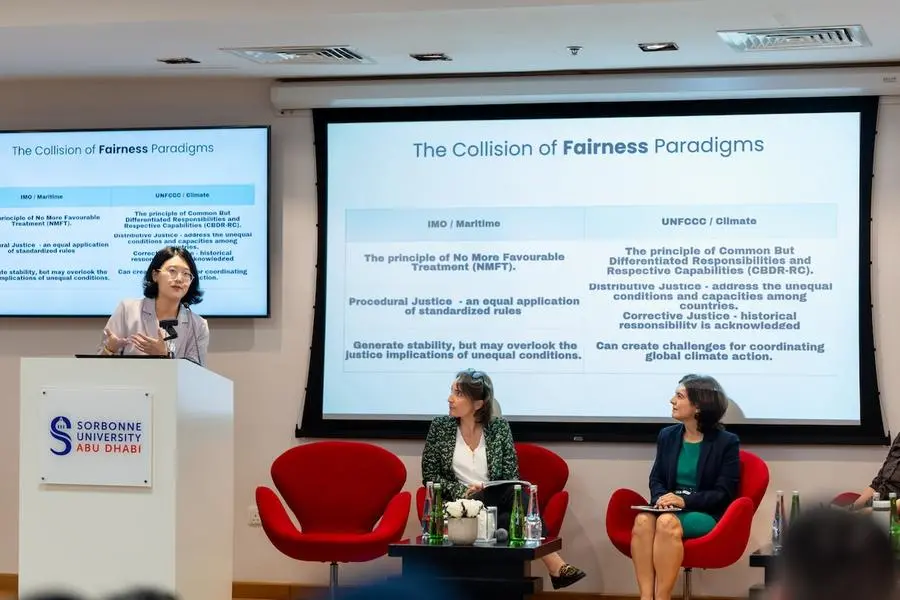
Abu Dhabi, UAE: Sorbonne University Abu Dhabi (SUAD), in partnership with the Asia-Pacific Centre for Environmental Law (National University of Singapore) (APCEL), successfully concluded the international symposium ‘Ocean Futures: Advancing Decarbonisation and Innovation in Shipping and Marine Biodiversity through Law, Policy, and AI’, held last week at its campus on Al Reem Island.
The event gathered policymakers, academics, international organisations, NGOs, and industry leaders from across the UAE and beyond to explore how legal, technological, and policy frameworks can accelerate a more sustainable future for the world’s oceans. Held in collaboration with the Embassy of Switzerland to the United Arab Emirates and the Kingdom of Bahrain, and the MENA Oceans Initiative by Goumbook, the symposium formed part of SUAD’s Year of Ocean – an ongoing commitment dedicated to advancing marine science, innovation, and governance through SUAD’s Ocean Institute, launched at COP28.
Professor Nathalie Martial-Braz, Chancellor of Sorbonne University Abu Dhabi, commented: “It was inspiring to see leaders from across disciplines and regions come together with a shared purpose – to safeguard our oceans through knowledge, policy, and innovation. The symposium’s success lies not only in the quality of dialogue but in the genuine commitment expressed by all participants to turn ideas into collective action. As we move forward, Sorbonne University Abu Dhabi will continue to channel these learnings into impactful research and partnerships that advance sustainable ocean governance locally and globally.”
Strengthening Global Collaboration
One of the most significant outcomes of the event was the strengthened partnership between SUAD and APCEL, marking a deepened commitment to joint research and publications in environmental law, policy, and ocean governance. The symposium’s interdisciplinary approach drew engagement from key representatives of the UAE Ministry of Climate Change and Environment, the UN Ocean Decade (IOC-UNESCO), CMA CGM, Al Aidarous Law Firm, the Blue AI project, and regional universities including Zayed University, reflecting the growing importance of cross-sector collaboration in addressing ocean challenges.
Towards Fair and Coordinated Maritime Decarbonisation
Speakers underscored that decarbonising the maritime sector requires a coordinated global effort that links international law, national implementation, and private-sector innovation. Discussions emphasised that the International Maritime Organisation’s strategies must remain equitable, considering the capacities and needs of developing nations to ensure a fair transition towards net-zero shipping.
Integrating Biodiversity into Maritime Governance
Participants also highlighted the urgent need to embed biodiversity protection into maritime decision-making. With the shipping industry contributing to underwater noise, invasive species transfer, and pollution, experts called for stronger legal and policy mechanisms to balance economic activity with the safeguarding of marine ecosystems. Collaborative approaches involving governments, academia, and industry were recognised as essential to achieving resilient ocean governance.
Data, Technology, and the Future of Ocean Monitoring
The symposium further spotlighted the role of technology and data in enabling informed policymaking. Delegates stressed the importance of strengthening research capacity and data sharing among institutions to ensure transparency and accountability in ocean management. Emerging technologies such as AI and robotics can further enhance marine monitoring, enabling better data generation, sharing, and analysis to protect ocean ecosystems in the Gulf and beyond. The potential of new technologies was showcased through projects such as Blue AI – an innovative citizen-science platform designed to tackle plastic pollution in Gulf waters.
Future Impact
Building on the momentum of the discussions, SUAD and APCEL will jointly produce a policy brief and an academic paper for publication in a peer-reviewed environmental law journal. These outputs will be disseminated to policymakers, research institutions, and industry partners to support evidence-based decision-making and future collaboration. The recommendations and insights generated from the symposium will also be shared with relevant government agencies in the UAE to inform research priorities and inspire new partnerships focused on decarbonisation and marine conservation.
The symposium reaffirmed the UAE’s growing role as a hub for dialogue and innovation in sustainability, aligning with the nation’s long-term vision to advance climate action, responsible industry, and ocean stewardship. The programme featured keynote addresses and panel discussions on maritime decarbonisation, biodiversity protection, and the use of AI and autonomous technologies to strengthen ocean governance across the Gulf region.
To learn more about the symposium and Sorbonne University Abu Dhabi’s Year of the Ocean initiatives, visit https://sorbonne.ae/
About Sorbonne University Abu Dhabi (SUAD)
Sorbonne University Abu Dhabi, established in May 2006 as the first French university in the UAE and under the patronage of His Highness Sheikh Mohamed Bin Zayed Al Nahyan, is a branch campus of the Sorbonne University in Paris, licensed by the Abu Dhabi Department of Education and Knowledge (ADEK). SUAD brings 768 years of academic excellence from the prestigious Sorbonne University and Université Paris-Cité in Paris to a 93,000 sqm state-of-the-art campus on Al Reem Island. The multidisciplinary research university offers over 20 undergraduate and postgraduate programmes across three specialised schools: Arts and Humanities; Law, Economics, Business; and Data, Science and Engineering as well as on-demand PhD programmes from the doctoral schools in France All degrees are awarded by Sorbonne Université and Université Paris Cité and are evaluated by France’s Higher Council for the Evaluation of Research and Higher Education (HCERES) and accredited by the Ministère de l’Enseignement Supérieur, de la Recherche et de l’Innovation (MESR), as well as the UAE’s Commission for Academic Accreditation (CAA).
SUAD’s programmes blend academic rigour, critical thinking, with practical experience through industry partnerships. Home to the Gulf’s largest French language academic library, the university advances research, innovation, and cross-cultural dialogue between French and Emirati communities. Its motto “Choose Excellence, choose SUAD” reveals its commitment to Excellence, one of its 5 strategic pillars – Research, Education, Excellence, Visibility and Sustainability. SAFIR, its multidisciplinary research institute powers the wider knowledge production with 7 centers working on critical domains (such as AI, Humanities and Marine Science), access to 17,000 researchers in France and UAE and strong industry research partnerships. Since 2022, SUAD welcomes the community to its cultural center offering a year-round program of exhibitions, theater plays, concerts, cinema and cultural talks. SUAD is engaged in advancing the UN SDGs through its sustainability pillar. With over 3,000 graduates from more than 90 nationalities, SUAD contributes significantly to Abu Dhabi’s multicultural academic ecosystem. Sorbonne Université is ranked 43rd globally in 2024 and 11th in mathematics in the Shanghai Ranking, and it is also ranked 8th in the Young University Rankings by Times Higher Education. Université Paris Cité is ranked 60th globally in the 2024 Shanghai Ranking of World Universities. SUAD’s School of Arts and Humanities was named the 1st Humanities Education University by the Forbes Middle East Higher Education Awards in 2019. In 2025, SUAD ranked second in the UAE for Responsible Consumption and Production in the Times Higher Education Impact Rankings.
For more information about Sorbonne University Abu Dhabi: https://www.sorbonne.ae/
About the Asia-Pacific Centre for Environmental Law (APCEL)
The Asia-Pacific Centre for Environmental Law (APCEL) is a research centre at the Faculty of Law, National University of Singapore. APCEL is committed to promoting research-based capacity building and advancing innovative scholarship in a spirit of partnership. APCEL was established in 1996, in cooperation with the World Conservation Union-Commission on Environmental Law (IUCN-CEL) and UNEP, in response to the call in Agenda 21 to build capacity in environmental law and promote environmental consciousness.
Since its inception, APCEL has pioneered a wide-ranging programme of teaching, research and outreach to galvanise the use of legal mechanisms to address climate change, biodiversity loss, and plastics pollution. Recent projects include research on the Paris Rulebook, sustainability standards, and environmental courts and tribunals. APCEL also brings internationally renowned scholars together, alongside industry and other civil society stakeholders, to share the latest thinking on environmental law and policy at seminars and conferences.
For more information about APCEL: https://law.nus.edu.sg/apcel/about-us/
About Goumbook
Goumbook is a social enterprise dedicated to accelerating Sustainability and Climate Action in the UAE and beyond since 2009.
Goumbook shapes the global sustainability landscape by offering local solutions to corporates, youth, civil society, and the public sector. Through its programmes and initiatives, Goumbook mobilises cross-sectoral stakeholders to drive action. By addressing the unique challenges faced by the MENA region, we ensure that our region's priorities are at the forefront of global sustainability efforts. Goumbook raises awareness, develops and runs initiatives, advises and consults to change mindsets and create impact on the current and future living experience of the people in our region.
The MENA Oceans Initiative by Goumbook was established in 2023, in Strategic Partnership with the UN Climate Change High Level Champions Team and the United Nations, UAE to forge cross-sectoral, multistakeholder efforts that will accelerate the pace of ocean action in the region. The Initiative brings regional ocean, coastal, and freshwater priorities to the forefront of climate and sustainability agendas through its four key pillars: an annual Summit, a Network, its Global Programmes, and Knowledge Hubs.
For more information about Goumbook: https://goumbook.com