PHOTO
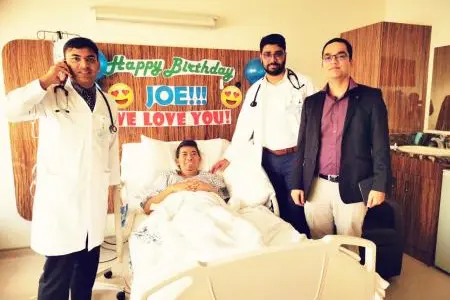
Manama, Bahrain: A 49-year-old Fillipino suffering from a rare form of cancer was rushed to Bahrain Specialist Hospital, complaining of a copious amount of blood in stools coupled with excruciating abdominal pain. The patient, who was already on palliative chemotherapy for stage four peritoneal mesothelioma (a form of cancer that affects the lining of the abdomen) was immediately taken for necessary imaging which revealed a large-sized tumour occupying a very complex position on the right side of the patient’s colon, in close proximity to the duodenum, the right kidney and its blood vessels.
Since the disease was already at stage four (spread to other organs), the gastrointestinal specialists at the Hospital decided that the only way to save the patient’s life was through surgery, despite its inherent risks. As per the WHO data, the incidence of this rare form of cancer is one in million for industrialized countries.
“Clinically I felt that there must be bowel infiltration based on the acuteness of his symptoms” noted Dr Subhadeep Bose, Consultant Oncologist at the Oncology department of Bahrain Specialist Hospital.
Commenting on the challenging procedure, Dr Teerath Kumar, Consultant Nephrologist at Bahrain Specialist Hospital added: “The decision to undergo surgery was difficult for the patient too as the complicated surgery had to take into account the possibility of having to remove one kidney. Since the patient was already suffering from diabetes and kidney problems from the beginning, it was vitally important to preserve both his kidneys.
“Sometimes, in such bleeding tumours, the interventional radiologist can go inside the bleeding vessel and block it. But, in this case, it was not possible due to the large size of the tumour, which was almost 12x10cm and it was surrounding vital structures and had already invaded the colon. So, it had to be taken out,” added Dr Kumar
The patient underwent major surgery where the part of the tumour which was threatening his life was removed, the intestines were also joined primarily, thus avoiding the need for external stoma to divert the patient’s stool. Another tumour infiltrating the small intestine was also removed.
Dr Manish Madnani, Consultant Gastrointestinal and Hepatobiliary Surgeon at Bahrain Specialist Hospital, who operated on the patient along with a team of specialists, was happy to have been able to save the patient’s right kidney.
Explaining the many challenges that he and the operating team encountered while performing the complex surgery, Dr Madnani said: “The large tumour was sitting next to major blood vessels of the abdomen, which, if injured during the course of the surgery or had started bleeding after surgery, would have been very difficult to control.
“Also, the close proximity of the tumour to the right kidney and its blood vessels was not as easy a task as was envisaged prior to surgery. In spite of all these odds, surgery was completed within 200 minutes, with blood loss of approximately 150ml,” Dr Madnani added.
The patient recovered well after surgery and stayed for just one day in ICU. Although he had to undergo minor procedures to remove infection from his abdomen after surgery, the thankful patient is now back to chemotherapy with Dr Subhadeep Bose.
Diagnosed in 2016 with stage four peritoneal mesothelioma, the patient – a longtime resident of Bahrain began chemotherapy treatment at the Oncology Department of Bahrain Specialist Hospital. He was responding well to his treatment until he developed severe abdominal pain, accompanied by blood loss in his stool.
Dr Madnani further commented: “Despite suffering from stage 4 disease, the patient has survived three years with us [BSH] on his treatment. He is very fit otherwise and even though he is not entirely cancer-free the new types of chemotherapy/immunotherapy that he is now undergoing at Bahrain Specialist Hospital following his surgery should ensure that his tumour will shrink in size, allowing him to enjoy good quality of life. Without his treatment and subsequent surgery this patient would not have survived - even for a few months.”
Dr Madnani reiterated that Bahrain Specialist Hospital is able to manage complex medical cases due to its various world-class specialist and consultant teams, including challenging gastrointestinal surgeries, such as the one successfully carried out on the Filipino patient.
-Ends-
For media enquiries, please contact:
Sa’adia Reza,
Pulse 360 PR & Marketing Communications,
Tel: +971 4 2327789, Mob: + 97150 4765309
Email: saadia@pulse360me.com , anuroopa@pulse360.com
Disclaimer: The contents of this press release was provided from an external third party provider. This website is not responsible for, and does not control, such external content. This content is provided on an “as is” and “as available” basis and has not been edited in any way. Neither this website nor our affiliates guarantee the accuracy of or endorse the views or opinions expressed in this press release.
The press release is provided for informational purposes only. The content does not provide tax, legal or investment advice or opinion regarding the suitability, value or profitability of any particular security, portfolio or investment strategy. Neither this website nor our affiliates shall be liable for any errors or inaccuracies in the content, or for any actions taken by you in reliance thereon. You expressly agree that your use of the information within this article is at your sole risk.
To the fullest extent permitted by applicable law, this website, its parent company, its subsidiaries, its affiliates and the respective shareholders, directors, officers, employees, agents, advertisers, content providers and licensors will not be liable (jointly or severally) to you for any direct, indirect, consequential, special, incidental, punitive or exemplary damages, including without limitation, lost profits, lost savings and lost revenues, whether in negligence, tort, contract or any other theory of liability, even if the parties have been advised of the possibility or could have foreseen any such damages.