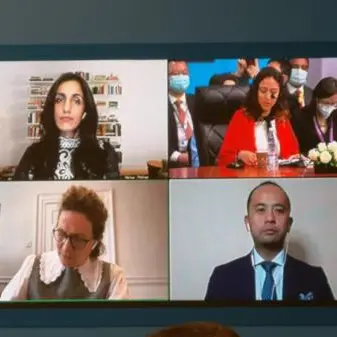
Tunisian courts sentenced eight human rights defenders to prison terms and fines in recent days for charges connected to their human rights work, including two prominent women who were handed harsh sentences, Human Rights Watch said today.
On June 26, 2026, a Tunis Court of First Instance sentenced Sihem Bensedrine, the former president of the Truth and Dignity Commission, to 25 years in prison and a joint fine with several other defendants of approximately 1.8 billion Tunisian dinars (about US$600 million). Three days earlier, a Tunis appeals court sentenced Saadia Mosbah, president of the antiracism association Mnemty (“My Dream” in Tunisian Arabic), to eight years in prison and a fine of 122,000 dinars (about $41,400). It sentenced five other Mnemty members to prison terms ranging from one to three years, some of which were suspended.
“The harsh prison sentences and astronomical fines are another devastating blow to human rights defenders and all those fighting to preserve what remains of Tunisia’s civic space,” said Bassam Khawaja, deputy Middle East and North Africa director at Human Rights Watch. “By targeting leading human rights figures, the authorities are crushing their demands and quashing the quest for social justice in Tunisia.”
These latest convictions come amid a drastic closure of civic space and increasing attacks on civil society groups and members in Tunisia. Tunisian authorities should immediately vacate their convictions, free those detained, and drop abusive prosecutions against rights defenders.
Bensedrine, 75, appeared before the court on June 25 in two separate cases. Her conviction appears to be in retaliation for her role from 2014 to 2018 as head of the Truth and Dignity Commission, which worked to uncover accountability for decades of human rights abuses. Tunisia’s Transitional Justice law grants immunity to the commission members and states that members and officials who have performed a duty at the commission’s request “shall not be held liable for the content of reports, conclusions, opinions, or recommendations made within the scope of this law.”
In one case, the authorities charged Bensedrine with “using her position to gain unfair advantage for herself or a third party,” “fraud,” and “forgery,” in connection with the commission’s official report. The charges followed a former commission member’s complaint in 2020 that Bensedrine had falsified its final report with regard to alleged corruption in the banking system. Bensedrine was placed in pretrial detention in this case in August 2024, and provisionally released in February 2025 after going on a hunger strike.
In another case, authorities charged Bensedrine with “using her position to gain unfair advantage for herself or a third party,” in connection with an arbitral reconciliation agreement by the commission’s council regarding Slim Chiboub, a businessman and son-in-law of former President Zine el-Abidine Ben Ali. One of her lawyers told the media that this agreement was never implemented.
Bensedrine was sentenced to twenty years in prison in the first case and an additional five in the second. She remains free and has appealed the verdict.
Bensedrine worked for nearly 40 years to expose human rights violations in Tunisia and has faced repeated retaliation from the authorities. She was imprisoned for two weeks in 1987 under President Habib Bourguiba, and again for nearly two months in 2001 under the autocratic rule of President Ben Ali. Bensedrine went into exile from 2010 until Tunisia’s 2011 revolution. She has strongly criticized President Kais Saied and denounced his “incessant assaults on democracy.”
Bensedrine’s prosecution and conviction in connection with her work on the Truth and Dignity Commission deal another blow to transitional justice in Tunisia, Human Rights Watch said.
On June 26, 2026, a Tunis Court of First Instance sentenced other defendants in the same cases, including Khaled Krichi, a lawyer and former commission member arrested on June 3, to 10 years in prison, in connection with his work at the commission.
The authorities are similarly targeting Mosbah for her human rights work and her efforts to combat racial discrimination. She contributed to the adoption of a landmark 2018 law for the elimination of all forms of racial discrimination. Tunisian authorities first brought the case against Mnemty in May 2024, amid a wider crackdown on refugee aid groups and a racist online smear campaign against Mosbah, who is Black, from pro-government social media accounts.
Authorities arrested Mosbah on May 6, 2024. On May 16, a prosecutor brought charges against her, seven other members of Mnemty, and their landlord for illicit enrichment, money laundering by an organized group, and failure to maintain adequate accounting records. An investigative judge ordered Mosbah detained without a hearing. She has remained arbitrarily detained ever since, though Tunisian law limits pretrial detention to 14 months.
She has faced racist remarks and assaults by inmates and prison guards, her family told Human Rights Watch. A Tunis Court of First Instance convicted her of these charges and sentenced her to eight years in prison on March 19, 2026, which the court of appeal upheld on June 23.
The appeals court also sentenced five other members of Mnemty on similar charges on June 23, based on the minute of the verdict, which Human Right Watch reviewed. Ghofrane Binous was sentenced in absentia to three years. The sentences of Zied Rouin and Fares Gueblaoui, who appeared before the court, were reduced to two-year suspended terms, and they were fined 34,113.50 dinars (about $11,560) and 23,665 dinars (about $8,020), respectively. The court sentenced two other members to suspended terms, one for two years and the other for one, and acquitted three others. Five were stripped of their right to vote and to run for office for five years, a Mnemty member told Human Rights Watch.
Tunisia is a state party to the International Covenant on Civil and Political Rights and the African Charter on Human and Peoples’ Rights, which guarantee the rights to freedom of expression, association, and assembly, to not be subject to arbitrary arrest or detention, and to a fair trial.
In a 2025 report, the United Nations Committee on the Elimination of Racial Discrimination recommended that Tunisia review its legislative framework to ensure space for civil society organizations, including those working with ethnic minority groups, asylum seekers, refugees, and migrants.
“The Tunisian authorities should strive to implement the laws and measures that Bensedrine and Mosbah fought for over decades, rather than dismantling their struggle for accountability and against discrimination,” Khawaja said. “Tunisia’s international partners, including the European Union, should urgently condemn the ongoing persecution of human rights defenders and press the government to protect civic space.”
Distributed by APO Group on behalf of Human Rights Watch (HRW).