PHOTO
(The views expressed here are those of the author, the founder and CEO of Emmer Capital Partners Ltd.)
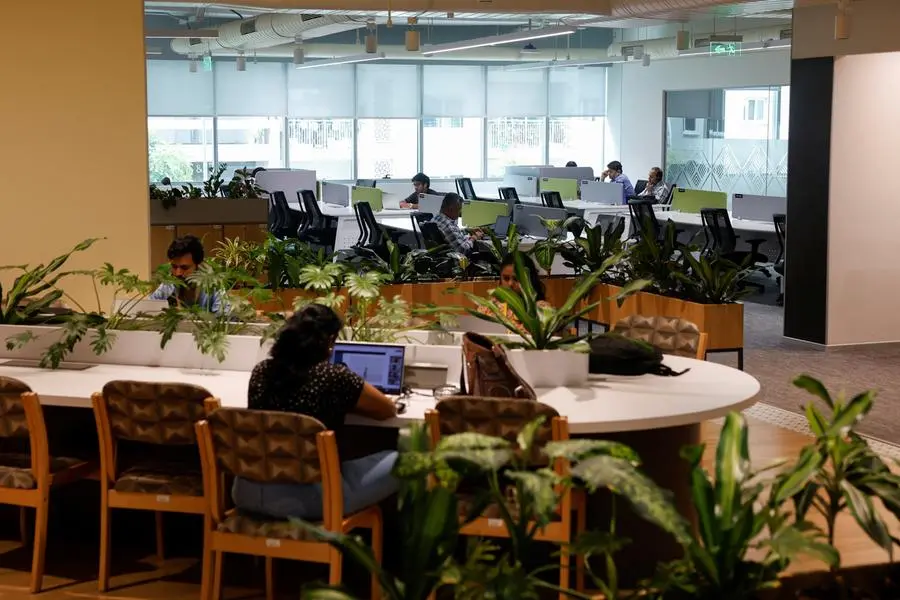
HONG KONG - India's long-vaunted services sector has been boosted in recent years by the exponential growth of Global Capability Centres, multinational corporations’ offshore hubs. However, President Donald Trump’s administration is now threatening to dramatically alter the landscape for Indian workers, even as GCCs face several domestic challenges.
By the end of 2024, India had 1,700 GCCs, wholly owned and controlled by their overseas parent companies. GCCs generated over $64 billion in revenue last year and employed almost 2 million people, accounting for 17.2% of India’s service exports, up from 12.5% in 2015, according to FactSet. India has much to offer global corporations, including a low-cost talent pool of 1.5 million engineering graduates a year, as well as urban workers with English language skills and an efficient digital connectivity infrastructure.
GCCs used to primarily be back-office support hubs. Repetitive jobs like customer support and HR operations represented 60% of their activities in 2010, according to GCC Consulting. But they constitute only around 20% today, giving way to more knowledge-intensive R&D, technology and financial services work. Nearly one-fifth of the world’s chip design engineers, including those of Intel, Nvidia, Qualcomm and MediaTek, are located in India. Amazon’s largest office in the world in terms of area and headcount is in Hyderabad. And almost 20% of Goldman Sachs’s global staff are in Bengaluru and Hyderabad.
In short, India's GCCs are now a significant cog in the global economy.
A U.S. SPANNER
However, the U.S. has thrown some rather large spanners in the works that could disrupt India’s relationships with global corporations. First, the administration introduced a new $100,000 application fee for H-1B visas, over 70% of which were given to workers from India last year. This could shut down one of the main talent channels for U.S. technology companies, driving up IT service costs and increasing the offshoring of services, according to technology research provider Forrester.
On the face of it, this should be good for Indian GCCs. Not only could it increase their revenue pool, as it would likely result in more U.S. companies relying on offshore talent, it could also help India retain more of its skilled workers. But the U.S. could also hike the cost of offshoring via the recently proposed HIRE Act (Halting International Relocation of Employment), which seeks to impose a 25% tax on payments by U.S. businesses to foreign entities for services directly or partially benefitting American consumers.
The act may not have enough support to become law. And even if it does, the additional tax would not meaningfully reduce the cost advantage of GCCs compared to paying for the equivalent services in the U.S. or other Western nations. But the proposal of the HIRE Act sends a signal that Washington is becoming increasingly serious about curbing offshoring by U.S. companies. Several Western nations appear to view the U.S.’s growing aversion to overseas talent as an opportunity. Germany’s ambassador to India recently highlighted Germany's stable immigration policies and high-end jobs in a message specifically targeted to “talented Indians”.
FURTHER OBSTACLES AHEAD
Domestic obstacles could also upend the growth of Indian GCCs, most notably the limited availability of workers with the right skill set. India’s largest staffing company TeamLease recently noted that only 45% of India’s engineering graduates each year are meeting industry standards in terms of skill-readiness, a number that’s shrinking further as they struggle to keep up with advancements in artificial intelligence. Collaborations between industry and academia will therefore be essential. While such efforts are being supported by several programmes, this will likely need to be accelerated. India’s GCCs will also need to look beyond the top-tier cities for talent. The Ministry of Electronics and Information Technology’s upcoming GCC policy framework has specific targets for GCCs in tier-2 and tier-3 cities such as Kochi, Jaipur and Indore.
Still, meeting all of the government’s GCC targets will likely be challenging given not only the talent issues, but also the gaps in physical and digital infrastructure outside of the top-tier cities.
GCCs have the potential to continue boosting India’s service exports for years to come. But sustaining this growth will require policy interventions and significant investments. It’s a long road ahead.
(The views expressed here are those of Manishi Raychaudhuri, the founder and CEO of Emmer Capital Partners Ltd and the former Head of Asia-Pacific Equity Research at BNP Paribas Securities).
Enjoying this column? Check out Reuters Open Interest (ROI), your essential new source for global financial commentary. ROI delivers thought-provoking, data-driven analysis of everything from swap rates to soybeans. Markets are moving faster than ever. ROI can help you keep up. Follow ROI on LinkedIn and X.
(Writing by Manishi Raychaudhuri; Editing by Anna Szymanski, Kirsten Donovan)