PHOTO
(The views expressed here are those of the author, the Chief Market Analyst for Zaner Ag Hedge.)
LONDON - This was a year of abundance for grains, with strong corn, soybean and wheat harvests rising to meet the world’s expanding appetite, generally keeping prices in check.
Demand was the far bigger wildcard due to spiking trade tensions, as the United States pitted itself against the world and China in particular in its efforts to balance trade deficits.
Both themes – rising global output and trade pressures – are likely to stick around in agricultural markets next year. But where will abundant supply most likely be found in 2026?
Here’s a hint: probably not in the cattle market.
WORLD GRAIN BOOM
Global wheat supplies are typically inflated by massive Chinese stockpiles, but that is not the case in 2025-26. For the first time in several years, most major wheat exporters around the world reaped bumper harvests, producing at least 10% more wheat than in 2024-25.
This has driven up 2025-26 world wheat stocks outside of China by a massive 13.5%, the largest annual increase in 16 years, though the global bump is just 6% with China included.
Chicago wheat prices responded in late 2025 by dipping below $5 per bushel for the first time in more than five years.
The corn picture is also nuanced. The U.S. Department of Agriculture pegs 2025-26 global corn stocks at a 12-year low, but that changes to a six-year high when excluding China.
Ultimately, sinking profitability could send 2026-27 U.S. wheat acres to all-time lows, per early USDA estimates, and plantings could also decline in top exporter Russia.
US SOY EXPORT SHARE TUMBLES
U.S.-China trade tensions reignited in early 2025, causing U.S. soybean exports to China to dry up by mid-year, kicking off what would be a six-month shipment drought.
Activity resumed in late 2025, following a Washington-Beijing truce laying out Chinese buying targets for U.S. soybeans, though most evidence suggests China doesn’t actually need these supplies and that the 2025–2028 targets won’t provide sufficient support to U.S. farmers.
U.S. soybean market share has been under threat for years, declining sharply following the 2018 trade war with China during President Donald Trump’s first term.
Since then, top exporter Brazil has ramped up soybean output by 40% and appears set for another record crop in 2025-26, taking advantage of U.S.-China quarrels. The USDA projects the United States will account for a record-low 24% of global soybean exports in 2025-26, with Brazil expected to notch a record-high 60%.
U.S. soybean plantings in 2026-27 are expected to rebound from historically low 2025-26 levels. However, there is significant uncertainty surrounding acreage due to ongoing geopolitical risks.
US STILL KING OF CORN
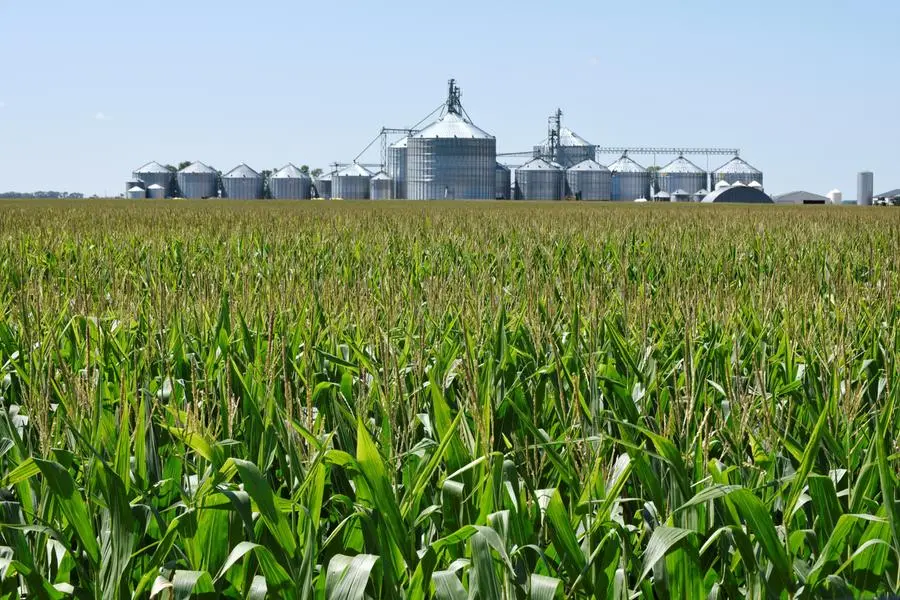
The U.S. share of global agricultural exports may be slipping, but don’t blame corn. Driven by both soybean woes and strong global corn demand, U.S. corn plantings approached 99 million acres in 2025-26, an 89-year high.
Additionally, the U.S. corn yield in 2025-26 is set to exceed the USDA’s trendline for the first time in seven years. Luckily for farmers, this staggering output was met by an acceleration of demand from already-robust 2024-25 levels.
Just three years ago, U.S. corn exporters appeared to be permanently losing their edge to Brazil, but the United States is fully in command of the 2025-26 corn trade. It is expected to account for 40% of total global corn exports, with Brazil a distant second at 21%.
U.S. corn shipments have been on fire for nearly a year, setting a slew of weekly records following the recent harvest. The USDA estimates that 2025-26 U.S. exports will rise 12% from last year’s high.
While the U.S. corn area should remain historically strong in 2026-27, feed demand is questionable as animal herds are contracting. This could be a wet blanket for corn bulls next year.
IS BEEF STILL FOR DINNER?
Yes, it is. U.S. consumers are still hungry for beef and apparently don’t mind paying up for it.
The U.S. cattle herd shrank to a 75-year low in 2025 after years of drought and elevated feed costs forced producers to liquidate herds. In the fallout, some major U.S. beef plants have announced 2026 closures.
Both U.S. cattle futures and beef prices screamed higher this year, though consumers hardly batted an eye. At the wholesale level, monthly U.S. beef prices in the second half of 2025 have remained at levels nearly 20% above prior maximums.
Meanwhile, the USDA projects total U.S. beef consumption in 2025 could near record-high levels, even with per-capita consumption dipping below historical peaks.
Demand could slightly soften in 2026, however, due to increasing inflationary pressures as supplies will almost certainly remain constrained.
US-CHINA TRADE HITS 20-YEAR LOW
Although the Trump administration is attempting to revitalize U.S. farm exports, China slashed purchases across the board this year, including for soybeans, corn, cotton, sorghum and beef.
Through the first nine months of 2025, U.S. agricultural and related exports to China fell just short of $8 billion. Adjusted for inflation, that is a 20-year low and down 54% on the year.
It’s not just China. Inflation-adjusted values of total U.S. farm exports to other countries have been slowly easing for at least a decade, a trend masked by sky-high prices. The decline is attributable to both rising global competition and shifting demand habits.
Given recent U.S.-China agreements, this trade flow will remain in the spotlight for at least the next three years, with periods of heightened uncertainty almost guaranteed.
One of the major reasons to doubt optimism about Beijing ramping up purchases of U.S. agricultural goods is the slowdown in China’s economic growth, which is expected to continue next year.
(The views expressed here are those of Karen Braun, the Chief Market Analyst for Zaner Ag Hedge and former Reuters agricultural columnist. Karen is the author of Karen’s Market Context, a data-driven newsletter featuring her agricultural commentary, charts and other insights.)
Enjoying this column? Check out Reuters Open Interest (ROI), your essential new source for global financial commentary. ROI delivers thought-provoking, data-driven analysis of everything from swap rates to soybeans. Markets are moving faster than ever. ROI can help you keep up. Follow ROI on LinkedIn and X.
(Writing by Karen Braun; Editing by Anna Szymanski, Kirsten Donovan)