PHOTO
LONDON - Supply disruption and tariff dislocation have defined the London Metal Exchange (LME) base metals complex this year.
The demand picture is far from rosy, but supply-chain stress has still lifted the LME Index, a basket of the exchange's six base metals contracts, to its highest level since the all-time peak in 2022.
That was the year Russia invaded Ukraine.
This year's turbulence has come from a different direction, as markets navigate U.S. President Donald Trump's topsy-turvy tariff world.
Financial markets have recovered from their "Liberation Day" swoon in April, but targeted U.S. aluminium tariffs and the threat of copper tariffs are causing tectonic shifts in trading patterns.
Tariff dislocation adds complexity to the spectrum of supply risk facing individual metals and helps explain the wide divergence in performance this year.
DOCTOR COPPER'S SPLIT PERSONALITY
LME three-month copper has been punching out fresh all-time highs this month as it challenges the $12,000 per metric ton level.
The CME's U.S. copper contract is trading higher still because it's pricing in possible tariffs on imports of refined metal. The Trump administration has deferred a decision until the middle of next year, but the threat of tariffs has proved as disruptive as the reality.
The world's surplus copper has gravitated towards the U.S., lifting CME stocks to multi-year highs and leaving everyone else short of metal.
Feast or famine? Copper is currently both depending on where you are.
The arbitrage between CME and LME copper has been a wild ride this year as tariffs were on, then off, then on again maybe. Until Trump makes up his mind, it will continue to define global flows of refined copper.
TIN HAS NEW FUND FRIENDS
While copper has grabbed the headlines, this year's star turn has come from tin, a market grappling with multiple supply threats.
Tin's problem is too much mine supply is concentrated in too few countries, including high-risk jurisdictions such as the Democratic Republic of Congo and the semi-autonomous Wa State in Myanmar.
Extra volatility is coming from increased fund participation in the smallest of the LME's core contracts.
Tin appears to be moving onto the investment radar as the world wakes up to the fact that, in the form of circuit-board solder, the Bronze Age metal has a bright future in the coming Internet-Of-Things Age.
ALUMINIUM - MIND THE CAP...AND THE GAP
Aluminium has been the third strongest LME performer this year, reflecting a growing awareness that production in China, the world's largest producer, is now bumping against the government's mandated capacity cap.
Not everyone agrees with Citi's call that aluminium is "sleep-walking into the biggest (supply) deficits in 20 years", but it's certainly a long time since the market has paid so much attention to new smelter projects outside of China.
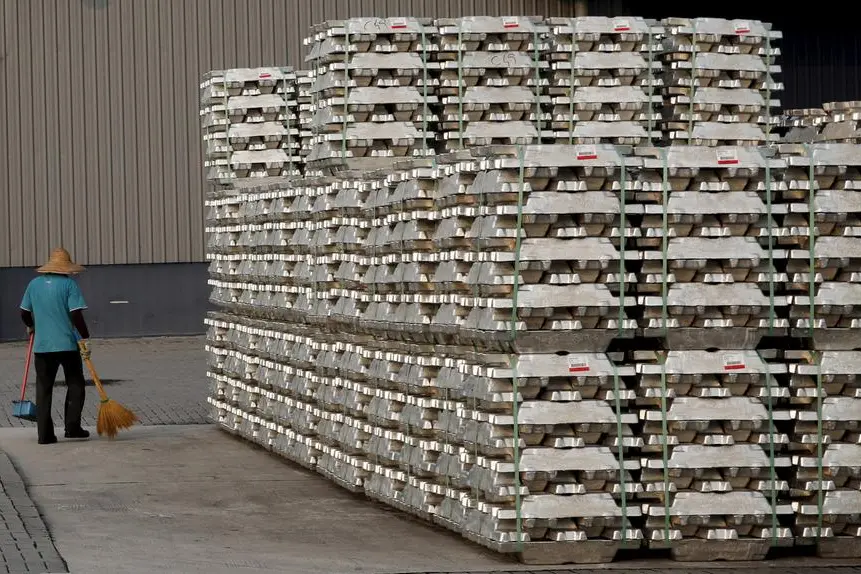
Aluminium trade flows, already dislocated by sanctions on Russian metal, have been further fractured by the doubling of U.S. import tariffs. The premium for U.S. delivery stands at a record 89 cents per lb ($1,967 per ton) over the LME price. That's also a premium over the implied 50% tariff rate, suggesting that the U.S. is now running short of metal.
ZINC SURPRISE
And talking of sleep-walking into a deficit, the LME zinc market was rocked by a ferocious squeeze in October.
The cash premium over three-month delivery flexed out to over $300 per ton backwardation, a record level, as LME stocks fell to just 50,000 tons.
This was supposed to be a year of zinc surplus as a wave of new mine supply washed through the supply chain.
But the surplus has all ended up in China.
Global mine production rose by a robust 6.5% year-on-year and refined output by 2.9% year-on-year in January-October, according to the International Lead and Zinc Study Group.
However, Western production of refined zinc actually fell by 2.2%, reflecting a mix of closures, suspensions and unforeseen smelter hits.
This month's implosion of the LME spread structure suggests Chinese surplus is on the move to satiate Western hunger.
TOO MUCH LEAD
There's no shortage of lead. Nor is there likely to be one any time soon.
Warehousing the stuff is as profitable as trying to sell it in the physical market, which is why traders have spent the year arm-wresting units off each other to profit from warehouse incentives.
Over a million tons of lead have been delivered in and out of LME warehouses this year for a net rise of just 16,425 tons in registered inventory.
The noise masks the signal coming from the underlying uptrend in combined LME registered and off-market stocks, which have risen from 21,500 tons at the start of 2023 to over 440,000 tons.
INDONESIAN BOOM, NICKEL BUST
Nickel stocks have also mushroomed thanks to Indonesia's continued production boom, which has caused global supply growth to far outstrip demand.
The good news is that exchange stocks would be even higher had there not been what Macquarie Bank describes as "large unreported strategic stockpiling" in China.
The bad news is that the LME has just approved a new Indonesian nickel brand, produced by PT Eternal Industry at a rate of 50,000 tons per year.
Nickel is currently enjoying an end-of-year bounce on renewed hope that Indonesia can tame its production growth in 2026, which says everything you need to know about the nickel market right now.
Andy Home is a Reuters columnist. The opinions expressed are his own. Enjoying this column? Check out Reuters Open Interest (ROI) for thought-provoking, data-driven commentary on markets and finance. Follow ROI on LinkedIn and X.
(Editing by Marguerita Choy)