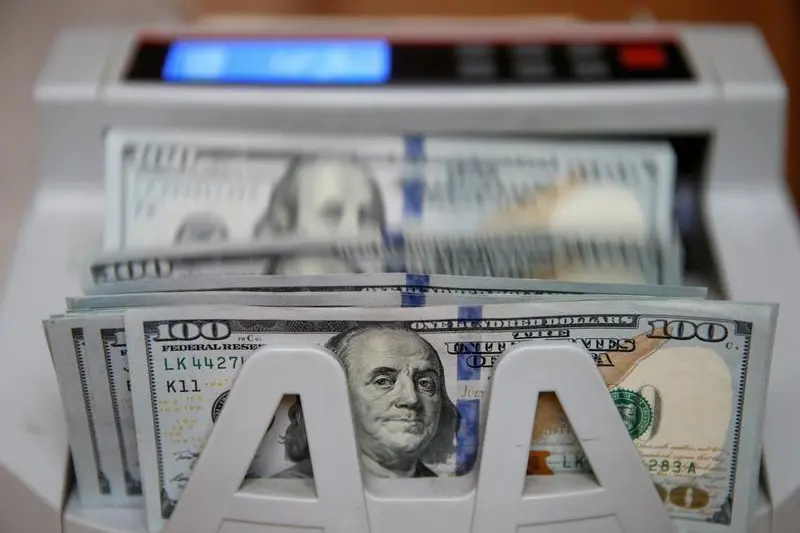
PHOTO
(The opinions expressed here are those of the author, a columnist for Reuters.)
LONDON - Suddenly, the dollar is back on the slide, on an inkling that Washington is ready to use more than words to reverse its long-standing overvaluation in pursuit of a global trade reset. But trying to prod gigantic currency markets into seismic shifts could get very messy indeed.
A relatively placid start to the year for foreign exchanges, despite major geopolitical ructions, had many assume the dollar's precipitous early year slide in 2025 had petered out. Re-accelerating U.S. growth and its re-invigorated asset markets had drawn a line under it in many investors' eyes.
But the past week has seen Japanese authorities try to rope in U.S. counterparts to defend the ailing yen ahead of elections next month. That revived speculation Washington could take more direct action to keep the dollar down and perhaps even reverse years of broad dollar appreciation.
Even though no official selling of dollars was detected, a "quote check" from U.S. authorities on Friday - often seen as a prelude to intervention - sent the dollar/yen pairing plunging. Subsequent Japanese warnings against excessive yen weakness point back to last September's joint Washington-Tokyo statement.
The dollar slide hasn't been confined to the yen. South Korea's won has rebounded, while China's yuan and Australia's dollar hit their highest in three years. The move shifted to Europe on Tuesday, with the euro soaring to its highest level in almost five years and the Swiss franc climbing to 10-year peaks.
The dollar's index against the most traded currencies - which had its worst first half of any year of the floating exchange era in 2025 - plumbed its weakest since early 2022.
SMOKING GUN?
The narrative returns once more to a long-standing assumption that President Donald Trump's administration wants a deeper unwind of the dollar's near-50% real rise in the decade before his return to power, as part of a push to shrink U.S. trade deficits. Many of his closest advisers see tariff hikes and a more competitive exchange rate as central planks of any reboot of America's industrial economy.
Despite last year's dollar drop, the real effective exchange rate index has shaved only about 8% from the peak a year ago - and still sits 35% above levels in 2011. Although Treasury Secretary Scott Bessent has been vague about the administration's overall attitude to the dollar exchange rate - and may well have supported Japan on the yen simply to prevent an explosive rise in Japanese government bond yields going global - speculation has swirled nonetheless.
Inevitably, attention has returned to pre-election papers by Trump adviser — now Federal Reserve Governor — Stephen Miran, which raised the prospect of a so-called "Mar-a-Lago Accord": a multi-pronged effort to devalue the dollar, echoing the 1985 Plaza Accord, when G5 powers coordinated to sell dollars and puncture the Reagan-era surge. But even if a weaker dollar suits Japan for now, it's hard to see why Europe or China would sign up for a forced jump in their own currencies — especially given the rancorous state of trade and political relations with the Trump administration.
And sending any such signal to global currency markets, which turn over almost $10 trillion a day, risks opening a Pandora's box of other potential problems.
'DOUBLE-EDGED'
The big concern for Washington about sowing seeds of a dollar devaluation in an election year is what that may mean for the stability of gigantic net foreign ownership of U.S. assets - more than $27 trillion and rising as of late last year.
The prospect of unhedged U.S. stocks and bonds suffering a 10-20% dollar hit may well destabilize that unprecedented investment imbalance - now a U.S. liability to the rest of the world of about 90% of GDP. Japanese investors are the single biggest overseas holders of U.S. Treasuries and European investors hold $8 trillion of U.S. stocks and bonds.
What's more, any sudden and sharp dollar slide would complicate things further for Fed policymakers, who are already mindful of tariff-driven imported inflation and have been signalling a longer pause in rate cuts despite political pressure.
That suggests to many that Washington may sidestep this.
"Treasury Secretary Bessent is well versed on the double-edged nature and tensions inherent in any attempt to drive the dollar significantly lower for U.S. bond markets, inflation, and in fueling the latest round of 'sell US' market narrative," wrote SGH Macro Advisors economist Tim Duy.
Even if "Mar-a-Lago Accord" suspicions are fanciful, others see an anti-consensus dollar slide resuming regardless.
Stephen Jen of Eurizon SLJ Capital reckons the market is embarking on a second leg of a structural dollar correction - one which he thinks can coincide with buoyant growth and stock markets, and still be consistent with Washington's aggressive trade stance.
"In 2025, the dollar only experienced roughly one-third of its structural correction, in my guesstimate," Jen wrote. "The next third will likely come mainly against Asia, (and) euro/dollar may rise in sympathy."
But juggling fresh dollar weakness, brisk growth, high debt and Fed pressure alongside the biggest long position in U.S. assets in history may be a hard act to pull off without triggering broad market ructions or extreme volatility.
Against such an aggravated political and geopolitical backdrop, it seems even trickier. The eye-popping rise of gold over the past year doesn't seem so strange in that light.
(The opinions expressed here are those of the author, a columnist for Reuters.)
Enjoying this column? Check out Reuters Open Interest (ROI), your essential new source for global financial commentary. Follow ROI on LinkedIn, and X.
Plus, sign up for my weekday newsletter, Morning Bid U.S. and listen to the Morning Bid daily podcast on Apple, Spotify, or the Reuters app. Subscribe to hear Reuters journalists discuss the biggest news in markets and finance seven days a week.
(by Mike Dolan; Editing by Marguerita Choy)