PHOTO
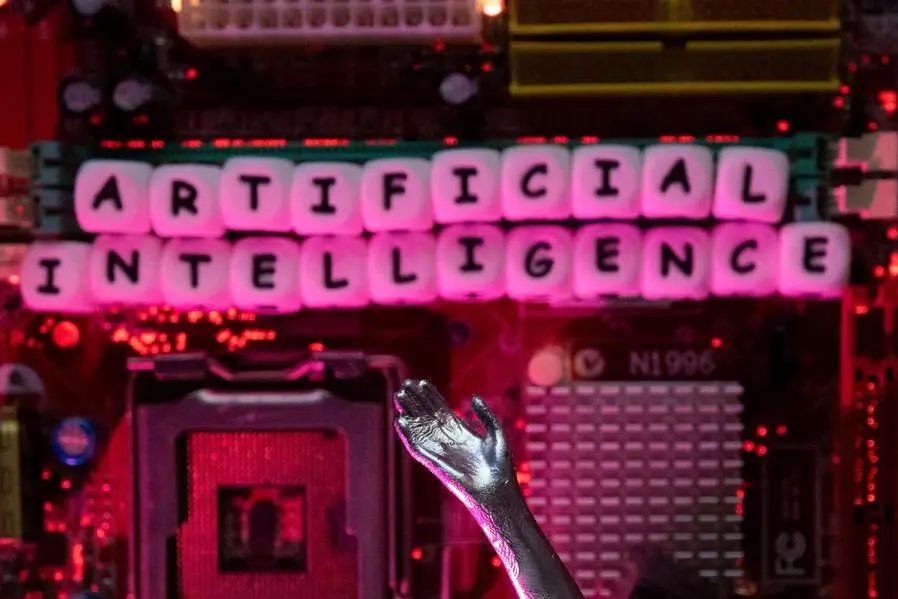
LONDON - The artificial intelligence boom once again shielded the stock market from the sharp macroeconomic edges of 2025. But there's a gnawing anxiety that the dominant AI theme could do the opposite next year - even as it overshadows the real economy.
After this year's early turbulence and disruption, the global economic outlook for 2026 looks remarkably bright, even though there's a reasonable assumption that 2025's 20% world stock market gain - close to its best year since before the COVID-19 pandemic - has baked most of that in already.
Global economic growth is expected to top 3% next year, fiscal stimulus from the U.S., Germany, Japan and China is set to kick in and interest rates - in America at least - are still set to fall further. Corporate earnings growth estimates for next year in the U.S., Europe and Asia are a racy 12-15%.
But while any number of issues could crash that party, few now doubt next year's market outcome will once again hinge on the fate of the AI story.
Since ChatGPT's arrival three years ago, the AI theme has been unambiguously positive for stock index values regardless of the underlying economic or interest rate stories in those years.
But its ability to outweigh other macro variables may cut both ways.
Schroders Chief Investment Officer for equities Alex Tedder reckons that because the largest U.S. firms account for more than 70% of the capex spending surge this year, "it is no exaggeration to say that the fate of the U.S. stock market, as a whole, depends on continued confidence in the future of AI."
No pressure then.
Stock index valuations are already expensive nearly everywhere relative to recent 15-year medians. Just 10 AI-infused U.S. megacaps now account for 40% of the S&P 500 and U.S. stocks now account for 65% of MSCI's all-country stock index.
There's an awful lot riding on this.
Tedder acknowledges the growing anxiety about AI overspend, doubts about eventual returns and the circularity of investment between the megacaps. But he feels the growth, optimism and valuations can persist for a while yet.
For one, he points to signs that Alphabet's AI deployment is already contributing to revenue growth in its cloud, search and YouTube divisions.
ChatGPT itself is generating revenue of about $20 billion this year and Schroders' analysis shows that could rise to $200 billion by 2030. If parent OpenAI were listed, a "not unrealistic valuation" of 10 times forward sales would put its market cap at $2 trillion from current estimates of $500 billion.
"The enthusiasm for AI investment suddenly becomes quite rational," he wrote, adding that there's likely another leg to the market journey despite all the reasonable caution.
BACK TO THE FUTURE
But if already historically expensive markets continue to rise, fear of a sharp correction will inevitably persist.
And it's here that skeptics outline the scale of the risk.
Carlyle investment strategist Jason Thomas has all year framed the whole AI build-out in terms of an effective re-industrialization of America that's making its once "asset-light" cash generating mega firms into "asset-heavy" companies of old with bricks, mortar and equipment back on their books.
This, he argues, is where the wider economy, the AI theme and the stock market all come together. A rethink of valuations of companies which once soared on near cost-free revenue creation from software design, digital development and "intangibles" is now overdue.
With the AI investment boom in datacenters and physical infrastructure needed to support it - and debt being increasingly incurred to fund that - the way the market has been valuing these companies needs to change too.
In his latest number crunch on the issue, Carlyle's Thomas focuses on the use of price-to-book (P/B) ratios - capturing market value relative to accounting value - in the 1990s as the most statistically significant model of future returns.
He points out that in 17 years to 2007, the 20% of "cheapest" stocks on a P/B ratio outperformed the most expensive 20% by 4.5 percentage points a year.
But, since the banking crash of 2008, the most expensive 20% outperformed the cheapest by some 5% a year - mainly because the winners seemed overvalued on P/B metrics and yet were rich in tech intangibles not reflected in accounting statements and often with zero marginal costs.
The capital intensity of the new AI push changes all that, he argues, adding that the five mega companies at the center of the boom - Microsoft, Meta, Amazon, Alphabet and Oracle - have increased physical assets by 50%-200% in just two years.
In the process, their cash return on equity - the free cash flow generated per unit of book value - has declined by between 600 and 1300 basis points.
And yet investors continue to value the companies as if nothing had changed.
In what he admits might be an overly "restrictive" example for illustrative purposes, Thomas said these companies' market caps would be roughly half of what they are today if you assumed the physical assets on balance sheet were valued at cost and a 10 times P/B multiple assigned to the rest.
"It raises questions about customers' capacity to fund the operating expenses necessary to push the return on this capital to levels that validate current valuations."
High stakes indeed - whatever the real economy is doing.
The opinions expressed here are those of the author, a columnist for Reuters
-- Enjoying this column? Check out Reuters Open Interest (ROI), your essential new source for global financial commentary. Follow ROI on LinkedIn. Plus, sign up for my weekday newsletter, Morning Bid U.S.
(by Mike Dolan; Editing by Marguerita Choy)