PHOTO
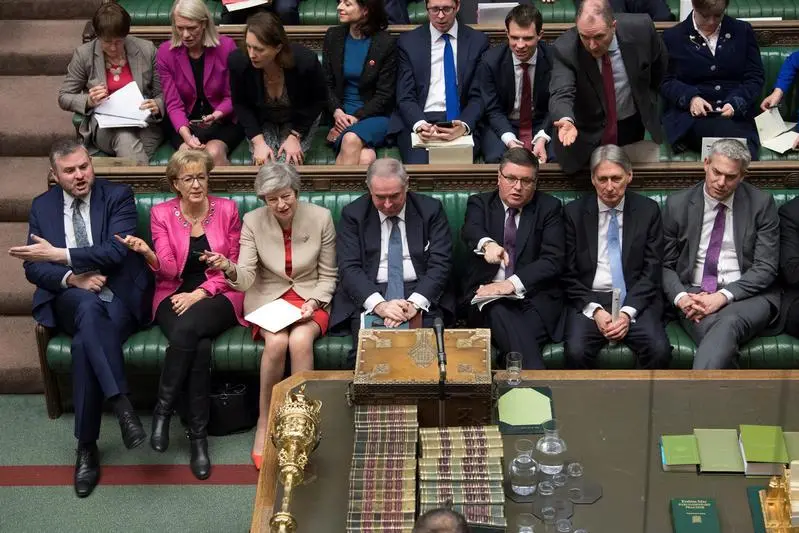
LONDON - Only one definite conclusion can be drawn from Theresa May’s latest parliamentary defeat. Britain will not leave the European Union on March 29, despite the prime minister’s repeated promises that it would. After lawmakers on Friday voted by a majority of 58 to reject her Brexit deal for the third time, the country will remain part of the bloc for at least another two weeks.
What happens next is less certain but there are four broad conclusions to be drawn. The first is that May’s deal is almost certainly dead. The latest vote was much closer than the first two attempts, which saw the government defeated by 230 and 149 votes, respectively.
Nevertheless, 34 members of May’s Conservative party rejected the withdrawal agreement, as did the 10 members of the Northern Irish Democratic Unionist Party on which her government’s majority depends. May would either need to change their minds, or persuade an equivalent number of opposition members to switch sides. Both look unlikely.
Instead, parliament will keep trying to find a compromise that can command a majority. Though non-binding votes on different scenarios failed to deliver a winner this week, two options performed well. A proposal for Britain to join a permanent customs union with the EU attracted more than 260 votes in the 650-strong chamber. So did a plan to hold another referendum. Those alternatives may gain more support next week.
Any alternative Brexit plan would, however, require May to compromise at the risk of splitting her party, something she has consistently resisted for almost three years. That leaves her little choice but to call a general election in a desperate attempt to change the parliamentary arithmetic. But it’s hard to see how May, who this week promised to resign if her Brexit deal was approved, could credibly lead a campaign. The Conservatives might first have to choose a new leader. Either way, May would have to ask the EU to delay the Brexit date again.
A lengthy extension is therefore the most plausible outcome. Yet other options cannot be ruled out. These include a chaotic “no deal” Brexit on April 12, which the European Commission now says is a “likely scenario”. More than 33 months after Britain voted by a narrow majority to quit the EU, the country still cannot agree how to leave, or whether to do so at all. That’s the hardest lesson of all.
On Twitter https://twitter.com/peter_tl
CONTEXT NEWS
- British lawmakers on March 29 rejected Prime Minister Theresa May’s Brexit deal for a third time, leaving the country’s withdrawal from the European Union in turmoil on the very day it was supposed to leave the bloc.
- After a special sitting of parliament, lawmakers voted 344-286 against May’s withdrawal agreement, which had been agreed after two years of tortuous negotiations with the bloc.
- Within minutes of the vote, European Council President and summit chair Donald Tusk said EU leaders would meet on April 10 to discuss Britain’s departure.
- The European Commission said that “a ‘no-deal’ scenario on 12 April is now a likely scenario”.
- The pound fell as much as half a percent to $1.2977 after the vote before rebounding. It was largely unchanged against the U.S. dollar at $1.303 by 15.45 GMT on March 29.
- For previous columns by the author, Reuters customers can click on LARSEN/
- SIGN UP FOR BREAKINGVIEWS EMAIL ALERTS http://bit.ly/BVsubscribe
(The author is a Reuters Breakingviews columnist. The opinions expressed are his own.)
(Editing by Swaha Pattanaik and Amanda Gomez) ((peter.thal.larsen@thomsonreuters.com; Reuters Messaging: peter.thal.larsen.thomsonreuters.com@reuters.net))