PHOTO
LONDON - The 2019 Nobel Prize in economics is a victory for the academics of Cambridge, Massachusetts. It’s also a slight rebuke to a large amount of economic theory and a reward for making the world better.
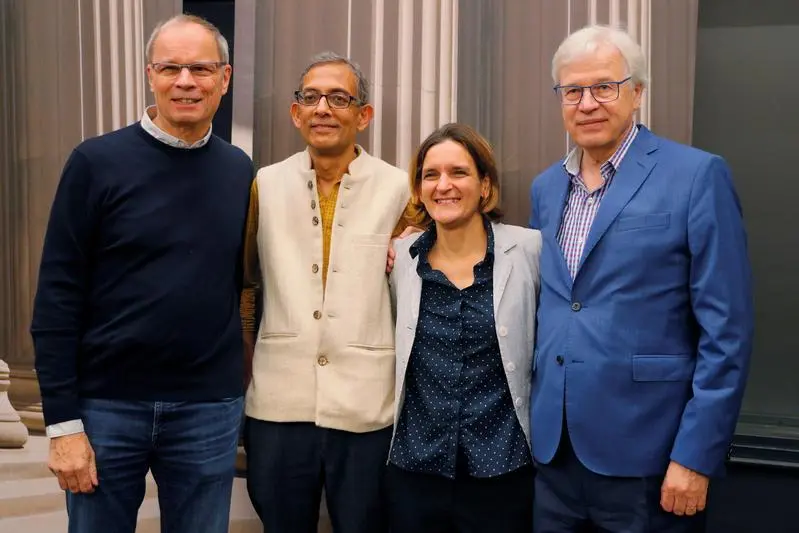
Two of the winners, Abhijit Banerjee and Esther Duflo, who are now husband and wife, teach at the Massachusetts Institute of Technology. The third, Michael Kremer, works down the road at Harvard. The trio on Monday received the Nobel for “for their experimental approach to alleviating global poverty”. The experimental part of the citation refers to their pioneering use of randomized controlled trial in economics.
RCTs are familiar in most of the scientific world. Take two groups of people who are similar in relevant ways, for example in the distribution of ages and incomes, and in their initial health. Give one group a drug and another a placebo, and see whether the treated group has better outcomes. Such tests have been around for almost two centuries and spread into many other fields, from ecology to marketing. However, many economists long preferred elegant and rather hypothetical models to the complex and often murky results of real-life experiments.
Kremer, followed by Banerjee, and later Duflo helped one part of the dismal science, development economics, catch up with best practice elsewhere. For example, Kremer and others studied the effects of preventive medicine in Kenyan villages. By comparing villages with and without universal child-deworming, they found that the universal approach helped reduce the presence of parasitic worms in neighbouring villages.
Banerjee and Duflo concluded that paying bonuses to Indian teachers for coming to work improved students’ test results more than using the same amount of money to buy additional textbooks or hire extra teachers. Duflo’s work on microcredit suggested that this much-lauded technique for funding the projects of very poor people had little effect.
The Nobel committee’s explanatory essay says that the “credibility revolution” took advantage of a “well-articulated microeconomic theory on…incentives and information”, but that is too kind to the state of the discipline. Untested, and often untestable, claims about motivations and behaviour are right at the centre of neoclassical theory.
As might be expected from an approach which deals with real-life complexity, the RCT approach discredits simple theories of development. It turns out that there is no recipe for enrichment. Rather, growth comes as individuals, communities and states change a rich matrix of established customs, widespread ignorance and unhelpful power relations.
The details are welcome, but inevitably entail controversy. It is hard to ensure that the tested groups are really comparable and that the issue being tested caused the results that are measured. Effects often cannot be measured easily. If some technique works in one part of Kenya, it may not work in another part of the same country, let alone in Uganda or Bangladesh.
Development economists now spend a fair amount of their time criticising, defending and refining RCT studies. A few years ago, Kremer was involved in a “deworming war” with economists who argued that his original study did not show what he claimed it did.
The controversies are frustrating, just as the work of practical testing is hard. Unlike most economic theorists, who can do maths in an office, experimental development economists cannot hope to succeed without the sort of field work usually associated with anthropology. First-hand experience is a prerequisite for determining whether the right questions are being asked.
The Nobel laureates have led more economists to do the work and to ask the right questions. They generally do so with less ideological bias than the free-market and big-government schools that fight over theory and evidence in other parts of the discipline.
Neither ideology seems terribly relevant to the fight against grinding poverty. Much progress has been made in the last two decades, thanks to both markets and governments, but also to many other factors. Banerjee, Duflo, Kremer and their peers are helping with the next phase. They richly deserve this accolade.
CONTEXT NEWS
- Abhijit Banerjee and Esther Duflo of the Massachusetts Institute of Technology, and Michael Kremer of Harvard University were awarded the Sveriges Riksbank Prize in Economic Sciences in Memory of Alfred Nobel for 2019.
- The award, announced on Oct. 14, was “for their experimental approach to alleviating global poverty”.
(Editing by Swaha Pattanaik and Karen Kwok)
© Reuters News 2019