PHOTO
LONDON/SYDNEY - Share markets sagged on Thursday as cracks quickly began to appear in the fragile Gulf truce, nudging oil prices back up toward $100 a barrel and reminding investors the inflationary fallout would last a long while yet.
Crucially, there was scant sign that the Strait of Hormuz was open in any meaningful way, with Iran flexing its control over the vital oil artery and demanding tolls for safe passage.
President Donald Trump took to social media to declare U.S. forces would remain in the Gulf until a deal was reached and complied with, otherwise the "'Shootin’ Starts,' bigger, and better, and stronger than anyone has ever seen before."
Meanwhile, Israel has carried out its heaviest strikes on Lebanon since its conflict with Iran-backed Hezbollah militia began last month, killing more than 250 people on Wednesday.
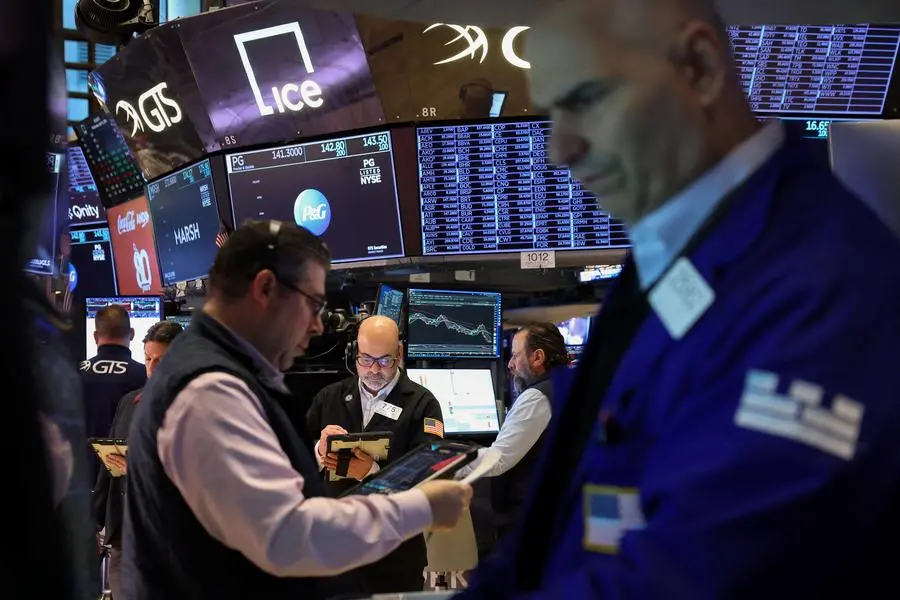
As a result, Brent crude futures rose 2.5% to $97.28 a barrel, U.S. WTI futures bounced 3.3% to $97.55 and the pan-European STOXX 600 index opened 0.2% lower having leapt 3.7% on Wednesday following the ceasefire announcement.
UBP's Head of Investment Services UK Peter Kinsella said the moves showed markets remained focused on trading headlines, although apart from the big swings in oil prices, he stressed volatility in most of the main currencies was still limited.
"It is very difficult for investors as they are dealing with a conflict where the protagonists don't even know what they want," Kinsella said.
SPLUTTERING GERMANY
Europe's government bond yields - which drive the cost of borrowing - were also nudging higher again in early trading having plunged on Wednesday.
Data from Germany showed industrial production fell unexpectedly in February, showing Europe's largest economy was subdued and on course for another quarter of contraction even before the Iran war.
Overnight in Asia, Japan's Nikkei hadended 0.7% lower after jumping 5.4% the previous session. South Korea dipped 1.6%, following a leap of 6.8%.
Chinese blue chips also slipped 0.6%, while MSCI's broadest index of Asia-Pacific shares outside Japan eased 0.7%. On Wall Street, S&P 500 futures and Nasdaq futures were both off around 0.4% ahead of their restart later.
INFLATION IS INEVITABLE
With oil prices still around 40% higher than pre-conflict, an inflationary spike is about to show up in the hard data across the globe.
Figures on U.S. core prices for February due later Thursday are expected to show a chunky 0.4% rise for a second month, and that was before the surge in energy costs.
State Street's PriceStats' inflation metrics meanwhile show March has seen the biggest month-on-month increase in prices since at least 2008 when its data series began, according to its head of Macro Strategy Michael Metcalfe. Minutes from the Federal Reserve's last policy meeting on Wednesday showed a growing number of members felt a rate hike might be needed to contain inflation, though many hoped the next move would still be a cut.
That tempered a rally in Treasuries, which proved modest compared to the big gains seen in European debt marketson Wednesday. Yields on U.S. 10-year notes sat at 4.296%, compared to 3.96% before the attack on Iran.
Fed fund futures imply only 6 basis points of easing for the rest of this year, having given up on 50 basis points of cuts since the end of February. Europe's money markets though still, by contrast, price in at least two ECB rate hikes this year.
"The committee broadly agreed that it was too early to act, suggesting the Fed will likely remain on hold this year, in line with our view," said analysts at JPMorgan in a note.
The shifting outlook for rates saw the dollar pare some of its knee-jerk losses, with the dollar index at 99.06 and the euro flat at $1.1660 and off its previous day's top of $1.1721.
The dollar inched up to 158.93 yen, having fallen as far as 157.89 at one stage on Wednesday. In commodity markets, gold inched back to $4,713 an ounce , after bouncing as high as $4,777 while European natural gas prices rebounded to 45.65 euros per megawatt hour (MWh) although the move was far more modest than in oil markets.
(Reporting by Marc Jones Editing by Keith Weir)