PHOTO
Pakistan's assets dipped on Wednesday after Indian military strikes targeted regions in Pakistan and Pakistani Kashmir, while a series of central bank decisions across Central Europe were due later in the day.
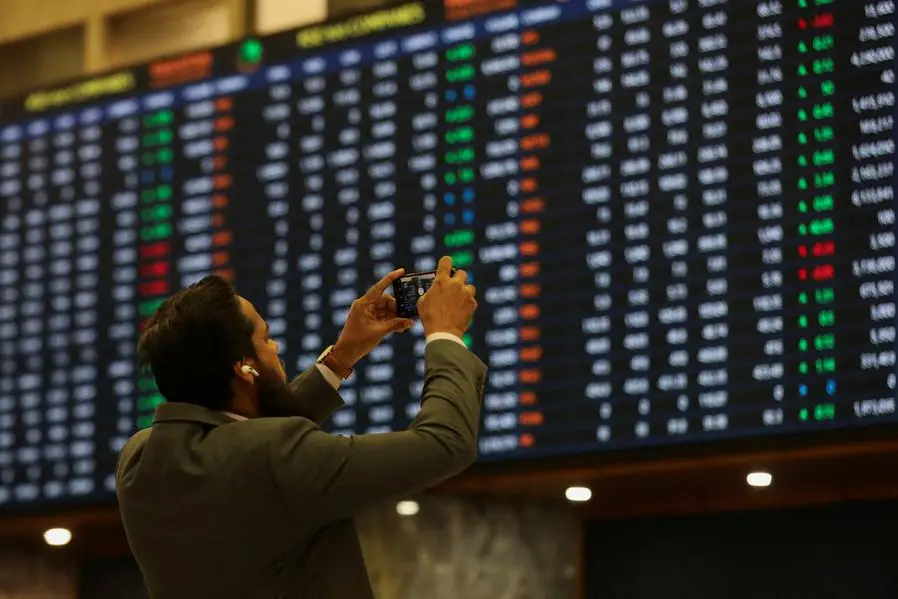
Islamabad's benchmark stock index plunged as much as 5.8%, while the Pakistani rupee weakened to a near two-week low against the U.S. dollar as India's attack in response to the killings of tourists in April escalated the most intense hostilities between the nuclear-armed neighbors in over two decades.
The nation's long-dated 2036 international dollar bond dipped by 0.9 cents, settling at a bid of 72.477 cents, according to Tradeweb data.
Indian equity benchmarks shook off initial losses to trade flat. The Indian rupee slipped 0.5%, while government bond yields dropped early in the session as traders indicated possible bargain buying by investors.
"The reliance of Pakistan on external capital inflow — in recovery from an external account crisis, in the midst of an IMF programme, and with under 3 months of import cover compared to over 9 months in India — makes its asset prices much more sensitive to any conflict than those in India," said Hasnain Malik, head of equity research at Tellimer, a research firm.
Meanwhile, MSCI's emerging market currencies index was marginally lower, while its stock counterpart held flat.
Turning to Central and Eastern Europe, the Czech koruna held firm against the euro, as markets awaited the Czech National Bank meeting amid expectation of what analysts describe as a "hawkish" quarter-point rate cut. Prague's benchmark stock index gained 1%.
"The rate cut is basically a deal done by 25bps. We expect forward guidance to be hawkish, while the new forecast should be more mixed," said Frantisek Taborsky, EMEA FX & FI strategist at ING.
The Polish zloty slipped 0.2% ahead of the National Bank of Poland's interest rate decision, where expectations are set for a reduction in borrowing costs for the first time since 2023. A Reuters poll suggests the central bank might implement a 50 basis point cut.
Warsaw's benchmark stock index rose 1%.
In Asia, cautious sentiment prevailed ahead of an impending meeting between top U.S. and Chinese trade officials. Hong Kong's Hang Seng relinquished early gains but managed to close up 0.1%, while China's blue-chip index ticked up 0.6%.
The rally in Asian currencies, buoyed by a softer dollar, fizzled out. The Taiwanese dollar declined 1.2% after posting an unprecedented 6% two-day surge against the greenback. The South Korean won fell 1.3% as minutes from the central bank suggested that another rate cut was on the cards.
Meanwhile, a rate cut in China exerted pressure on the Chinese yuan.
The spotlight is also on the U.S. Federal Reserve's rate decision, due later in the day. Investors expect no changes.
For TOP NEWS across emerging markets
For CENTRAL EUROPE market report, see
For TURKISH market report, see
For RUSSIAN market report, see (Reporting by Pranav Kashyap and Medha Singh in Bangalore; Editing by Mrigank Dhaniwala)
Reuters