PHOTO
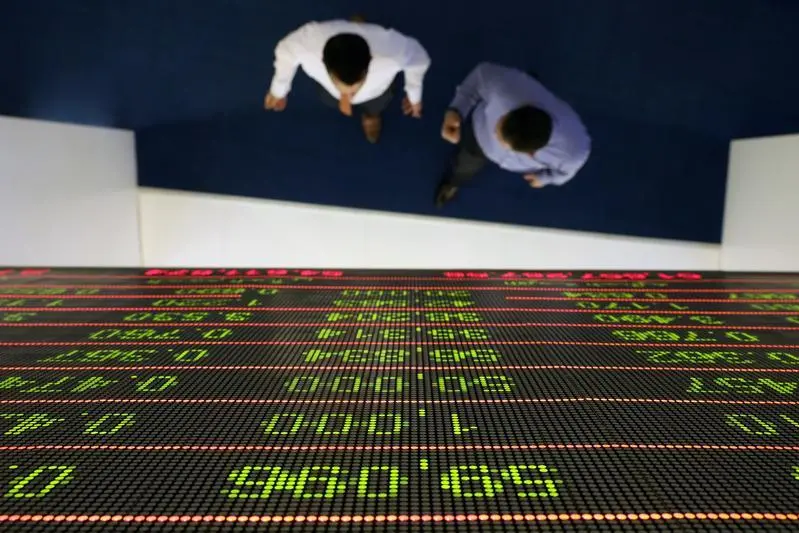
Gulf stock markets jumped on Wednesday, after the U.S. and Iran agreed to a fragile two-week ceasefire, which included the immediate and secure reopening of the Strait of Hormuz.
Markets have remained on edge since the U.S.-Israel war with Iran broke out in late February, with Tehran's effective closure of the strait — a vital artery for 20% of global oil and gas supplies — fuelling concerns over higher inflation.
U.S. President Donald Trump on Tuesday said the last-minute deal was subject to Iran's agreement to pause its blockade of the Strait of Hormuz.
Iranian Foreign Minister Abbas Araqchi said Tehran would cease counter-attacks and provide safe passage through the waterway if attacks against it stopped.
Brent futures were down 13.3% to $94.76 a barrel at 0822 GMT.
"U.S. presidential policies remain difficult to predict, so investors are expected to stay cautious. Even though markets are reacting positively to the recent announcement, the fundamentals of the UAE equity market remain strong," said Tariq Qaqish, deputy CEO at FH Capital in the UAE.
At the same time, higher risk levels are increasing the discount rate used to value capital markets, which may put pressure on valuations, he added.
The MSCI gauge of EM Asia equities surged 5% to a three-week high on Wednesday. A broader index of global EM equities jumped 4% to a three-week high, while its currency counterpart advanced nearly 1%.
Dubai's main market spiked as much as 8.5%, its highest intraday gain in more than 11 years.
The index was last trading 6.4% higher, led by a 11.3% jump in blue-chip developer Emaar Properties and a 9.8% surge in top lender Emirates NBD Bank. Abu Dhabi's benchmark index climbed as much as 4.9% in early trade, its biggest jump in six years.
It was last up 3.2% with the largest lender, First Abu Dhabi Bank, rising 6.7% and real estate giant Aldar Properties soaring 11.2%.
Energy firm Adnoc Gas gained 3.8%, while Abu Dhabi Ports Company advanced 11.4%. Qaqish said he expected the UAE government to keep supporting the economy through aid for banks, small and medium enterprises, and new measures to restore confidence.
In Qatar, the index jumped 3.4%, as all its constituents advanced, led by energy shares.
Petrochemical maker Industries Qatar gained 5.5% and Qatar Gas Transport traded 9% higher, the top gainer.
The Gulf's biggest lender, Qatar National Bank, climbed 3.5%.
Saudi Arabia's benchmark index added 1.4%, led by a 2.8% rise in Al Rajhi Bank .
Unlike its regional peers, the Saudi stock market was the least affected during the war. The rise in global oil prices generated substantial financial gains for Iran, Oman, and Saudi Arabia, while costing states without alternative export routes billions of dollars, a Reuters analysis found. Oil major Saudi Aramco dropped 2.8%, and Yanbu National Petrochemical Co retreated 5.2%, while the Saudi energy index was down 2.4%.
Boursa Kuwait added 1.8%, while Bahrain's index increased 1.2%.
Outside the Gulf, Egypt's blue-chip index was up 2.9%, as most of its constituents were in positive territory, including Commercial International Bank.
(Reporting by Mohd Edrees and Ateeq Shariff in Bengaluru; Editing by Kate Mayberry and Harikrishnan Nair)