PHOTO
SYDNEY - Asian share markets held Wall Street-driven gains on Friday while the yen eased after the Bank of Japan raised interest rates to a three-decade high and left the door wide open to further tightening.
The decision to lift rates to 0.75% had been widely anticipated and the knee-jerk reaction was to sell the yen on the fact, while awaiting a more detailed outlook from BOJ Governor Kazuo Ueda's media conference later in the session.
Markets had wagered on only one more hike next year to 1.0%, even though Ueda has suggested a neutral range for rates would extend from 1.0% to as high as 2.5%.
Investors will thus be cautious in case he offers any hint that rates could be hiked more than once in 2026.
"Given that real interest rates remain strongly negative despite today's hike, the BOJ signalled that further tightening was likely," Abhijit Surya, a senior APAC economist at Capital Economics, said.
"Our own view is that the incoming data are more likely than not to surprise to the upside," he added, and saw rates reaching 1.75% by 2027.
Data on Friday showed Japan's core CPI rose at an annual pace of 3.0% in November, unchanged from the previous month.
For now, the dollar had edged up 0.3% to 156.03 yen , while the euro also firmed 0.3% to 182.96 . Yields on Japan's 10-year bonds held at 1.975%, just below an 18-year high.
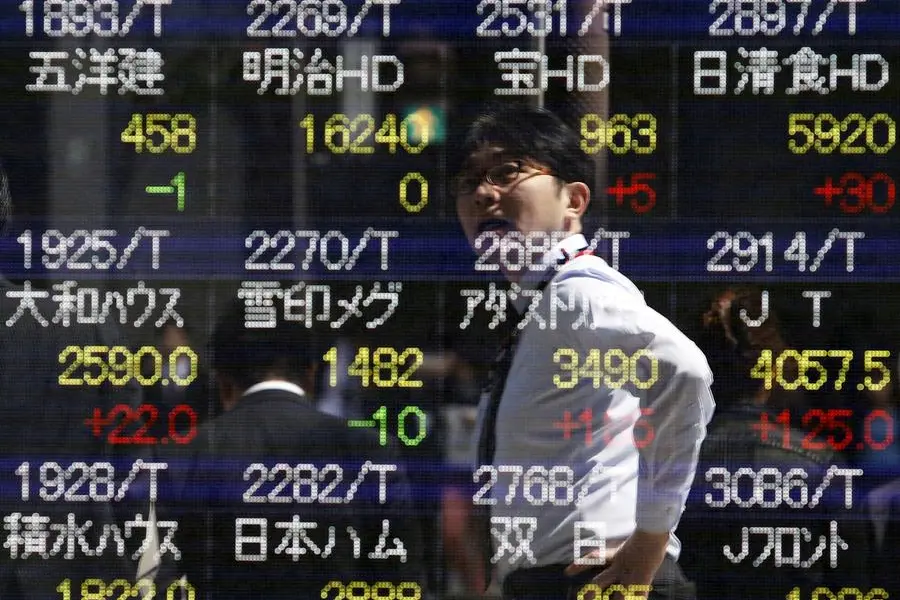
Japan's Nikkei was up 1.3%, having tracked an overnight rally on Wall Street. South Korea rose 0.8% and tech-heavy Taiwan 1.3% encouraged by stellar results from chipmaker Micron Technology.
MSCI's broadest index of Asia-Pacific shares outside Japan added 0.7%, while Chinese blue chips gained 0.6%.
TikTok's Chinese owner, ByteDance, announced a deal with three major investors to form a joint venture to operate TikTok's U.S. app in a bid to avoid a U.S. government ban.
ECB, BoE OFFER DIFFERENT LEVELS OF HAWKISHNESS
For European bourses, EUROSTOXX 50 futures and FTSE futures were both down 0.3%, while DAX futures dipped 0.2%.
S&P 500 futures were flat, while Nasdaq futures added 0.2%.
Sentiment had got a boost from a surprise slowdown in U.S. consumer price inflation to 2.7%, though analysts cautioned the data were clearly distorted lower by the government shutdown and could not be taken at face value.
Pricing for the Federal Reserve moved only marginally with a rate cut in January implied at just 27%, while March nudged up to 58% from 54% before the data.
Bond markets gave a cautious welcome to the U.S. CPI numbers as 10-year Treasury yields held at 4.126%, some way from the recent 3-1/2-month top of 4.209%.
Overnight, British bonds had taken a hit after the Bank of England cut rates as expected but only after a very tight 5-4 vote. Policymakers also signalled caution about the pace of future easing and another cut is now not fully priced in until June.
The European Central Bank was even more hawkish as it held rates at 2.0% and signalled a likely end to the easing cycle. Markets imply only a minor chance of a cut for all of 2026.
Central banks in Sweden and Norway also held steady, though the latter left the door open to one or more cuts.
In commodity markets, gold slipped 0.3% to $4,319 an ounce , and still short of its October peak of $4,381. Silver ran into profit-taking after its meteoric run, but palladium and platinum remained in demand.
Oil prices found some support from the possibility of further U.S. sanctions against Russia and the supply risks posed by a blockade of Venezuelan oil tankers.
Brent edged down 0.2% to $59.71 a barrel, while U.S. crude eased 0.3% to $56.00 per barrel.
(Reporting by Wayne Cole; Editing by Sam Holmes and Jacqueline Wong)