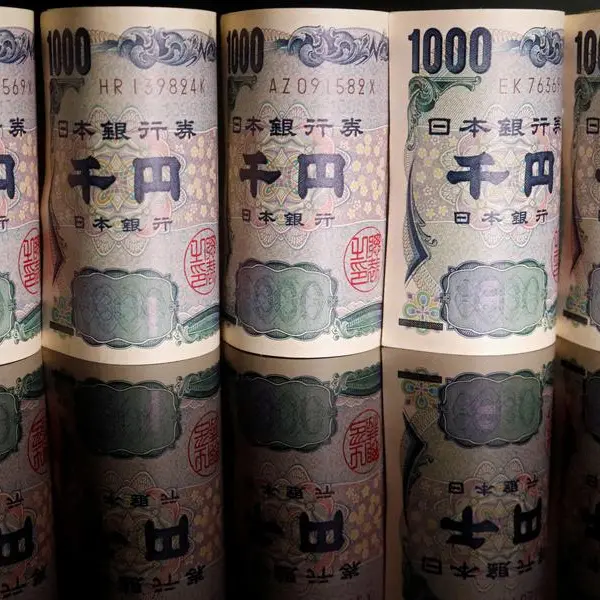
TOKYO - The yield on Japan's two-year government bond rose to a three-decade high on Thursday, as the protracted Middle East crisis added to inflationary pressures and reinforced expectations for a Bank of Japan interest rate hike as early as April.
The two-year yield, most sensitive to the BOJ's policy, rose 2.5 basis points to 1.33%, the highest since April 1996, based on Japan Bond Trading Co. data.
The yield on the five-year Japanese government bond rose 2.5 bps to a record high of 1.74%.
Yields move inversely to bond prices.
"There was a perception that the BOJ would not raise interest rates during the crisis, but the fate of the Middle East remains uncertain," said Katsutoshi Inadome, senior strategist at Sumitomo Mitsui Trust Asset Management.
"The BOJ is aware that inflation accelerated in the wake of the Russia-Ukraine war. Therefore, the market is increasingly bracing for an early interest rate hike and that could happen in April."
Japan's economy remains highly exposed to spikes in crude oil prices due to its heavy reliance on imported energy. Higher oil costs feed into inflation, eroding the real value of fixed bond payments and adding pressure on the central bank to tighten monetary policy.
A key gauge of Japan's service-sector inflation rose 2.7% in February from a year earlier, data showed on Thursday, reinforcing the BOJ's view that a tight labour market is prompting firms to pass on rising costs to consumers.
Minutes of the BOJ's January meeting released on Wednesday signalled that many policymakers saw the need for further rate hikes.
Markets are now pricing in a 61% possibility of a 25-bp rate hike to 1.00% at the April meeting, as per LSEG-compiled data.
The benchmark 10-year JGB yield rose 2 bps to 2.270%.
(Reporting by Rocky Swift, Satoshi Sugiyama and Junko Fujita; Editing by Sumana Nandy, Sonia Cheema and Sherry Jacob-Phillips)