The UAE remains a sanctuary for many expatriates from troubled countries across the entire North Africa and South Asia landscape. Expats from Iran, Afghanistan, Pakistan, Jordan, Lebanon Syria and the CIS states consider the UAE a home away from home, and this trend played a large part in fuelling the great surge in Dubai real estate during the mid 2000s.
While the more stable Indian and British investors were the top two foreigners piling into Dubai real estate during the boom periods, Pakistanis and Iranians were the next two major foreign investors in Dubai during those peak years.
Many of those investors were lured by the incentive of residence visas, but that turned out to be false marketing for the most part on the part of many developers. Real estate companies in other emirates also promised visas which led to an unprecedented boom and then an equally unprecedented bust in the country's real estate.
Among other developments, the lack of clarity surrounding visas was one of the key reasons why Dubai real estate fell off a sheer cliff.
But in June the UAE government appears to have revived that law in the hope of attracting 'refugee' capital back into the lacklustre real estate sector. Will the strategy work?
The UAE's decision to introduce three-year visas for UAE property buyers should make 'refugee capital stickier', according to Citibank.
"This could be the first step to recovery, beyond balance sheet restructuring, for the UAE's internally driven sectors, which are dependent on capital raising and formation: these internal sectors are banks, real estate development and, for those with the most risk tolerance, diversified financials," Citibank notes.
The bank notes:
- If clearly implemented, this decision could clarify confusion dating back to:
June 2008 when the head of Dubai's Real Estate Regulatory Authority, Marwan Bin Ghalita, was quoted by Gulf News as saying that "There is no direct link between property ownership and residence visas. Developers should not lure investors to [the] property sector with a promise of residence visa"....
- We await clarification in terms of how the law will work in practice but, at first glance, this is significant positive news for the medium-term revenues of UAE developers.
- Dubai developers should benefit more than Abu Dhabi ones due to the emirate's competitive advantage in terms of physical (roads, airport, port) and institutional (freezones) infrastructure and greater critical mass (cultural amenities, schools, malls).
- The likely boost to the value of existing finished and off-plan property portfolios and the sticky deposits that longer-term residents should bring with them should also boost the UAE banks.
- This sector has also recently seen improving liquidity (demonstrated by sharp falls in interbank rates) as a result of orderly Dubai debt restructuring and inflow of "refugee" capital from regional political hot spots.
- We also note that this is a UAE-wide, federal law. That suggests a little more effective coordination of strategy between Abu Dhabi and Dubai is finally under way.
- This change may pressure rival "regional hub" development strategies of, for example, Doha in Qatar.
Over the last three months there has been some positive developments such as the extension of the property visa period from six months to three years and the implementation of the International System of Units.
"Both are steps in the right direction and represent the government's commitment to increasing transparency and confidence in the market, which in turn will encourage investment," notes Elaine Jones, CEO, Asteco Property Management.
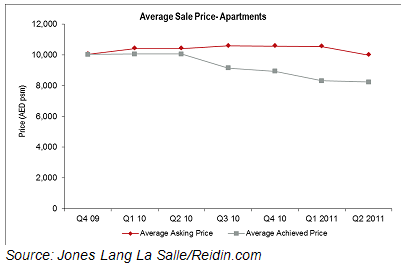
While Asteco research shows that the apartment sales prices have fallen a mere by 3% in the second quarter, a 'significant' number of people are using their housing allowance to purchase a home rather than rent.
Real estate consultant Jones Lang La Salle (JLL) is far more cautious on the UAE government's decision to extend visas to three years, arguing that it is just one of a number of steps required for the residential market to experience a sustained recovery.
More importantly, the Dubai's Real Estate Regulatory Authority (RERA) has cancelled 217 projects - a welcome development as it reduces future supply.
JLL sees the Dubai residential market slowly bottoming out. Still, supply continues to add pressure to the real estate market. In the second quarter, close to 2,000 new units came on line, taking the total residential stock to around 322,000 units, according to JLL research.
"An additional 18,000 units are expected to be completed in Q3-Q4 2011. While we have reduced our supply pipeline, it is still expected that completions will be higher than the 10,000 units that RERA expect to be completed over the second half of 2011," says JLL in a report on the emirates' real estate sector.
Changes to Nakheel's ownership structure and its decision to revive The World project is also a welcome signal as it was one of the two largest Dubai developers - the other being Emaar - operating in the emirate.
JLL notes that single owners have also started work on residential projects near the Dubailand and Al Warqa area, suggesting a pick up in activity.
These developments serve as a major boost for real estate companies and contracting companies, that desparately need a fillip..
DEPA, the Dubai-based contractor that was among the many construction companies that suffered during the global recession are now facing headwinds from regional turmoil.
"...Uncertainty generated by the Arab Spring has delayed the signing of a number of larger projects in the MENA region and this lag effect will dampen full year market expectations," said Depa, which is listed on the Nasdaq Dubai exchange.
Japanese bank Nomura has cut target prices for Depa and its peers Drake & Scull International and Arabtec, although it has maintained a buy rating for Depa.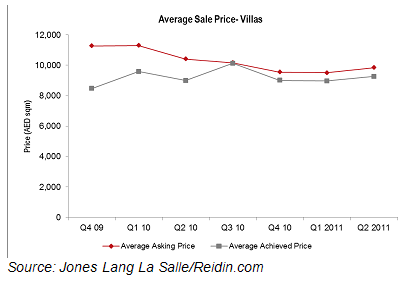
On the funding side, there are also some signs of improvement.
UAE banks have reduced their exposure to real estate and the trend is likely to continue. National Bank of Kuwait notes that major residential developments have either been completed or are in the completion phase. "Therefore, we expect a natural decline in credit demand coming from developers and/or contractors, thus freeing up more space for buyers."
While efforts to merge home-grown mortgage providers Tamweel and Amlak have failed spectacularly, the mortgage market is also turning a corner.
"We believe banks are making increasing funding available to the mortgage sector, while Tamweel seems to have restored its financial health (although it still does not have bank status, keeping a question market over its financing options)... we do not believe that funding will provide a hindrance for the Dubai residential market in the near to medium term," says an NBK analyst in a report.
Asteco also reports similar activity in the mortgage market, citing that rates hover around 4.99% for 80% financing, with many clients switching lenders to take advantage of lower rates.
"The improvement in mortgage products has not just stopped at interest/profit rates, we have also witnessed a number of lenders either reducing or removing their Early Repayment Charges. This, we believe, will kick start a 'remortgage market' and provide clients with the flexibility seen in a more mature market," says Asteco.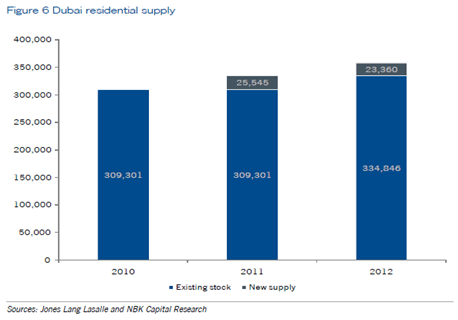
This favourable outlook is already throwing up opportunities for the brave. EFG-Hermes has picked Union Properties (UP) - one of the worst affected Dubai real estate companies - as one of its top 20 Middle East stock picks.
"UP is geared to a recovery in Dubai sentiment and in Dubai's property market. Anecdotal evidence suggests that there is selective upward pressure on prices in UP's residential portfolio. UP, which still trades at depressed levels, is best positioned to benefit from this trend due to its large unsold inventory close to the Dubai International Financial Centre (DIFC), as well as its sizeable investment properties portfolio."
CONCLUSION
A periodic survey from a UK real estate consultant Knight Frank showed that Dubai - which once held the dubious distinction of being the worst housing market in the world over a six -month period - is now placed the 4th worst housing market in annual percentage terms, according to the most recent edition of that survey. The survey shows that at a global scale the Dubai real estate market is still a long way down and needs to claw its way back as a viable investment alternative for refugee as well as stable investors.
Read full story here: Dubai Real Estate Prices Rise
While analysts are unanimous in their view that it will take a while for the emirate's real estate sector to recover, the market has certainly shown signs that it is bottoming out and creating a sufficient base for the next cycle of growth. The real estate visa incentive needs further clarity, but it could emerge as a trigger for a sustained real estate recovery.
© alifarabia.com 2011