PHOTO
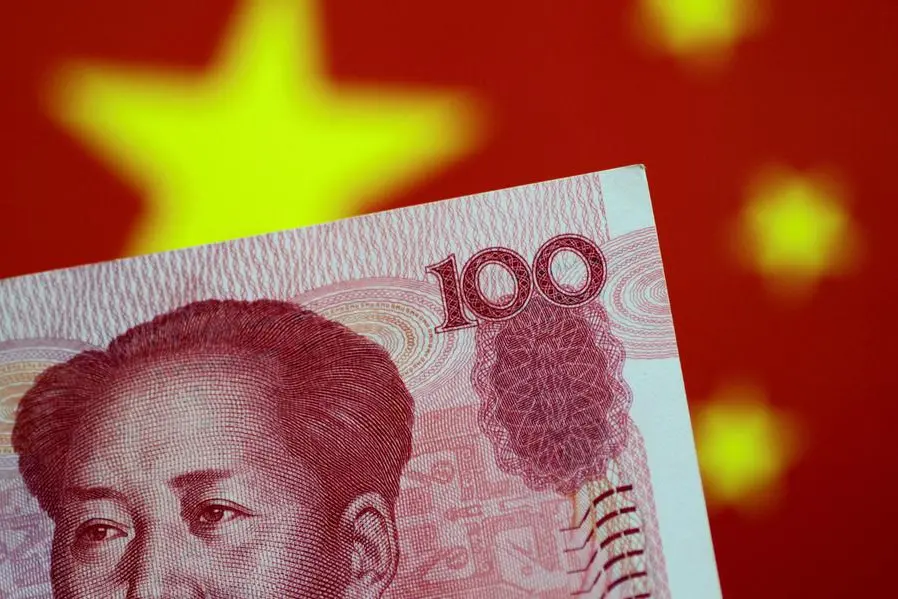
SHANGHAI - China's yuan retreated on Wednesday from a 32-month high against the dollar, after the central bank lowered its official guidance fix for the first time in four sessions.
The slight yuan weakness also followed the central bank's dovish signal, as it pledged to maintain an appropriately loose monetary policy stance this year and said it will cut the reserve requirement ratio and interest rates to aid the economy.
"With exports likely to lose steam, domestic demand needs to pick up the slack especially after the weak performance in Q4 2025," said Tommy Wu, senior economist at Commerzbank.
"Lifting consumption and investment, as well as breaking the deflation cycle, would require policy stimulus," Wu said, but noted that the size of the stimulus package may not be very different from last year.
Prior to the market opening, the People's Bank of China (PBOC) set the midpoint rate at 7.0187 per dollar, the first weaker guidance rate in four sessions and 291 pips softer than a Reuters' estimate of 6.9896.
The spot yuan is allowed to trade a maximum of 2% either side of the fixed midpoint each day.
In the spot market, the onshore yuan eased 0.09% to 6.9891 per dollar as of 0302 GMT. It hit a 32-month high of 6.9770 on Monday.
Its offshore counterpart was down about 0.06% at 6.9855 per dollar.
In early trading, the U.S. currency held to tight ranges ahead of a slew of U.S. economic data that could set the tone for the Federal Reserve's rate outlook.
The onshore yuan looked set for the first daily drop in more than a week, as demand for foreign exchange picked up at the start of the year and offset exporters' seasonal settlement, traders said.
Chinese individuals are allowed to convert an equivalent of $50,000 every year into foreign currency, and household demand rose as the quota was renewed at the beginning of this month, they added.
Moreover, heavy capital flows into the Hong Kong stock market via the southbound leg of the Stock Connect scheme this week also weighed on the yuan.
On the other hand, exporters usually have rising demand for the yuan as they settle their foreign exchange receipts for payments such as year-end bonuses ahead of the Lunar New Year in mid-February.
"Market focus could shift to the pace and timing of subsequent policy implementation in the period leading up to the March National People's Congress with January and February likely to be the first window for RRR/policy rate cut," Citi analysts said in a note.
"In general, policy priority is likely to be front-loading of fiscal policy while allowing some gradual yuan appreciation and at the same time saving room for policy easing as and when needed."
They expect the yuan to rise to 6.9 per dollar in the next three months and to 6.8 over the next six to 12 months.
(Reporting by Shanghai Newsroom Editing by Shri Navaratnam)