Obstacles to home ownership have emerged as one of the key issues in the Saudi economic, social and development landscape. A unique mortgage market, a booming young population and bureaucratic bottlenecks are among the factors that create an imbalance in the kingdom's affordable-housing market.
A generous government package of USD 67 billion pumped into the sector last year has helped address the severe shortage in low- to mid-income housing units. However, an overall strategic approach is still needed.
Analysts estimate that around a third of the Saudi population owns homes, a ratio well below that of most developed and many emerging economies.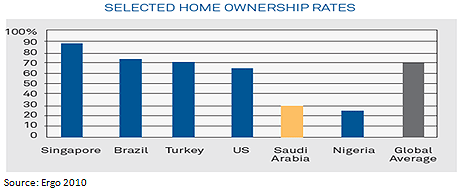
Affordability Matrix
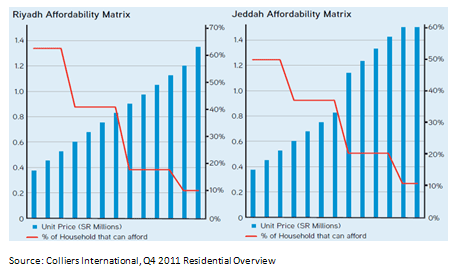
Real estate consultancy Colliers International believes Riyadh's home-ownership market is hampered by affordability constraints, on-going increases in selling prices and the shortage in supply of new residential units aimed at the lower and middle income segments.
As for Jeddah, Colliers finds that the residential stock is estimated at more than 730,000 residential units. Most of the new stock in the market is targeted at mid- to high-income households at prices well beyond the financial reach of the majority of Jeddah's households.
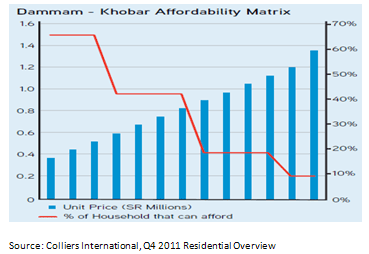
In Dammam and Khobar, Colliers states that the demand for products for low income households remains strong and the potential for mid income households is severely limited, with the constraints in home financing.
Booming Young Population
A key factor in this issue is that the Saudi Kingdom has one of the youngest demographic profiles in the world. "A growing population and other factors have exacerbated the housing shortage, especially for low-and middle-income households," says David O. Robinson, IMF mission chief, in the annual assessment of Saudi Arabia's economy.
Saudi Arabia's population reached more than 27 million according to November 2010 census in the Saudi Gazette. More than 95% of the population is settled in the major cities, resulting in extremely dense areas that reach higher than 1,000 people per square kilometer, according to a Deloitte report in November 2011. This growing population entails higher demand for residential real estate, especially at the lower end of the market, Deloitte adds. Riyadh, Jeddah and Khobar account for approximately 71% of total new housing demand, according to the Ministry of Economy and Planning.
Wider Demand-Supply Gap
According to the government's 9th 5-Year Development Plan, 1.2 million units are needed over the next five years, or 250,000 units every year. NCB Capital estimates less aggressive figures, predicting that the country will need an additional 973,000 units over 2010-15 and a total of 2.1 million units over the coming decade (215,000 units per year).
While there is a shortage in the number of affordable housing units, there is an oversupply of high end developments on the other hand. "Since most developers are seeking luxurious projects to serve high class income people, this has made housing a serious problem in the Gulf countries to mid- and low-income people. And Saudi Arabia's housing market continues to wrestle with a shortage of supply and mounting demand, which has placed home ownership affordability out of reach for many young Saudis," Fahad M. Al-Mutawa, CEO of Ewaan Global Residential Company, was quoted as saying in a December 2011 interview with Arab News.
Government Intervention
In the wake of the changing geopolitical scene of the region in 2011, the Saudi government announced two enormous spending packages in March and February 2011. A large portion of the package aimed to support homebuyers including a substantial allocation for low-cost residential construction. In fact, the government pledged USD 67 billion to fund building 500,000 affordable housing units over an unspecified time period.
"The fiscal package is trying to address shortages in the available stock of housing. A Ministry of Housing has also been created which will deal with housing issues in the Kingdom. So the housing issue is being addressed on both the demand and the supply sides. We hope that the combination of these initiatives helps resolve the issue," Robinson.
The Economist Intelligence Unit, however, foresees delays in the implementation of Saudi spending for housing initiatives of 2011. "Implementing the new housing initiatives and overcoming bureaucratic bottlenecks will ensure a significant lag in implementation- for example, the house-building program could take anything up to ten years to complete," the EIU states in a November 2011 report.
"The government package was an excellent move to stimulate the market. However, more government intervention is necessary to create balance in the current prices, by creating an applicable model for the target market. Additional public private partnerships can also help bridge the gap between supply and demand," Mohammed Al Bur, Board Member of Khadamati and Founder of Saken Company, told Zawya in a telephone interview.
Rising Land Prices
While the government stimulus has helped kick the sector into gear, the rising land prices has slowed down the momentum of building affordable housing units.
In fact, land prices are rising at a much higher rate than property prices. "Prices of developable land have been increasing at roughly 15% a year, compared to a 5%-6% increase in prices for housing units," says John Harris of Jones Lang LaSalle. In such conditions, a land owner prefers to hold on to his land instead of turning it into an affordable housing development.
Moreover, the absence of fees on land owners motivates owners to hold on more to those assets. However, early in January, local daily Al-Watan reported that imposing fees on empty plots of land is expected to take effect soon. Many realtors in the kingdom believe that such regulations would help reduce the prices of real estate units.
Colliers also predicts that increased land supply by the government will help bring about a stabilization of residential selling prices where price escalations are driven by growth in real demand rather than speculation.
"Because of the strength in the market for serviced plots, land development (rather than full residential development) became a popular phenomenon in recent years. This trend is however expected to be curbed by the efforts of the Riyadh Municipality and ArRiyadh Development Authority to control land prices by increasing the supply of land in the city," according to Colliers.
Much Debated Mortgage Law
The much debated Saudi mortgage law has been in the pipeline for almost a decade. The pending status of this law has discouraged many private investors from entering the market. Early last year, the Shoura council approved the law draft, but it still needs a royal decree to approve the amendments.
An extremely low percentage of Saudi home purchases are financed by mortgages. Experts estimate that Saudi Arabia has only a 2% mortgage penetration in its real estate market.
"Access to housing finance has been tightly constrained with very little mortgage financing available. Some subsidized loans were available through the Real Estate Development Fund (REDF), a state-funded entity. But they had a very long waiting list, and loan amounts were not necessarily sufficient to cover construction costs," says Robinson.
"As part of the fiscal package that was introduced earlier this year, the funding to the REDF was increased, and the loan amount raised. In addition, new mortgage legislation is expected to be passed soon, which should significantly improve the housing finance framework."
Some argue that the implementation of the law would even be more significant to the market than the Saudi Stimulus package, while others disagree. "I don't think the implementation of the law would have much of an impact on the market, especially with the absence of accurate figures on the real housing needs and income potential of the different segments of society," according to Al Bur.
"Mortgage products pricing may only fall after security for lenders has been fully tested in the courts. So banks may continue to be wary of lending in the short term."
Tarek Hilal, Product Manager, Zawya Projects, seconds this opinion. "With the absence of clear data on the target group in the market, the law can't do much, actually. Financing terms should be within reach for low and middle income group, for the mortgage law to have a real impact on the affordable housing market," he says.
"While high hopes are pinned to implementing the mortgage law, I don't think that it would make instant substantial changes to the market. For the law to be fully assessed and tested in the market, it will certainly take some time."
For many, the law would certainly bring better lending access home ownership seekers and create better funding options for the low and middle income group. "I believe that the long-awaited mortgage law could be enforced in Saudi Arabia in 2012 after a series of delays, as the enactment of the mortgage law will act as a catalyst for the domestic real estate sector, enhance the market's sophistication and widen funding options for middle and lower-middle income groups if applied and enforced," says Al-Mutawa of Ewaan Global.
Conclusion
"An inclusive view of real estate projects at the level of strategic thinking and not only at the executive level of projects is necessary at this stage," according to Al Bur, who believes that the focus in the next phase should involve the following:
- Re-analysis of the figures for the housing needs of the different groups of society from the private sector and the government sector as well as the demand by the citizens and residents in the Kingdom
- Analysis of the levels of income and levels of savings for the different segments of the population.
"Through the foregoing, I think there should be the establishment of specialized centers for studies and strategies aimed at the elaboration of possible solutions and practical formulae to address housing issues in the kingdom," Al Bur says.
Correcting the imbalance in the affordable housing market in Saudi Arabia is not to be seen as a purely economic goal. It is, more importantly, a critical social and developmental goal necessary to meet the aspirations of a growing young population.
Zawya 2012




















