PHOTO
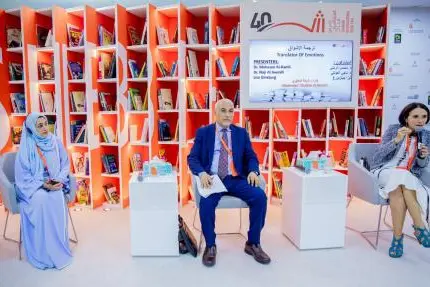
Sharjah : “A translator straddles two worlds; you have to function as two individuals at the same time,” said Lisa Ginzburg, Italian author and translator, at a panel discussion held at the 40th Sharjah International Book Fair, where she explored some of the key challenges involved in literary translation in a discussion with Dr. Mohsen Al-Ramli, Iraqi-Spanish writer, academic, scholar and poet.
“In the first phase, the translator must immerse himself/herself in the layers of meaning and be one with the voice of the original author while in the second phase, a translator must embellish the language to give it an individual treatment and elevate it both linguistically and aesthetically,” said Ginzburg, as she emphasised the importance of becoming one with the voice of the original writer to do justice to the work.
The session titled, ‘Translator of Emotions’, was moderated by Shaikha AlMutairi, and outlined the growing importance of translated works in the modern world.
“Translation has a unique character. Even though the text remains static, every translator brings his own style to the narrative, creating something distinctive that evokes the same feelings as that of the original,” said Dr. Al-Ramli, who called on Arab publishers and writers to inscribe the names of translators on book covers.
A translator is a co-author who inhabits the world of the characters created by another writer, he added. “Critics scrutinise and are harsh on literary translators, but you never hear criticisms levelled against translations of scientific works.”
He added: “Previously, it used to be said that one must be a master of two languages to translate from one to the other, but I believe it is more important to be a master of both cultures to understand the nuances of cultural aspects implicit in the source text, and to convey it appropriately in the target language.”
The experts pointed out that important works of literature must be re-translated periodically, as time and current realities reflect the way a work is interpreted, creating a new layer of understanding and perspective. They also cited the challenges involved in translating a language with a rich and extensive vocabulary, such as Arabic, into one with a limited repertoire of words.
Highlighting the importance of books in advancing literacy, and the role of translation in revitalising literature, Dr. Al-Ramli concluded: “It is better to know a work through a poor translation than not know it at all.”
-Ends-
© Press Release 2021
Disclaimer: The contents of this press release was provided from an external third party provider. This website is not responsible for, and does not control, such external content. This content is provided on an “as is” and “as available” basis and has not been edited in any way. Neither this website nor our affiliates guarantee the accuracy of or endorse the views or opinions expressed in this press release.
The press release is provided for informational purposes only. The content does not provide tax, legal or investment advice or opinion regarding the suitability, value or profitability of any particular security, portfolio or investment strategy. Neither this website nor our affiliates shall be liable for any errors or inaccuracies in the content, or for any actions taken by you in reliance thereon. You expressly agree that your use of the information within this article is at your sole risk.
To the fullest extent permitted by applicable law, this website, its parent company, its subsidiaries, its affiliates and the respective shareholders, directors, officers, employees, agents, advertisers, content providers and licensors will not be liable (jointly or severally) to you for any direct, indirect, consequential, special, incidental, punitive or exemplary damages, including without limitation, lost profits, lost savings and lost revenues, whether in negligence, tort, contract or any other theory of liability, even if the parties have been advised of the possibility or could have foreseen any such damages.