PHOTO
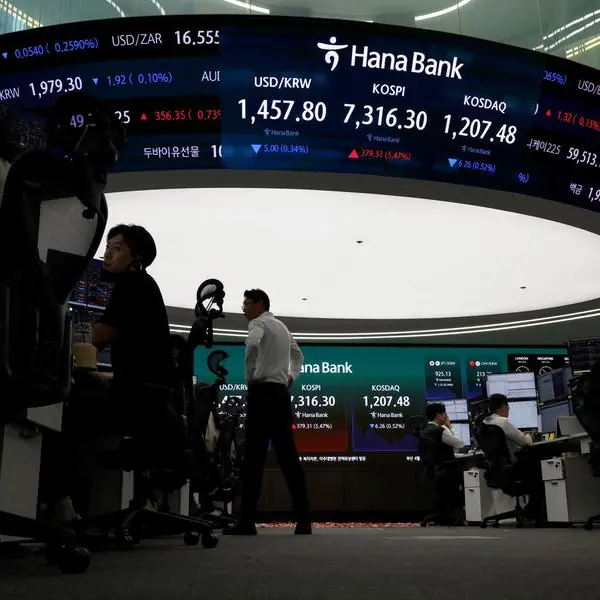
LONDON - Investors' long-held "fear of missing out" is now vying with their "fear of wipeout", creating a peculiar situation in which there are simultaneously anxieties about all the risks that could upset today's stretched markets, as well as concerns about pulling back from an equity boom that could just keep running. The tension between the two instincts was on full display last week. The mere suggestion of a credit wobble at U.S. regional banks sent global equities plunging and volatility spiking, yet buyers were drawn back within 24 hours.
"Trick or treat?" was the seasonal question Morgan Stanley posed on Monday, adding that markets may be underestimating the potential for the cycle to run "hotter" on the back of the "triple easing" of U.S. monetary, fiscal and regulatory policies.
Yet it's hard to get a firm consensus about this rally. Is this a cresting bull market that should make you run for the hills or just the beginning of a swelling artificial intelligence mega trend and investment supercycle spurred by government deregulation?
The tension between the two fears was one of the most pondered puzzles on the sidelines of the International Monetary Fund's annual meeting last week.
Credit cracks started to emerge last month with the First Brands auto parts bust, which then rippled through regional banks' bad loan flags last week. This could easily be read with caution as a cyclical or even systemic warning signaling that we could be nearing the market top.
Or maybe they are isolated events getting more attention than they deserve simply because markets are so richly priced. Even though U.S. junk bond credit spreads crept up about 25 basis points over the past month, they're still lower on a year-over-year basis and 100 bps tighter than April's peaks.
The Federal Reserve appears a touch uncomfortable with all this.
On the one hand, Chair Jay Powell and crew seem intent on continuing with interest rate cuts, as they view tightening money markets as a potential sign of banks hitting their lending reserve buffers and remain concerned that the current immigration shock will lead to weaker labor markets over time.
"Something's gotta give — either economic growth softens to match a soft labor market, or the labor market rebounds to match stronger economic growth," said dovish Fed board member Chris Waller last week.
There may be other things that give, of course.
A series of interest rate cuts would come amid the loosest financial market conditions in almost four years, record high stock markets and still wafer-thin credit spreads.
If there is a bubble, monetary easing now will only make it bigger.
Either way, the Fed may get a reality check on Friday if the delayed release of the September consumer inflation report shows annual inflation climbing back above 3%.
FOGGY CREDIT
With so many moving parts, two key issues are getting attention right now from edgy investors.
The first is a long-standing worry about how relatively opaque private credit markets, which have grown significantly in recent years, may be masking stress in some areas of the financial market. There's also concern that the structure of those credit funds, including their time-limited "maturity walls," may amplify problems, particularly if many funds get into trouble at the same time.
Related to this is the worry that banks that have lost lucrative lending business to private credit have partly made up for this by investing in those credit funds directly, meaning they still have exposure to some of the credit risk but also less visibility about the underlying loans, and thus much less inclination to stay invested.
Last week's anxiety was amplified by news of a $2.4 billion investor exit from U.S. high-yield funds in the week to October 15, ostensibly on worries about the First Brands and Tricolor bankruptcies. That outflow marked the biggest reversal since the week of the April tariff jolt, according to Morningstar's Pitchbook.
JPMorgan boss Jamie Dimon's recent "cockroaches" comment - the idea that when you see one credit problem, there are probably many others - won't have helped.
But, if there's so much hand-wringing, why have markets bounced back so quickly?
At a most basic level, there's still no real sign of a slowdown in U.S. economic growth, though the lack of economic data updates might be masking some of that.
In the absence of those updates, corporate reports are taking on greater heft as investors try to make sense of what's happening in the economy at large. And the early stages of the earnings season seem fine thus far, with the AI theme still on the boil and big banks pulling in healthy fees from the pickup in mergers and acquisitions activity.
But the biggest tailwind may be President Donald Trump's deregulation push and industrial priorities. Knowing how much is in the pipeline may be preventing many investors from throwing in the towel on this equity rally.
Jefferies, itself caught up in the First Brands bust, says the return of big government and industrial policy is the real mega trend that has been accelerated by Trump's return to the White House.
The banks' strategists cite the corporate "re-shoring" of the rare earth, pharma, chips, steel and shipbuilding industries; the U.S. government taking direct stakes in key firms and AI funds; and JPMorgan's "Security and Resilience" plan for $1.5 trillion of effectively "America First" lending over the next decade.
The market jitters are real, but it's just hard to jump off when you see that coming down the pike.
The opinions expressed here are those of the author, a columnist for Reuters -- Enjoying this column? Check out Reuters Open Interest (ROI), your essential new source for global financial commentary. Follow ROI on LinkedIn. Plus, sign up for my weekday newsletter, Morning Bid U.S.
(by Mike Dolan; Editing by Marguerita Choy)