PHOTO
(The opinions expressed here are those of the author, a columnist for Reuters)
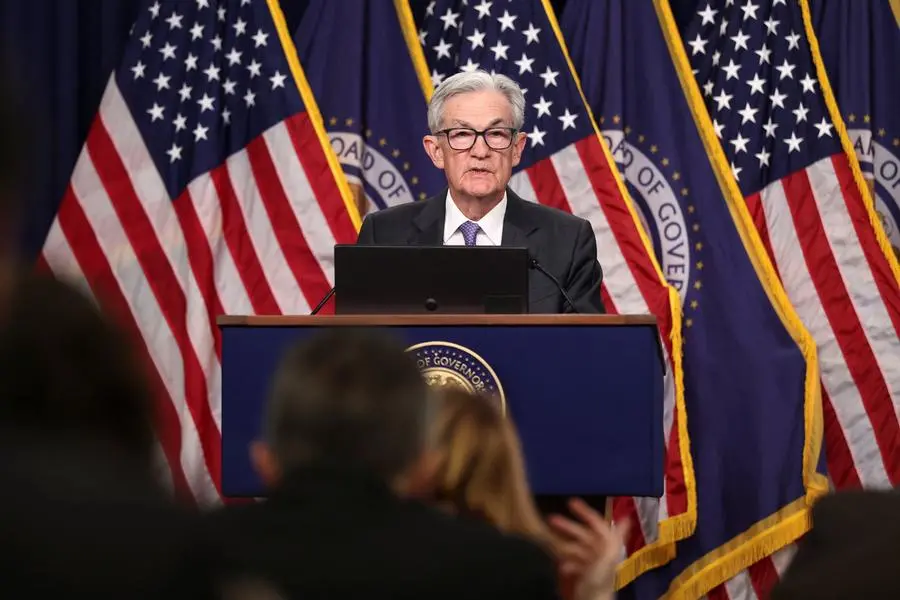
ORLANDO, Florida - Federal Reserve Chair Jerome Powell admitted on Wednesday that there is still no "risk-free" path for the central bank as it seeks to bring down stubbornly high inflation while also supporting an increasingly creaky labor market. But he suggested the Fed might have a "get-out-of-jail-free" card: higher productivity.
Speaking to reporters after the Fed cut its policy rate by 25 basis points and published its revised economic projections, Powell indicated that productivity may square the circle of solid growth, sticky inflation and a soft jobs market.
High productivity means workers are producing more output per hour. This keeps a lid on unit labor costs and therefore inflation, while also helping to drive stronger wage growth, purchasing power, and overall economic activity.
It is a big factor behind Fed officials' rosier outlook for 2026 and expectation for only one more quarter-point rate cut next year.
Policymakers raised their median 2026 GDP growth projection to 2.3% from 1.8% in September, while lowering their outlook for headline inflation to 2.4% from 2.6%. Powell said almost half of the growth upgrade reflects a reacceleration of activity following the government shutdown, but much of it is due to high productivity too.
And that's not only because of artificial intelligence. Powell said the U.S. economy's elevated productivity rate of around 2% for the last several years predates the recent AI boom. But the new technology is helping.
"There is no risk-free path for monetary policy," said Jeffrey Roach, chief economist for LPL Financial, echoing Powell, "but it seems the committee is banking on higher productivity, implying stronger growth despite softer job creation."
BETTING ON THE WRONG HORSE?
But there are potential problems with the productivity story.
First, relying on it as a silver bullet is a gamble, both because productivity is notoriously challenging to forecast – or even to measure properly – and because it is too early to say what the economic impact of AI will be.
As a recent Institute of International Finance report warned, "if AI adoption remains concentrated among a handful of hyperscalers and specialized firms, returns will likely plateau, leaving overall growth vulnerable once the current investment cycle peaks."
What's more, the flip side of AI's positive impact on productivity could be massive job losses. This could create "social and labor market implications that we don't have the tools to deal with," Powell said.
Second, higher sustained productivity implies faster growth and therefore a higher neutral rate of interest, or "r-star." That's the neutral interest rate that neither stimulates nor restricts activity when the economy is running at full employment with stable inflation.
Powell said policy is now in a broadly neutral range, with rates having been cut 175 basis points since September last year. But if there is a productivity boom underway and potential growth is higher, r-star and the fed funds rate should be higher too.
In this scenario, current policy might actually be too loose.
"All things equal yes, but all things aren't equal," Powell said when asked on this matter on Wednesday. "There are many things pushing in different directions on where the neutral rate would be."
Estimates of r-star, a theoretical figure, are understandably varied. Two closely watched models co-created by New York Fed President John Williams put r-star at 1.37% or 0.84% at the end of June. Fed officials' median long-run implied r-star projection is around 1%.
Productivity may offer the Fed some breathing room. Powell indicated that the Fed will pause to assess the incoming data before determining its next move. Rates futures markets believe him and are not fully pricing in another rate cut until June.
"They are buying into the AI productivity story. That's the only way you can interpret this," said David Kelly, chief global strategist at JP Morgan Asset Management.
Of course, if that story does not play out, Powell and his successor will have their work cut out for them in 2026.
(The opinions expressed here are those of the author, a columnist for Reuters)
Enjoying this column? Check out Reuters Open Interest (ROI), your essential source for global financial commentary. ROI delivers thought-provoking, data-driven analysis of everything from swap rates to soybeans. Markets are moving faster than ever. ROI can help you keep up. Follow ROI on LinkedIn and X.
(By Jamie McGeever; Editing by Marguerita Choy)