Tanzania's dream to beat Mozambique and emerge as East Africa's first exporter of liquefied natural gas has suffered a setback as politicians bicker over a new constitution for the country.
Analysts said that without clarity on new regulations for the natural gas sector, international companies were likely to delay final investment decisions until after general elections due to be held in 2015.
"The constitutional review is forcing interest groups to take a stand on all the most divisive political issues at once...In this climate, introducing new terms to govern the nascent natural gas sector will be politically difficult, making passage of a new bill unlikely this year," said Clare Allenson, Africa analyst at Eurasia Group.
"The highly disruptive constitutional reform process, which faces collapse, will be put on pause at the end of the month to deal with the budget," Allenson added.
Tanzania, along with Mozambique, has the potential to transform East Africa into the world's third largest exporter of natural gas.
In 2012, Tanzania nearly tripled its estimates of recoverable natural gas resources to 28.7 trillion cubic feet from an earlier estimate of 10 trillion cubic feet, after major producers such as Exxon Mobil Corp, Statoil Oil ASA, Ophir Energy and BG Group made new discoveries.
"It is estimated that Tanzania's upside potential is as much as 60 tcf of natural gas," according to management consultant KPMG. "It is reasonable to expect that the next five to 10 years would see continuing exploration. The reality however is that to commercialise Tanzania's offshore reserves of natural gas will take time; estimates are between seven years and a decade."
FOREIGN INVESTMENT
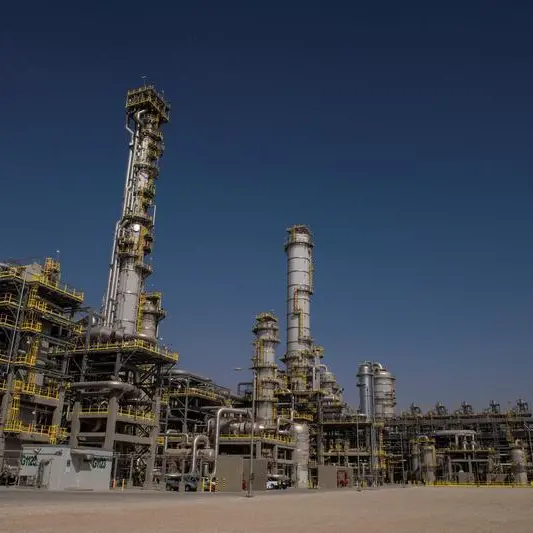
The government is working with Statoil, ExxonMobil, BG Group, and Ophir Energy on plans to develop a joint LNG plant.
Tanzania expects to see cumulative foreign direct investment of up to USD 30 billion during 2017-202, when some of the LNG projects get off the ground.
The country introduced a new model production sharing agreement (PSA) in late 2013, along with a licensing round covering seven deepwater natural gas reserve blocks and one block on Lake Tanganyika.
"The model PSA 2013 retained much of the provisions in the model PSA 2008, such as minimum state participation of 25%, additional profits tax, and government royalty," according to the U.S. Department of Energy.
"One of the differences is that the new model 2013 PSA incentivizes deepwater exploration by reducing the royalty rate to 7.5% from 12.5%. It also tightens local content requirements."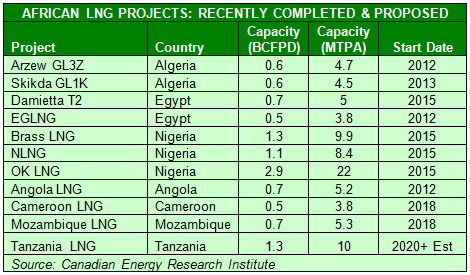
BIG GAS WARY
Analysts fear that Tanzania's constitutional reforms have the risk of delaying debate on natural gas. With an eye on the 2015 elections, the main opposition group has threatened to stall talks on issues like a two-tier government.
"Without clarity on terms, Statoil, BG and their partners will likely continue to delay final investment decisions, until after elections slated for October 2015," Eurasia Group's Allensen said. "As a result, first production is unlikely until 2022 at the earliest - a date at which the global gas market will probably face significant supply increases."
A budget session is also planned in May, which is also contentious as the government is unlikely to meet its target of capping fiscal deficit to 5% of GDP.
"Should the Constituent Assembly be dissolved after the budget, space could be opened for progress on natural gas - [President] Jakaya Kikwete recently promised a draft by October - but the political liability of debating such a sensitive matter in the wake of the collapsed constitutional reform process would likely be prohibitive."
The natural gas arrangement would likely have its own headaches, as industry players will discuss domestic off-take for deep-sea gas, clear land-leasing arrangements for the LNG plant between the operators, Tanzania Petroleum Development Corporation and the government.
"In addition, details on a proposed new industry regulator and the government's plans for a more active exploration and commercial role for TPDC pose other hurdles," the Eurasia Group analyst said. "Regulatory uncertainty will also likely slow new investment plans. The new bid round launched last fall and scheduled to conclude on 15 May is likely to be extended."
GAS RACE
The political distractions mean windfall revenues from gas exports will have to wait.
The IMF projects that at a price of USD10 per 1,000 cubic foot in the Far East market, Tanzania's export earnings from gas could significantly exceed USD 3 billion annually (10% of 2012 GDP).
The International Energy Agency sees global natural gas demand growing at about 1.6% a year to 2035, more than twice the expected growth rate for oil.
Ernst & Young said LNG demand growth was expected to be even strong, particularly through 2020. "While a wide range of forecasts exists, a broad consensus of industry analysts/observers sees average annual growth of around 5% to 6% per year."
EY said as many as 25 countries, many of which currently have little or no capacity, are expected to provide as much as 30% of the world's LNG capacity by 2020.
Australia, Canada, the United States and Africa are all racing to meet Asia's insatiable natural gas needs. They are keen to get projects up and running before 2020 when many of the long-term natural gas deals are expected to be secured with Asian buyers.
All the projects face delays of some sort, but with so many projects being planned, there are fears that some might not be able to justify their high costs.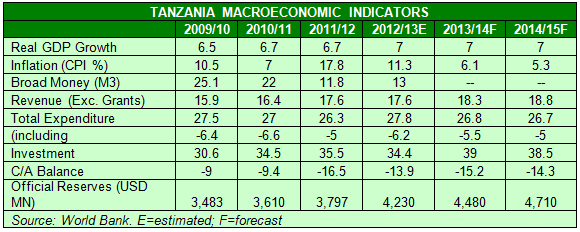
The feature was produced by alifarabia.com exclusively for zawya.com.
© Zawya 2014